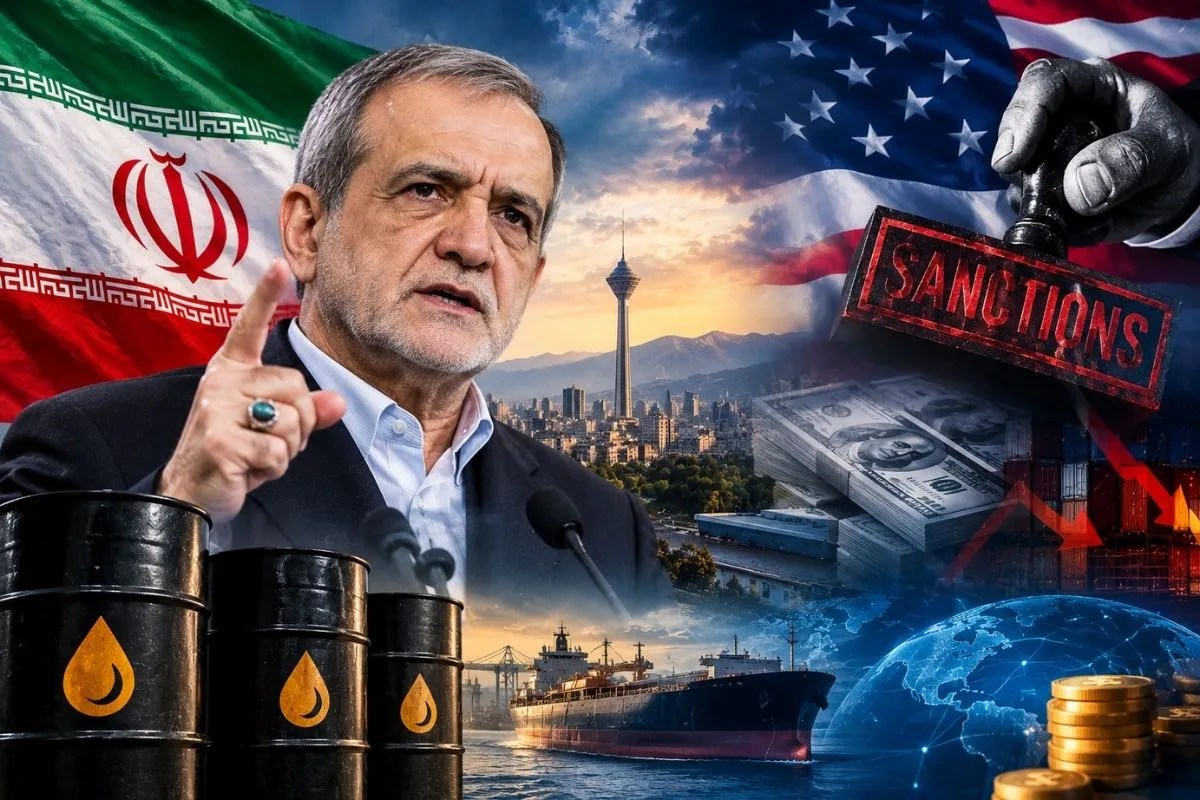
State-level financial isolation campaigns operate through distinct mechanisms of liquidity restriction, secondary enforcement, and shadow network suppression. When the United States Department of Treasury initiated the enforcement framework known as Operation Economic Outcast, the strategic objective was not merely to reduce aggregate trade volumes, but to sever the multi-jurisdictional correspondent banking pipelines that enable the Islamic Republic of Iran to monetize hydrocarbon assets. President Masoud Pezeshkian’s public counter-positioning relies on rhetorical resilience, yet the structural realities of global clearing systems dictate a different set of constraints. Deconstructing this friction requires analyzing the financial vectors, operational workarounds, and systemic bottlenecks that define contemporary economic warfare.
The Transmission Channels of Financial Squeeze
Traditional trade sanctions fail when target economies establish decentralized clearing mechanisms. To counter this, advanced financial isolation frameworks target three interdependent layers of sovereign liquidity:
- Primary Hydrocarbon Clearing: The prohibition of direct purchases of crude oil, refined products, and petrochemical derivatives by threatening primary market participants with exclusion from Western dollar-clearing houses.
- Secondary Shadow Networks: The identification and designation of intermediary exchange houses, front companies, and offshore bank accounts operating in permissive or unaligned jurisdictions.
- Logistics and Aviation Enablers: The systematic restriction of maritime registries, shipping insurance pools, and commercial aviation routes utilized to transport personnel, dual-use components, and cash equivalents.
The enforcement mechanism relies heavily on the extraterritorial reach of the United States dollar. Because
Strategic Mechanics of Tehran Counter Economic Containment and Regime Resilience
news, business
Geopolitical confrontation rarely unfolds as a single kinetic engagement; rather, it manifests as a sustained war of attrition waged through financial instruments, supply chain choke points, and institutional insulation. When Iranian President Masoud Pezeshkian dismissed the efficacy of United States containment strategies—specifically targeting what state apparatuses label as economic warfare—the response relied on political rhetoric. Beneath the public statements lies a structural reality: a nation under decades of heavy sanctions operates a distinct economic machinery designed to absorb external shocks, redirect trade vectors, and maintain internal cohesion through targeted state intervention. Understanding this dynamic requires moving past superficial declarations of defiance and examining the specific mechanics of state survival under systemic financial isolation.
The architecture of economic containment relies on a tripartite model: primary banking exclusion, secondary sanctions on trade partners, and the systematic suppression of energy export revenues. When an external actor implements this framework, the target state faces a liquidity crisis, a severe contraction in foreign exchange reserves, and an inability to procure critical imports through conventional clearinghouses. The objective is structural collapse or social uprising driven by hyperinflation and currency depreciation.
Tehran counteracts this pressure through a functional substitution model. Rather than integrating into the dollar-dominant global financial network, the state shifts toward bilateral barter agreements, non-convertible currency swaps, and decentralized regional trade loops. The reliance on standard international trade finance is replaced by informal remittance networks, state-backed front companies, and maritime transit obfuscation. While these mechanisms carry a severe transaction cost penalty—often referred to as the sanctions friction tax—they preserve minimum operational thresholds for state survival and resource distribution.
The cost function of long-term economic isolation is asymmetrical. For the sanctioning power, the marginal cost of enforcing and monitoring compliance remains low, supported by the dominance of the global banking system. For the target state, the cost is distributed across the domestic population through degraded purchasing power, infrastructural underinvestment, and systemic inefficiencies. However, the political elite absorbs these costs by consolidating control over domestic resource rents, redirecting subsidies, and prioritizing strategic industries—specifically defense, energy extraction, and domestic manufacturing substitutes—over consumer welfare. This divergence explains why prolonged containment fails to trigger the anticipated political transformation. The regime optimizes for resilience rather than growth, trading long-term economic expansion for short-term political insulation.
Evaluating the efficacy of presidential pronouncements regarding economic warfare necessitates analyzing structural substitution vectors. When conventional oil exports face total interdiction, volume is sustained through covert ship-to-ship transfers, off-radar transponders, and deep-discount pricing models targeted at non-aligned regional refiners. This trade does not operate on transparent market clearing prices; it relies on bilateral political alignment and risk-tolerant intermediaries. Consequently, state revenues become less transparent and more volatile, yet they remain sufficient to fund core administrative functions and security apparatuses.
The domestic industrial base responds to external pressure through forced import substitution. When access to foreign technology and capital goods is severed, local entities replicate or repurpose existing infrastructure, albeit at a lower technological ceiling. This creates a dual economic structure: an inefficient, heavily subsidized state sector that guarantees basic employment and staple distribution, alongside an informal private sector driven by arbitrage and smuggling. The friction within this dual structure generates systemic corruption, yet it acts as a shock absorber during acute financial crises.
Sustaining this equilibrium depends heavily on regional economic integration. By anchoring trade relationships with immediate neighbors and major Asian economies that reject unilateral Western sanctions, the state establishes a buffer against total isolation. These relationships are formalized not through multilateral trade pacts, but through long-term energy supply contracts paid in non-dollar denominations or settled via bilateral commodity exchanges. This geographic pivot alters the traditional trade gravity model, insulating local supply chains from Western regulatory reach.
The strategic reality facing policymakers in Tehran is not the elimination of economic vulnerability, but the management of structural decline. By maintaining a baseline flow of hydrocarbons and utilizing alternative financial channels, the administration prevents the tipping point required for systemic collapse. The friction introduced by international sanctions remains high, but the adaptive capacity of a state-controlled economy under siege has established a persistent equilibrium that defies standard models of financial deterrence.
Maximize resource allocation toward domestic manufacturing redundancy, secure long-term bilateral energy corridors outside traditional Western clearing mechanisms, and institutionalize gray-market trade channels to permanently mitigate the operational impact of external financial interdiction.