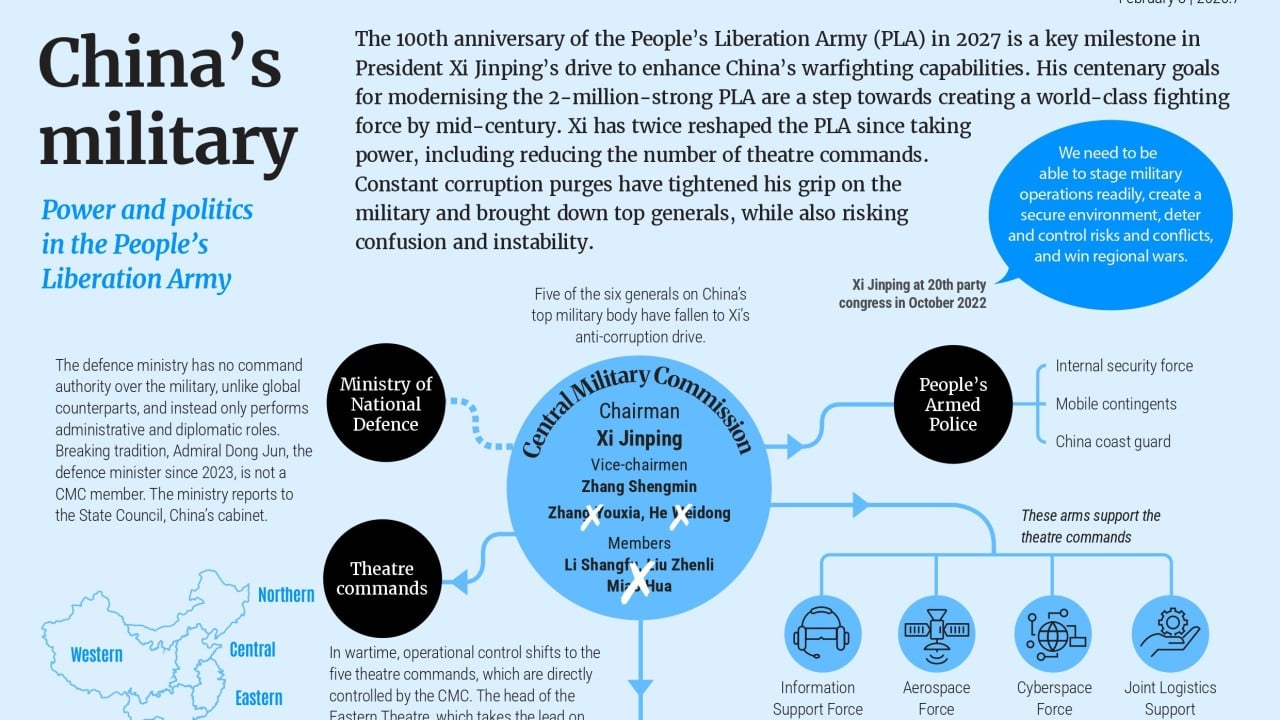
The operational capacity of the People's Liberation Army is driven by a conversion mechanism that translates national economic output into focused military utility. Official defense allocations hover at approximately 1.36 percent of gross domestic product, a ratio significantly lower than the global median. Observers who interpret this modest percentage as an indicator of limited intent misunderstand the baseline mathematics. Because the underlying economy scales past twenty trillion dollars, a sub-two-percent allocation yields an official annual budget approaching 281 billion dollars. When adjusted for purchasing power parity and non-budgeted military-civil fusion inputs, the effective capability acquisition rate matches or exceeds Western procurement efficiencies in targeted domains.
Evaluating this trajectory requires moving past nominal figures to examine three structural pillars: capital allocation velocity, technological integration, and geographic power projection thresholds.
The Capital Allocation Velocity and Resource Distribution
The internal mechanics of the defense budget operate on a tripartite division: personnel living expenses, training and maintenance, and equipment procurement. Historically, the People's Liberation Army distributed these funds broadly across a massive manpower base. Modernization has fundamentally altered this cost function.
As troop levels downscaled through successive structural reforms, human capital expenditures freed up fiscal headroom for hardware acquisition and high-tempo operational training. The state directs capital accumulation toward specific technological vectors rather than uniform force expansion. This shift reflects a transition from mass-mobilization doctrines to capital-intensive defense economics.
The primary cost drivers center on three distinct areas:
- Research, development, and procurement of advanced munitions and autonomous systems.
- Infrastructure hardening within the Eastern and Southern Theater Commands.
- Data architecture development to support joint command, control, communications, computers, intelligence, surveillance, and reconnaissance networks.
By stabilizing personnel overhead, the central military commission maintains an annual budget growth rate hovering near seven percent. This predictable compounding effect allows long-term industrial planning without creating inflationary pressure on the broader domestic economy.
The Doctrine of Intelligentized Warfare
Technological integration within the armed forces relies on the conceptual framework of informatization and intelligentization. This strategy moves beyond traditional mechanization, embedding algorithmic decision-making and automated data processing directly into tactical echelons.
The industrial base supporting this transition operates under military-civil fusion mandates. Commercial advancements in artificial intelligence, quantum computing, and advanced materials flow directly into defense acquisition pipelines. This structure bypasses the traditional bureaucratic latency found in Western defense procurement models.
The operational outcome is visible in the proliferation of high-end hardware ecosystems. The navy expanded past 300 battle force ships, prioritizing high-displacement destroyers equipped with universal vertical launch systems, alongside CATOBAR aircraft carriers featuring electromagnetic launch architectures. Simultaneously, the air force transitions its tactical inventory from legacy platforms to fifth-generation stealth airframes supported by specialized electronic warfare variants and heavy transport fleets.
Yet, structural bottlenecks persist. The transition from platform acquisition to operational mastery requires thousands of hours of complex joint-service exercises. While equipment delivery velocity is high, tactical proficiency in multi-domain command synchronization under severe electronic jamming represents a variable that can only be resolved through sustained operational stress testing.
Geographic Power Projection and the Regional Threshold
The operational design of the modernization program centers on a primary geographical vector: the Indo-Pacific periphery, anchored by the Taiwan Strait and the South China Sea. The strategy relies on anti-access and area-denial frameworks designed to raise the cost of third-party military intervention within the first island chain.
Medium-range ballistic and hypersonic missile inventories provide a layer of precision strike capability that neutralizes fixed regional hubs. Simultaneously, the nuclear deterrent posture has expanded past historical minimum deterrence baselines, creating a diversified triad capable of complicating strategic calculus at global scales.
The constraint facing this projection model is maritime logistics depth. Operating beyond the second island chain requires replenishment networks and overseas logistics facilities that remain in early developmental phases. The military footprint outside the immediate region relies on single-point access nodes, such as support bases in Djibouti, which lack the redundancy required for high-intensity sustained blue-water conflict.
Strategic assessment of this modernization requires tracking the conversion rate of industrial output into combat-ready formations rather than focusing on raw financial outlays. The operational readiness achieved by the target date of 2027 will depend less on budget allocations and more on the systemic ability to synchronize disparate autonomous systems under contested electromagnetic conditions.

/GettyImages-157526585-93425538070d4422ad42d22af28c0758.jpg)