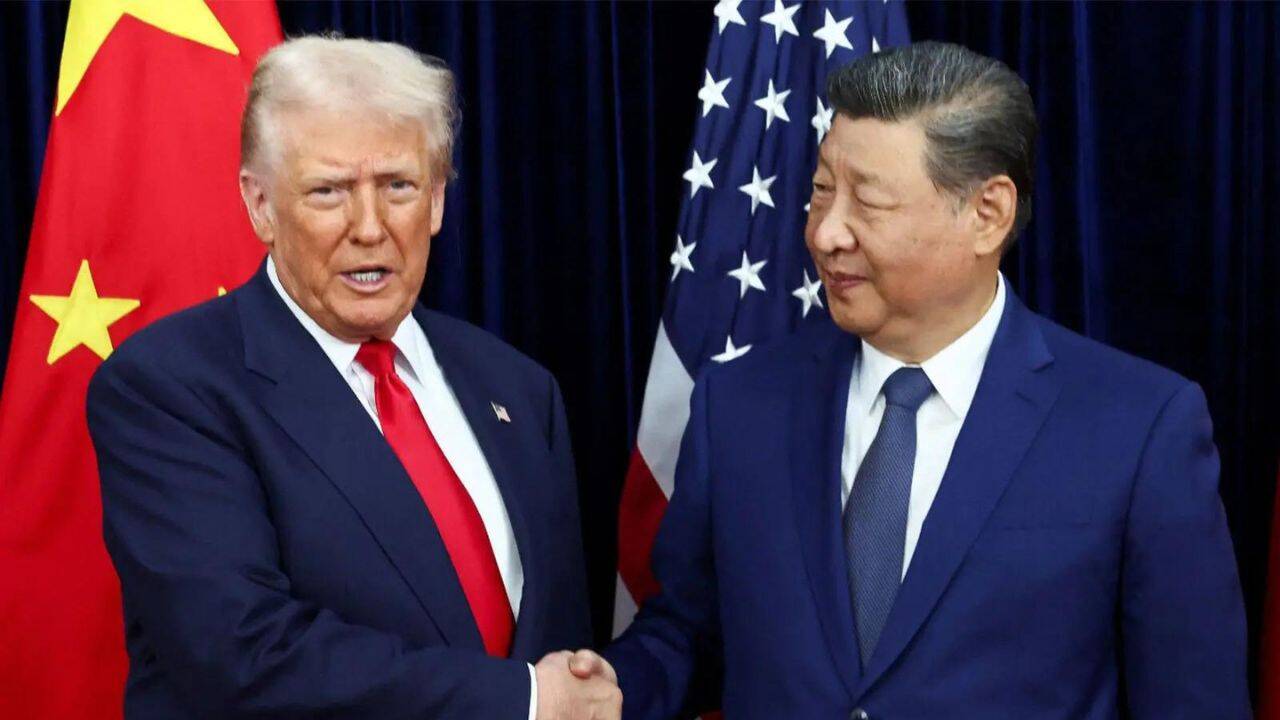
Geopolitical stability between major sovereign economies is rarely governed by diplomatic goodwill; it is determined by systemic leverage, structural asymmetries, and the credible execution of strategic penalties. Evaluating high-level state visits, such as those between United States and Chinese leadership, requires stripping away the theater of ceremonial diplomacy to analyze the underlying mechanics of statecraft. State-to-state negotiations function as a multi-variable optimization problem where each side attempts to maximize domestic utility while minimizing strategic vulnerability.
Bilateral economic relations between the United States and China operate on two distinct planes: a transactional marketplace and a structural competition over supply chain dominance. When assessing claims of diplomatic triumph or superior positioning, analysts must separate short-term concessions from long-term institutional shifts. Meanwhile, you can find related events here: The 2000-Acre Land Grab Saving South Carolina From Concrete.
The Asymmetry of Economic Leverage
Trade imbalances are frequently discussed as simple accounting discrepancies, but they represent deep structural dependencies. The structural trade deficit sustained by the United States has historically provided Beijing with substantial capital recycling mechanisms, primarily through the accumulation of United States Treasury securities. However, this dynamic creates a mutual vulnerability known in strategic economics as the balance of financial terror.
China relies heavily on external demand to maintain industrial capacity utilization and employment stability. When export velocity slows, domestic structural adjustments become politically and economically costly. Conversely, the United States relies on imported manufactured inputs to maintain price stability across consumer markets. Any abrupt truncation of this trade corridor introduces inflationary pressures and supply chain friction. To understand the bigger picture, we recommend the detailed report by Reuters.
The structural mechanics of this relationship rest on three primary variables:
- Market Access Asymmetry: The ease with which foreign entities can penetrate domestic markets differs significantly due to regulatory frameworks, state-backed industrial planning, and capital controls.
- Technological Enclosure: Control over foundational intellectual property, semiconductor fabrication equipment, and advanced research creates high-barrier chokepoints that restrict competitor scaling.
- Macroeconomic Policy Instruments: The capacity of central banks and executive authorities to absorb shocks, adjust tariffs, or implement targeted capital restrictions without triggering domestic liquidity crises.
The Cost Function of Retaliation
Diplomatic engagements often founder when one party underestimates the internal political cost constraints of the other. Statecraft requires a precise calculation of pain thresholds. When economic statecraft instruments—such as tariffs, export controls, or investment screenings—are deployed, they generate localized costs for domestic constituencies before achieving macro-level strategic objectives.
For instance, agricultural export restrictions or targeted tariffs immediately penalize specific domestic sectors in the initiating country, mobilizing concentrated interest groups against the policy. To sustain a hardline negotiating posture, political leadership must possess sufficient insulation or alternative economic cushions to absorb these domestic frictions.
The strategic utility of a summit lies primarily in its ability to signal resolve and establish boundary conditions. When leaders meet, the objective is not necessarily to achieve total resolution of structural conflicts, but to calibrate the parameters of managed competition. By defining acceptable bounds of behavior in commercial and security domains, both nations attempt to reduce the probability of systemic miscalculation.
Strategic Implementation and Operational Realities
Evaluating the outcome of bilateral negotiations demands an audit of verifiable metrics rather than rhetorical commitments. Effective diplomatic strategy relies on enforceable frameworks rather than non-binding declarations of intent.
- Verification Mechanisms: Agreements lacking transparent verification protocols degrade into symbolic gestures. True strategic progress requires measurable milestones, such as specific legislative adjustments, verifiable market opening quotas, or institutionalized enforcement panels.
- Timeline Alignment: Domestic political cycles in democratic systems often prioritize short-term economic indicators, whereas state-directed economic models can optimize for generational horizons. This temporal mismatch complicates long-term treaty execution.
- Multilateral Spillover: Bilateral agreements rarely occur in a vacuum. Third-party economies adjust their trade and security alignments based on the stability or volatility of the primary bilateral axis, creating complex second-order effects across global supply chains.
Future stability depends less on episodic diplomatic summits and more on the institutional resilience of the guardrails established during periods of high tension. The core objective of strategic management in this relationship is the institutionalization of friction reduction—ensuring that economic competition remains bounded by rules that prevent catastrophic decoupling or military escalation. Leadership must continuously balance the domestic imperative for robust posture against the global necessity of systemic equilibrium.
US-China Bilateral Relations and State Visits
This video provides historical context and official remarks from high-level state visits between United States and Chinese leadership, illustrating the diplomatic tone and economic priorities discussed in bilateral meetings.