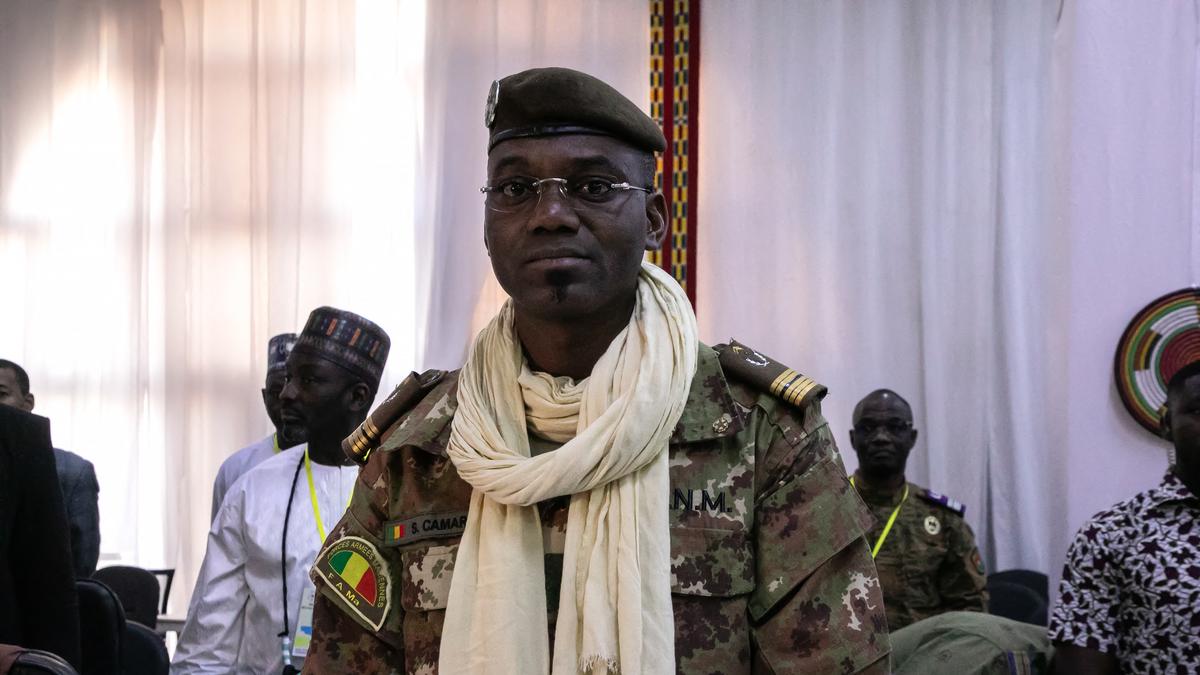
The assassination of Mali’s Defence Minister, Sadio Camara, represents a catastrophic failure of the state’s internal security architecture and a definitive shift in the kinetic balance of power between the Bamako-based transition government and the Permanent Strategic Framework (CSP) rebel coalition. This event serves as a lead indicator for the collapse of the 2015 Algiers Peace Accord, transitioning the conflict from a localized insurgency into a full-scale regional war of attrition. The removal of the primary architect of Mali's current defense policy creates a power vacuum that effectively paralyzes the Malian Armed Forces (FAMa) at a time when rebel forces have demonstrated a significant increase in operational sophistication and tactical reach.
The Architecture of State Fragility
The current instability in Mali is not a series of random skirmishes but a function of three intersecting structural deficits. Understanding the gravity of the Minister’s death requires an analysis of these pillars:
- The Legitimacy Deficit: The transition government’s authority rests on its ability to provide security. When the head of the defense establishment is neutralized, the state’s core value proposition—protection in exchange for compliance—evaporates.
- The Geographic Overextension: FAMa attempts to hold vast swaths of the northern and central territories while maintaining a concentrated presence in Bamako. This creates "thin" lines of communication that are easily severed by mobile rebel units.
- The Foreign Dependency Variable: The pivot away from traditional Western security partners toward private military contractors has introduced a profit-motive logic into national defense, often at the expense of long-term territorial stabilization.
The death of the Defence Minister acts as a force multiplier for these deficits. Without a central command figure to arbitrate between internal factions and external contractors, the Malian state faces a period of "strategic drift," where local commanders may act independently of Bamako’s directives to ensure their own survival.
Kinetic Mechanics of the CSP Offensive
The "fresh fighting" reported is a misnomer; it is a coordinated multi-axis offensive. Rebel groups, primarily under the CSP banner, have shifted from hit-and-run tactics to territorial contestation. This shift is characterized by the use of asymmetric hardware—specifically low-cost drones and improvised explosive devices (IEDs)—to neutralize the air superiority of the Malian state.
The Cost Function of Territorial Control
For the Malian state, the cost of holding northern outposts like Kidal or Tessalit is exponentially higher than the cost for rebels to disrupt those outposts. We can define this through the Asymmetric Attrition Ratio:
- State Expenditure: High. Includes fuel, payroll, air support, and maintenance of heavy armor.
- Insurgent Expenditure: Low. Includes small arms, light vehicles (technicals), and local intelligence networks.
When the Defence Minister was killed, the state's command-and-control (C2) efficiency dropped. In military logistics, a 20% reduction in C2 efficiency can lead to a 50% increase in the success rate of insurgent ambushes. The rebels are not trying to "win" a conventional war; they are trying to make the cost of governance so high that the state is forced to contract back to the southern "core" around Bamako.
The Wagner Variable and Private Military Risk
A critical component of Mali's current defense strategy is the integration of the Wagner Group (now functioning under the Africa Corps brand). The death of a high-ranking Malian official exposes a fundamental flaw in this partnership: the "Protection Gap."
Private military contractors (PMCs) are optimized for specific kinetic tasks—seizing a mine, clearing a village, or providing static guard duty. They are rarely designed for holistic national counter-insurgency (COIN). The failure to protect the Minister suggests that the intelligence-sharing mechanism between FAMa and its Russian partners is either siloed or compromised. This lack of integration creates "seams" in the security perimeter that the CSP and other jihadist elements, such as JNIM (Jama'at Nusrat al-Islam wal-Muslimin), are proficient at exploiting.
Fragmented Command Structure
The second limitation of relying on PMCs is the erosion of the national chain of command. In a standard military, the Defence Minister serves as the civilian-military bridge. In Mali, this bridge was already under heavy stress due to the junta’s structure. Now, with the Minister gone, there is a risk of fragmented loyalties. Units may choose to prioritize the orders of their PMC paymasters or local warlords over the central government, leading to a "feudalization" of the Malian security sector.
Regional Contagion and the Liptako-Gourma Dynamics
The conflict is no longer contained within Malian borders. The Liptako-Gourma region, where Mali, Burkina Faso, and Niger meet, has become a borderless theater of operations. The death of the Malian Defence Minister sends a signal to the Alliance of Sahel States (AES) that the "Security First" model is failing at its highest levels.
- Burkina Faso: Faces similar insurgent pressure; may see an uptick in cross-border incursions as rebels feel emboldened by the Malian state’s decapitation.
- Niger: Currently managing its own internal transition; likely to tighten borders, further isolating Mali and increasing the logistical burden on Bamako.
This creates a bottleneck for regional trade and security cooperation. If the Malian state cannot secure its own cabinet, its ability to contribute to the AES collective defense pact is effectively zero.
The Logic of the CSP Strategy
The Permanent Strategic Framework (CSP) is executing a "Pressure and Puncture" strategy.
- Pressure: Constant low-level attacks on logistics convoys to drain resources.
- Puncture: High-profile assassinations or the capture of significant urban centers to break the psychological will of the population and the rank-and-file soldiers.
By targeting the Defence Minister, the CSP has achieved a "Puncture" of the highest order. This is a signaling mechanism intended for two audiences. To the international community, it signals that the current government is not in control. To the Malian populace, it signals that the state’s protection is an illusion.
Quantitative Impact on National Stability
The economic downstream of this security failure is measurable. Mali’s credit risk is currently tied to its ability to export gold and cotton. Both industries require secure transit corridors.
- Logistics Disruption: Rebel control of the N7 and N15 highways increases the price of basic goods in Bamako by 15-30% within a 30-day window following major escalations.
- Foreign Direct Investment (FDI): Capital flight is inevitable when the primary guarantor of state contracts—the Defence Minister—is removed from the equation.
The "security premium" required to operate in Mali has just increased. For every major security official lost, insurance premiums for logistics firms rise, and the willingness of regional partners to engage in infrastructure projects diminishes.
The Intelligence Paradox
The most pressing question regarding the Minister's death is the failure of the state's intelligence apparatus. In a high-threat environment, a Defence Minister's movements are classified and guarded by multiple layers of redundancy. A successful assassination implies one of three scenarios:
- Scenario A: Internal Compromise: Elements within the Malian security forces provided the coordinates or timing of the Minister's location.
- Scenario B: Advanced Signals Intelligence: Rebel groups have acquired electronic warfare or SIGINT capabilities, likely through the capture of state equipment or black-market acquisition.
- Scenario C: Total Surveillance Failure: The state lacks the basic aerial or ground reconnaissance necessary to clear travel routes, rendering all high-value targets (HVTs) vulnerable.
The second scenario is the most concerning for the long-term stability of the region. If the rebels have achieved technological parity in intelligence gathering, the state’s conventional advantages are negated.
Strategic Forecast: The Retraction Phase
Mali is entering a "Retraction Phase." The state will likely respond to the Minister’s death with a series of high-intensity, retaliatory "sweeps" in northern territories. These are often performative and rarely lead to long-term holding of ground.
The data suggests that these sweeps result in:
- Increased civilian displacement, which fuels rebel recruitment.
- High fuel and ammunition consumption that the state cannot sustain without further Russian or Chinese credit lines.
- A temporary dip in rebel activity, followed by a resurgent "V-shaped" curve of violence once state forces withdraw to the south.
The state must now choose between a "Total War" footing—which requires a mass mobilization it may not be able to politically or financially afford—or a "Tactical Retreat" to defend the southern economic heartland.
The immediate tactical priority for the Malian transition government is the appointment of a successor who can consolidate the fractured loyalties of the military while simultaneously renegotiating the terms of engagement with PMCs. However, this is a stop-gap. The fundamental issue is that the Malian state is attempting to use 20th-century kinetic solutions for a 21st-century asymmetric problem.
The current trajectory indicates that unless Bamako can re-establish a credible presence in the northern administrative centers—not just through military force but through the restoration of basic services—the CSP and JNIM will continue to erode the state until "Mali" exists only as a city-state centered in Bamako. The death of the Defence Minister is the most significant milestone to date in this process of territorial and administrative dissolution.
Strategic Action: Transition government must immediately decentralize military command to regional hubs to prevent total paralysis during future HVT assassinations, while pivoting from "territorial reclamation" to "corridor security" to maintain the economic lifelines of the state.