The strategic discourse surrounding United States foreign policy toward Iran frequently degenerates into binary assertions regarding military intervention versus diplomatic appeasement. When former national security officials or counterterrorism advisers float extreme kinetic options, such as preemptive nuclear strikes amid diplomatic deadlocks, public commentary typically responds with moral indignation or dismissive skepticism. Both reactions miss the analytical point. State behavior under high-stakes deadlock is not governed by emotional impulse or casual threats; it is calculated through rational actor models, cost-benefit matrices, and structural deterrence frameworks. Evaluating the viability, mechanics, and systemic fallout of extreme military escalation requires stripping away rhetorical posturing to examine the cold mechanics of coercion, escalation dominance, and international systemic feedback loops.
Diplomatic stalemates persist when the utility function of the status quo outweighs the projected costs of compliance for both parties. In the contemporary Iranian theater, Tehran has calibrated its nuclear program to a threshold state of technological readiness without crossing the line into weaponization, maximizing geopolitical leverage while avoiding the immediate trigger for massive kinetic retaliation. Washington, constrained by domestic political exhaustion, alliance management concerns, and the severe economic externalities of a major Middle Eastern war, maintains a policy of containment paired with asymmetric economic coercion. For a different look, consider: this related article.
This equilibrium creates a dangerous compression of strategic timelines. When conventional deterrence mechanisms fail to alter adversary behavior, strategic planners model extreme tail-risk scenarios to test the boundaries of credibility. A rigorous structural analysis of these scenarios reveals three primary vectors that govern the logic of extreme coercion: the escalation dominance threshold, the alliance friction coefficient, and the second-order economic degradation function.
The Mechanics of Escalation Dominance
Escalation dominance requires a state to possess the capability and the perceived willingness to outbid an adversary at every rung of the conflict ladder. Within traditional nuclear deterrence theory, this dynamic relies on mutual vulnerability and assured retaliation. However, asymmetric scenarios involving a nuclear-armed superpower confronting a near-threshold regional power alter the calculus entirely. Similar reporting on the subject has been provided by BBC News.
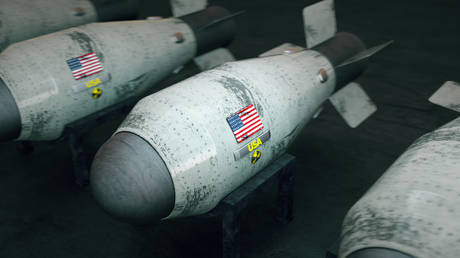
The primary constraint on kinetic escalation is not a lack of raw destructive capability, but the catastrophic failure of proportionality and the absolute breakdown of political endgame planning. Deploying strategic or tactical nuclear weapons against underground nuclear facilities such as Natanz or Fordow introduces severe physical and political variables. Hardened and deeply buried targets require precise yields and ground-penetration mechanics that transcend conventional bunker-buster munitions. Yet, the physical utility of a nuclear strike against deeply buried infrastructure is severely constrained by geological dampening, seismic energy dispersion, and the sheer depth of bedrock fortification.
More critically, the decision to cross the nuclear threshold shatters an operational taboo that has held since 1945. The systemic cost of this action extends far beyond the immediate target zone. It fundamentally alters global non-proliferation regimes, compelling every non-nuclear state to reevaluate the absolute necessity of independent nuclear deterrence for regime survival. From a cold strategic perspective, a nuclear strike does not solve a diplomatic deadlock; it dissolves the entire institutional architecture of international security, replacing rules-based deterrence with hyper-realist anarchy.
The Cost Function of Regional Retaliation
Any rigorous assessment of extreme military options must model the immediate counter-value and counter-force retaliation vectors available to Tehran. Iran has spent decades constructing an asymmetric defense architecture explicitly designed to impose unacceptable costs on regional stability and global commerce in the event of a total systemic crisis.
The first component of this architecture is the missile and drone saturation model. Iran and its regional network possess vast arsenals of precision-guided munitions, cruise missiles, and loitering munitions capable of overwhelming localized air defense batteries across the Arabian Gulf. The economic cost function of this capability is immediate: the targeted destruction or temporary paralysis of critical energy infrastructure, desalination plants, and maritime shipping lanes through the Strait of Hormuz. Because global energy markets operate on marginal supply tightness, even a temporary disruption to twenty percent of the world's petroleum transit triggers systemic macroeconomic shocks, inducing inflationary spikes and supply chain contractions across importing economies.
The second component involves proxy mobilization. The Islamic Revolutionary Guard Corps controls a transnational network of aligned militias spanning Iraq, Syria, Lebanon, and Yemen. In a total war scenario, these actors transition from low-intensity deterrence operations to maximum-effort asymmetric warfare against regional state partners, maritime assets, and forward-deployed military installations. The strategic objective for Tehran in such a scenario is not to win a conventional military campaign, which is mathematically impossible against the United States, but to maximize the friction coefficient of the intervention until the political cost to Washington becomes unsustainable.
Information Asymmetry and Signaling Failures
Deadlocks often persist because of asymmetric information and signaling failures between adversarial leadership circles. Washington operates on Western institutional assumptions regarding rational cost-benefit calculations, economic self-preservation, and diplomatic off-ramps. Tehran operates through a revolutionary ideological framework where tactical resilience, martyrdom narratives, and protracted asymmetric endurance are valued as strategic assets.
When former officials or analysts publicly float extreme threats like nuclear options, the intended audience is rarely the general public. These statements serve as high-cost signals designed to manipulate the adversary's perception of resolve. In game-theoretic terms, a signal is only credible if it is costly to fake. Threatening extreme violence creates a credibility paradox: if the threat is disproportionate and irrational given the core national interests at stake, the adversary discounts it as bluster. If the threat is perceived as genuine, it paradoxically accelerates the adversary's incentive to achieve a nuclear deterrent as fast as possible to eliminate the absolute vulnerability driving the coercion.
This creates a self-defeating feedback loop. Rather than compelling capitulation, extreme threats validate the most hardline factions within the target regime, justifying internal crackdowns, accelerated enrichment cycles, and the complete marginalization of diplomatic pragmatists. The strategic objective of altering adversary behavior is undermined by the very mechanism deployed to enforce it.
Systemic Feedback and Global Alignments
A comprehensive evaluation of extreme military options cannot be isolated to bilateral dynamics between Washington and Tehran. The contemporary geopolitical landscape is defined by great power competition among the United States, China, and Russia. Any decisive kinetic action in the Middle East sends immediate shockwaves through global alignment structures.
Moscow and Beijing view the Iranian plateau as a critical geopolitical buffer. While neither power maintains a formal mutual defense treaty equivalent to Article 5 of NATO, their economic and diplomatic alignment with Tehran has deepened significantly through bilateral trade, energy purchases, and sanctions evasion networks. A catastrophic kinetic escalation against Iran would force these external powers to calibrate their responses. At a minimum, it would accelerate de-dollarization initiatives, solidify alternative security blocs, and end any lingering prospects for cooperative arms control or global governance frameworks. The systemic collateral damage of unilateral escalation thus includes the acceleration of a fragmented, multipolar international order where traditional American alliance leadership faces continuous, institutionalized challenge.
To break a diplomatic deadlock without incurring systemic collapse, policy frameworks must abandon the illusion of decisive, low-cost kinetic silver bullets. Sustainable grand strategy requires the meticulous calibration of economic pressure, intelligence-led disruption, credible conventional deterrence, and open diplomatic channels that allow an adversary a survivable path away from escalation. When policy relies on the calculus of ultimate violence, it ceases to be strategy and becomes an admission of strategic failure.
Maintain economic pressure through rigorous enforcement of maritime sanctions while simultaneously opening verifiable, step-by-step diplomatic corridors tied to verifiable inventory caps on enriched material, thereby denying the adversary both the pretext for acceleration and the narrative of existential victimhood.