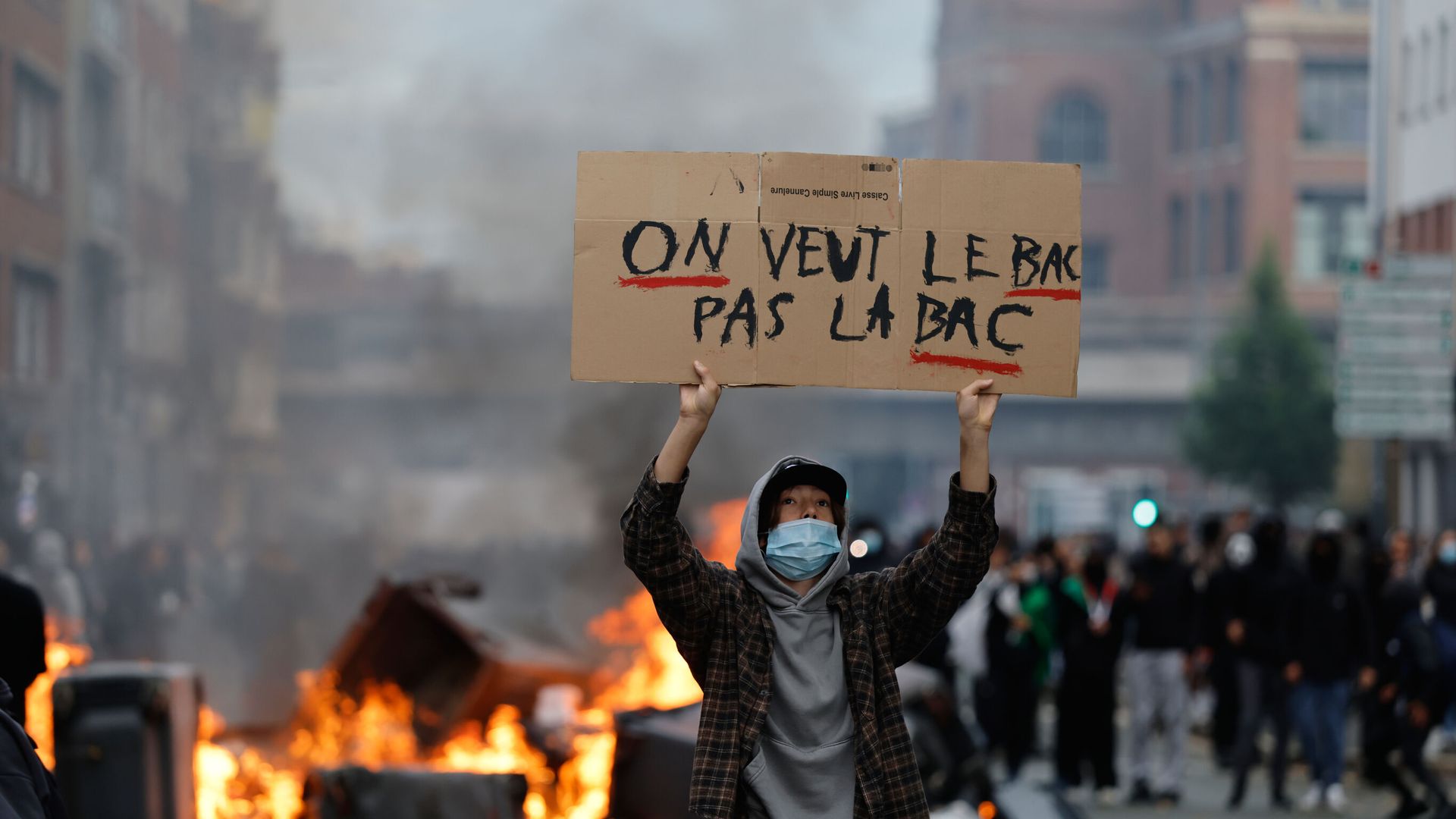
Mass civil unrest rarely materializes from a single point of failure. When thousands of students mobilize across urban centers, construct blockades, and engage in high-visibility arson outside institutional facilities, the phenomenon represents a systemic fracture point between state resource allocation and civilian expectations. Deconstructing the mechanics of the nationwide lycée disruptions reveals an operational blueprint of how administrative neglect, economic anxiety, and crowd dynamics compound into structural crisis.
The Input Variables of Structural Discontent
The genesis of the mobilization rests on measurable institutional constraints rather than abstract ideological grievances. Public educational infrastructure faces acute operational bottlenecks, characterized by prolonged teacher shortages, high staff absenteeism, and chronic underinvestment in basic facilities. When ambient environmental stresses—such as extreme heatwaves within uninsulated classrooms—coincide with rigid curricular demands and elongated daily schedules, the system reaches a saturation threshold. Recently making waves in related news: The Architecture of Commercial Crew Integration: Analyzing the Structural Mechanics of Long Duration Orbital Missions.
The cost function of this institutional strain is borne entirely by students and staff. Overloaded classes and missing instructional support reduce educational output quality, while administrative leadership struggles to maintain basic operational continuity. When the central state fails to resolve these localized deficits through standard bureaucratic channels, actors turn to direct action to force institutional attention.
The Mechanics of Escalation and Contagion
The transition from localized grievances to a synchronized national movement follows a distinct network trajectory. Digital platforms accelerate spatial contagion, turning isolated institutional pushback into a coordinated phenomenon. The tactical playbook relies on specific operational steps: Further insights regarding the matter are detailed by The New York Times.
- Information Synchronization: Grievances and blockade schedules are broadcast via decentralized digital channels, establishing a common operational timeline across geographically distant regions.
- Physical Interruption: Small groups seize control of entry points, erecting barricades using urban infrastructure, waste bins, and bicycles to completely halt administrative and educational functions.
- Escalation Loops: The presence of security forces outside closed institutions creates a friction point. As police deploy crowd control measures, including tear gas and containment tactics, the nature of the gathering shifts from a targeted institutional protest to a generalized confrontation with state authority.
This progression introduces opportunistic elements from outside the student body. Fringe actors exploit the dense crowds to introduce destructive tactics, including arson and property damage, which fundamentally alters the media framing and public perception of the movement.
The State Response Function and Security Overload
Faced with systemic disruption across hundreds of secondary facilities, public authorities deploy a heavy-handed containment strategy. The state response operates on an input-output model of deterrence: mass mobilization of security personnel, deployment of specialized tactical units, and the implementation of restrictive perimeter policies.
However, this security-first posture introduces counterproductive feedback loops. The use of restrictive containment methods, often termed kettling, alongside the heavy deployment of chemical agents and kinetic crowd control tools, increases physical injury rates among minors and educators. Rather than acting as a stabilizing deterrent, aggressive policing hardens local sentiment, increases distrust, and drives secondary actors—such as labor unions and broader political movements—into active alignment with the protesters.
Strained public finances leave central leadership with negligible fiscal flexibility to buy off structural discontent through immediate capital injections. Consequently, governance relies entirely on procedural clampdowns and minimal policy adjustments that fail to match the scale of the underlying deficits.
The Political Economy of Unrest
The macroeconomic backdrop amplifies these micro-level frictions. Stagnant purchasing power, combined with broader anxieties regarding employment stability and political representation, converts a sector-specific labor dispute into a proxy war for national political direction.
Extremist political factions capitalize on the visible breakdown of public order. For the political right, images of urban fires and chaotic street clashes serve to validate a law-and-order platform, shifting the national discourse toward security and authoritarian control. Conversely, radical left factions utilize youth dissatisfaction to anchor broader anti-establishment narratives, setting up a polarized electoral landscape.
Strategic Forecast
The trajectory of such movements is dictated by resource exhaustion and political timing. Because the structural deficits within the public infrastructure cannot be resolved via short-term administrative triage, and because fiscal constraints prevent major capital restructuring, tactical friction will persist whenever institutional pressure spikes. The ultimate resolution depends on whether the state can decouple legitimate educational reform from the cycle of urban violence, or whether security management permanently replaces policy reform as the primary instrument of state governance.