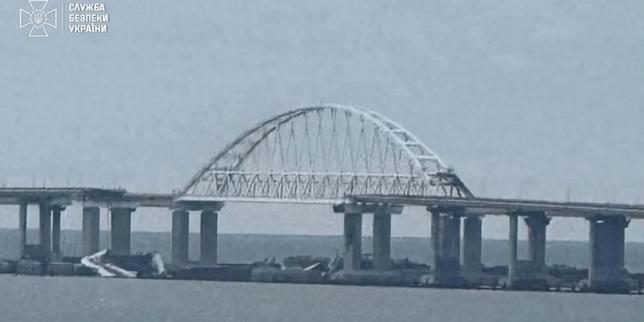
Ukrainian President Volodymyr Zelensky’s explicit claim of responsibility for the strike on the Crimean Bridge marks a decisive shift in Kyiv’s strategic communication, moving away from calculated ambiguity toward open psychological and logistical warfare. While Moscow insists it will rapidly restore the 19-kilometer span across the Kerch Strait, the physical damage tells only half the story. The real impact lies in how these recurring strikes expose the fragility of Russia’s southern supply lines, drain its air defense reserves, and shatter the domestic illusion that Crimea remains an untouchable fortress.
For years, Ukrainian officials maintained a wink-and-nod posture regarding operations deep inside occupied territory or Russian soil. Whenever an ammunition depot exploded in Belgorod or a fuel tank caught fire in Sevastopol, Kyiv offered cryptic remarks about "smoking accidents" or karma. Claiming the Kerch Strait attack directly signals a new phase of confidence. It tells both Western allies and the Russian public that Ukraine possesses the reach, the intelligence, and the domestic hardware to hit Moscow’s most prized infrastructure project at will.
The Strategic Artery of the Southern Front
To understand why a bridge built across a shallow strait carries so much weight, you have to look at a map of the northern Black Sea. When Russia annexed Crimea in 2014, the peninsula became an isolated island dependent on air and sea transport. President Vladimir Putin spent roughly $3.7 billion to build the dual road-and-rail bridge, inaugurating it himself behind the wheel of an orange Kamaz truck in 2018.
In military terms, the Kerch Strait Bridge is not merely a civilian transit route. It is the primary logistics artery feeding the Russian military machine in southern Ukraine.
Rail transport is the backbone of Russian military doctrine. Unlike Western armies that rely heavily on palletized truck convoys, the Russian armed forces move bulk ammunition, heavy armor, artillery shells, and fuel almost exclusively by train. The parallel rail span of the Crimean Bridge allows Moscow to push massive quantities of materiel from mainland Russia directly into Crimea, and from there northward into the Zaporizhzhia and Kherson regions.
Every time explosions buckle the roadway or warp the steel rail tracks, that logistical pipeline narrows. Even temporary closures force Russian commanders into a series of painful compromises. They must divert military cargo onto vulnerable amphibious landing ships, rely on congested ferry crossings that are easily disrupted by Black Sea storms, or route convoys through the occupied mainland corridor along the Sea of Azov.
That mainland route—running through Mariupol, Berdiansk, and Melitopol—brings its own severe headaches. Supply trucks and trains using this corridor must travel much closer to the active front lines, placing them squarely within the range of Ukrainian HIMARS rockets, Storm Shadow cruise missiles, and long-range strike drones. By hitting the bridge, Ukraine forces Russia into a logistical vise.
Anatomy of an Asymmetric Strike
Engineering a successful attack on a heavily fortified maritime bridge is an extraordinarily complex problem. Concrete and steel are notoriously difficult to destroy with conventional warheads, which is why bridges typically require massive, sustained bombardments to bring down completely.
Ukraine has bypassed the need for heavy strategic bombers through asymmetric innovation. Past operations against the span have utilized packed explosives disguised in commercial cargo trucks and custom-built unmanned surface vessels (USVs)—essentially sleek, low-profile naval drones packed with hundreds of kilograms of high explosives and guided via satellite links.
Consider the physics involved in hitting a bridge pier with a naval drone. A surface vessel detonating at the waterline directs its blast energy horizontally against concrete pilings designed primarily to bear vertical weight. Even if the piling does not collapse immediately, the shockwave can cause micro-fractures in the reinforced concrete and shift the bridge deck off its bearings. Once a deck segment is displaced by even a few inches, high-speed rail traffic becomes impossible until heavy cranes and specialized engineering crews can jack the span back into alignment.
Russia has responded to this threat by turning the Kerch Strait into one of the most heavily defended patches of water on earth. Moscow has deployed:
- Layered Air Defenses: S-400 and Pantsir-S1 systems stationed along both the Taman and Kerch peninsulas to intercept incoming missiles and aerial drones.
- Physical Maritime Barriers: Submerged booms, steel nets, and rows of sunken barges positioned parallel to the bridge piers to block surface drones from reaching the concrete supports.
- Active Smoke Screens: Specialized aerosol generators mounted on the bridge and nearby patrol boats designed to blind optical and infrared guidance systems during an attack.
- Constant Aerial Patrols: Ka-27 and Mi-8 helicopters flying continuous sorties over the strait to spot low-profile drones with heavy machine guns.
Despite these multi-layered defenses, Ukrainian intelligence and special operations units continue to find seams in the perimeter. Every successful breach proves that static defenses, no matter how dense, struggle against adaptable, low-cost autonomous systems.
The Kremlin Promise of Rapid Restoration
When Russian officials pledge to "restore" the bridge quickly, they are relying on a playbook that has worked for them in the past—at least on the surface. Following the massive truck bomb explosion in October 2022 and the naval drone strike in July 2023, Russian state media broadcast round-the-clock footage of welders, cranes, and asphalt crews working under floodlights. Within months, car traffic was flowing again, allowing Moscow to project an image of unstoppable resilience.
However, quick cosmetic repairs do not equal full structural recovery. Civil engineers and structural analysts have repeatedly pointed out that repairing a damaged bridge under wartime urgency often involves compromises that degrade its long-term load-bearing capacity.
When intense fire engulfs a steel rail span—as happened when fuel tankers ignited during the 2022 blast—the extreme heat alters the metallurgical properties of the steel girders. Metal loses its temper and structural rigidity. Simply replacing the warped tracks and repainting the girders allows light trains to pass, yet running heavy, multi-thousand-ton military freight trains over heat-compromised spans carries the constant risk of catastrophic structural failure.
Furthermore, the logistical cost of keeping the bridge open is astronomical. Russia has had to strip vital air defense batteries, radar units, and engineering equipment from other sectors of the front just to guard a single piece of infrastructure. In warfare, forcing your enemy to spend billions defending a stationary target while you attack it with weapons costing a fraction of that amount is a textbook win in attrition economics.
Psychological Warfare and the Myth of Crimea
Beyond the tonnage of artillery shells and the tensile strength of steel, the Crimean Bridge carries immense political symbolism. For Vladimir Putin, the span represents the physical welding of Crimea to the Russian mainland—the crowning achievement of his presidency and the centerpiece of his domestic legitimacy.
For nearly a decade, Russian state television sold the narrative that Crimea was completely secure, a sunlit vacation paradise insulated from the fallout of the invasion. Millions of Russian tourists drove across the bridge every summer to reach the beaches of Yalta and Alushta.
Zelensky’s direct claim of responsibility punctures that bubble. When explosions rock the Kerch Strait, traffic backs up for dozens of miles, trapping civilian vacationers in gridlock while smoke plumes rise on the horizon. The psychological shockwaves travel straight back to Moscow and St. Petersburg when those tourists return home.
By owning the strike publicly, Zelensky achieves three distinct psychological objectives:
- Eroding Domestic Confidence: It forces ordinary Russians to confront the reality that the war is not a distant "special military operation" happening somewhere else, but an active conflict reaching territory the Kremlin claims as its own.
- Pressuring Western Backers: Some Western policymakers have historically worried that strikes on Crimea cross a dangerous red line that could trigger Russian escalation. By executing the strike and claiming it without triggering a nuclear response, Kyiv demonstrates that Moscow’s red lines are largely rhetorical bluffs.
- Boosting Ukrainian Morale: Amid grueling, inch-by-inch infantry battles in the Donbas, high-profile strikes deep behind enemy lines provide tangible proof to the Ukrainian public and frontline troops that their military retains the initiative.
The Limits of Infrastructure Strikes
A clear-eyed assessment requires acknowledging what hitting the bridge cannot do on its own. Destroying or damaging the Kerch Strait span will not cause the Russian army in southern Ukraine to collapse overnight.
Modern armies maintain sprawling, decentralized stockpiles. Russian forces in Zaporizhzhia and Kherson have spent years digging in, laying millions of mines, and building fortified underground bunkers filled with ammunition reserves. Even if the bridge were completely severed tomorrow, Russian troops on the mainland could continue fighting at high intensity for months using existing stocks and supplies trickling in through the occupied land bridge.
Russia has also anticipated the vulnerability of the Kerch Strait by accelerating the construction of a new railway line running along the northern coast of the Sea of Azov, connecting Rostov-on-Don to occupied Donetsk, Mariupol, and Crimea. While this overland route is far closer to Ukrainian artillery and drone range—making it a permanent shooting gallery for Kyiv—it provides Moscow with an alternative lifeline that does not rely on a single vulnerable bridge over open water.
A Calculated Shift in the War of Attrition
The battle over the Crimean Bridge illustrates how modern warfare has evolved into a contest of industrial endurance and asymmetric reach. Ukraine does not need to drop every single pillar of the 19-kilometer structure into the sea to achieve its military goals. It only needs to keep the bridge in a perpetual state of repair, uncertainty, and reduced capacity.
Each time Kyiv forces Moscow to halt rail traffic, divert naval vessels to guard concrete pilings, and pull S-400 batteries away from frontline troops, the strike pays strategic dividends. Russia can weld steel girders back together and pour fresh asphalt over blast craters as many times as it likes, but it cannot restore the sense of invulnerability that once made Crimea feel permanent.



