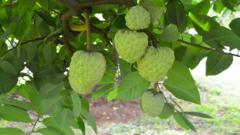
The first bite is an exercise in cognitive dissonance. Your eyes register an exterior that resembles a green, armor-plated hand grenade, or perhaps a prehistoric reptile egg. But your tongue encounters something entirely different. It is thick, velvety, and shockingly sweet. It tastes like a masterful blend of vanilla bean pastry cream, ripe banana, and a sharp twist of pineapple.
For decades, this fruit remained a localized secret, a fragile treasure hidden in the cloud forests of the Andes and the subtropical pockets of Southern California and the Mediterranean. It is called the cherimoya. Mark Twain once called it "the most delicious fruit known to men." Yet, for nearly a century after he wrote those words, global supply chains ignored it. It was too soft. It rotted too fast. It refused to cooperate with the brutal, mechanized reality of modern supermarkets.
Then the world changed.
The story of the cherimoya’s sudden ascent is not just a tale of changing culinary trends. It is a story about the human weariness with engineered perfection, the desperate scramble of farmers facing a warming planet, and the quiet triumph of flavor over convenience.
The Ghost of the Orchard
To understand why a fruit that tastes like custard is suddenly appearing in high-end grocers from London to Tokyo, you have to meet someone like Jaime. Jaime is a composite of the third-generation growers I spoke with in Almuñécar, a sun-bleached coastal valley in southern Spain where Europe’s only significant concentration of cherimoyas grows.
For thirty years, Jaime’s family survived on a simple, exhausting routine. They hand-pollinated every single blossom on their terraced trees.
Think about that. The cherimoya has a bizarre reproductive quirk. Its flowers open as female on the first day, then change to male on the second. Because the native beetles that pollinate them in South America do not exist in Spain or California, human beings must bridge the gap. Jaime spends his spring mornings with a tiny camel-hair brush, collecting pollen from male flowers into a small plastic cup, then carefully dabbing it onto the sticky stigma of the female flowers.
It is tedious, backbreaking work. For a long time, it barely paid for itself.
"My neighbors pulled out their trees," Jaime told me, pointing toward a scarred hillside across the valley. "They planted avocados. Everyone wanted avocados. They are tough. You can ship them around the world. They make people rich."
But the avocado gold rush had a dark side. Avocados are notoriously thirsty plants. As droughts intensified across the Mediterranean basin and water tables plummeted, farmers began to realize they had gambled on a crop that was drinking them dry.
Consider what happens next: the forgotten, high-maintenance cherimoya suddenly looked like a lifesaver. Cherimoya trees require roughly half the water of an avocado orchard. They possess a deep, resilient root system that holds the fragile mountain soil together. Jaime didn't pull his trees out. He waited. And his patience paid off.
The Counter-Revolution Against the Cardboard Apple
We live in an era of agricultural disillusionment. Walk down the produce aisle of any major supermarket. You will see rows of perfectly uniform, glossy red apples, flawless strawberries, and rock-hard peaches. They look beautiful. They last for weeks in a refrigerator.
They also taste like absolutely nothing.
Decades of breeding for shelf-life and transportability stripped the soul out of our food. We traded flavor for logistics. The global rise of the cherimoya is a direct, visceral rebellion against this corporate blandness.
When a consumer encounters a cherimoya for the first time, it feels like a revelation. The fruit does not care about your logistical efficiency. If you drop it, it bruises. If you leave it on the counter a day too long, it turns to mush. It demands respect. It forces you to slow down, to slice it open with a sharp knife, scoop out the large, toxic black seeds, and eat it with a spoon right then and there.
Logistics experts initially hated it. They called it unmarketable.
But they underestimated the power of word-of-mouth in a digital age. Chefs in Paris began using the creamy flesh to create dairy-free ice creams that rivaled the richest gelato. Well-travelled food influencers posted videos of themselves cracking open the scaly green skins, their expressions shifting from skepticism to pure euphoria.
The demand surged. Suddenly, those difficult, hand-pollinated orchards in Spain, Chile, and New Zealand weren't liabilities anymore. They were goldmines.
The Chemistry of Custard
How does a plant pull off this culinary magic trick? The secret lies in a complex matrix of natural sugars and volatile aromatic compounds.
Unlike an orange, which relies heavily on citric acid for its profile, or a banana, which leans into starch, the cherimoya mimics the texture of dairy fat through a dense concentration of soluble fibers and complex carbohydrates. When it ripens, these compounds break down at an asymmetrical rate. The starch converts entirely into fructose and glucose, while the cell walls dissolve into a silky, buttery emulsion.
Chemically, it contains high levels of linalool, the same aromatic compound found in lavender and bergamot, combined with ethyl butyrate, which gives juicy fruit its signature tropical punch. The result is a sensory illusion. Your brain tells you that you are eating something cooked, something whipped with heavy cream and eggs by a pastry chef, when in reality, it dropped off a branch.
This brings us to the confusion that often surrounds the fruit. People frequently mistake the cherimoya for its cousin, the soursop, or the North American pawpaw. While they belong to the same Annonaceae family, the soursop is fibrous and aggressively acidic, often used for juices. The pawpaw has a shorter window of ripeness and a more musky, mango-like tone. The true cherimoya stands alone in its pure, dessert-like refinement.
The High-Stakes Race for the Future
The current boom is not without danger. The global market is scrambling to solve the very problem that kept the cherimoya isolated for centuries: its fragility.
Right now, agricultural scientists are engaged in a quiet, high-stakes race to develop hybrids that possess the divine flavor of the traditional cherimoya but sport a slightly thicker skin. It is a dangerous game. Tinker too much with the genetics to satisfy the shipping containers, and you risk creating just another beautiful, tasteless cardboard apple.
There is also the climate reality. While cherimoyas need less water than avocados, they are incredibly picky about temperature. They loathe frost, yet they require a specific number of cool winter hours to set fruit. As global temperatures fluctuate wildly, the geographical sweet spots for growing this fruit are shifting. Orchards are moving higher up the mountainsides in Peru and Ecuador, while growers in California are experimenting with microclimates further north than ever before.
The farmers who stuck by the fruit during its dark ages are now the gatekeepers of a luxury commodity. Prices in metropolitan centers have skyrocketed. A single, prime-grade cherimoya in a New York specialty market can fetch upwards of fifteen dollars.
The Last Spoonful
I remember sitting on Jaime’s porch as the sun dipped below the Sierra Nevada mountains, casting long, purple shadows across the terraced orchard. He handed me a fruit that had softened to the consistency of a ripe avocado. He didn't use a knife; he simply split it in half with his thumbs. The aroma that bloomed into the cool evening air was intoxicating—sweet, clean, and redolent of a tropical bakery.
We ate in silence, spitting the polished black seeds into a clay bowl.
It occurred to me then that the rise of the cherimoya is a reminder of what we almost lost in our pursuit of industrial perfection. We tried to standardize nature, to make every fruit a durable soldier capable of surviving a three-week journey in a dark container.
But human beings do not crave standardization. We crave wonder. We crave the unexpected joy of a green, scaly orb that transforms into custard on the tongue.
The shadow of the corporate supply chain still looms large over agriculture, but for now, the hand-pollinated, delicate, defiant cherimoya is winning. It is a fragile victory, measured in spoonfuls, reminding us that some things are worth the trouble.
Jaime wiped his hands on his apron and looked out over his trees, the tiny camel-hair brush tucked neatly into his breast pocket, ready for tomorrow morning.