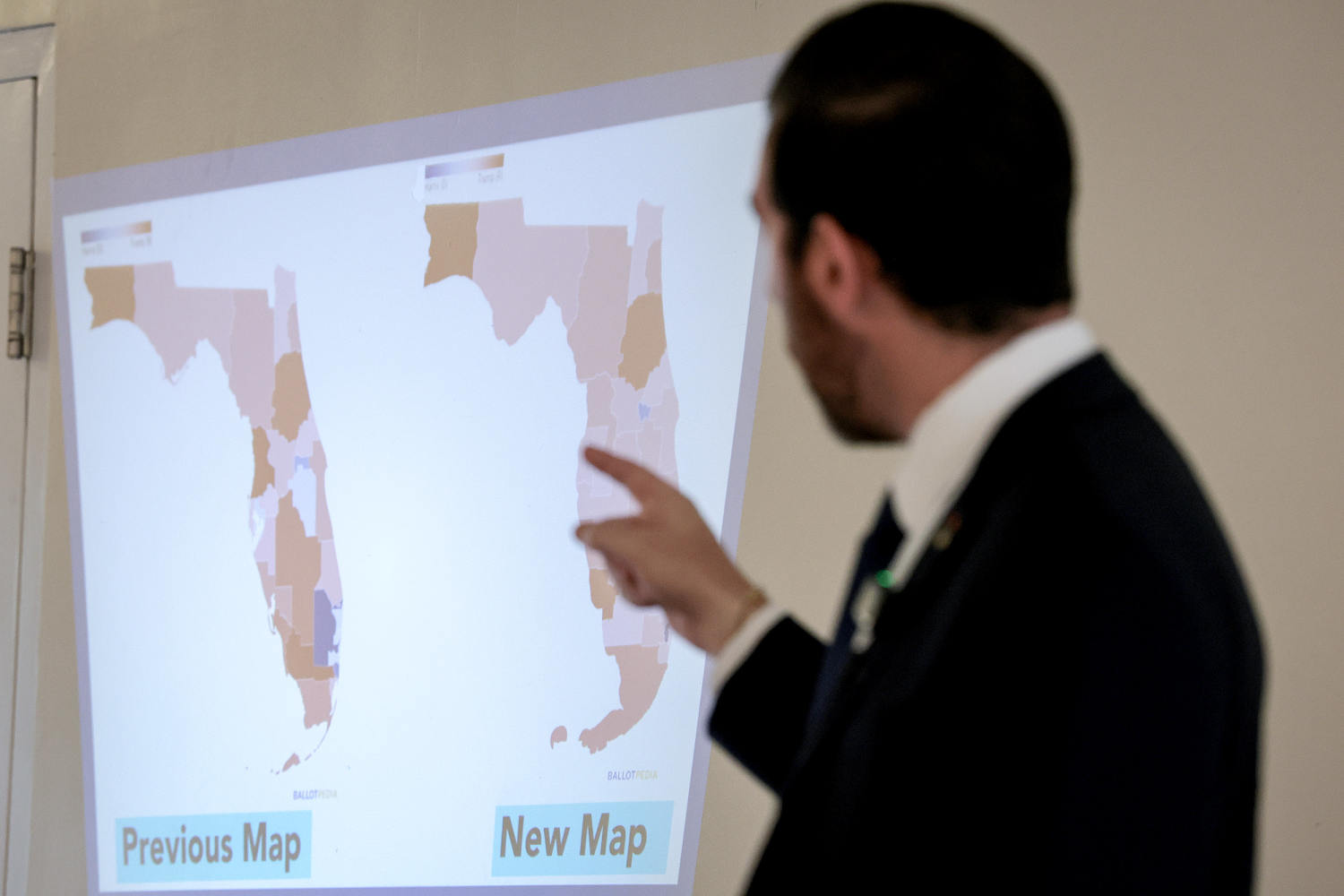
The national media is throwing another predictable tantrum over Florida’s newly minted congressional map, treating the Leon County courtroom drama like a pristine battle for the soul of democracy. Left-leaning voting rights groups weep over the alleged death of the 2010 Fair Districts Amendment, while Republican operatives quietly measure the drapes for four new offices in Washington. They want you to believe this is a shocking breakdown of constitutional norms, engineered by Ron DeSantis in a two-day legislative sprint to appease Donald Trump.
They are lying to you. Or worse, they genuinely do not understand how power works.
The lazy consensus dominating the airwaves posits that gerrymandering is a corrupt aberration that can be cured by independent commissions, neat geometric lines, and judicial intervention. This premise is fundamentally flawed. Gerrymandering is not a bug in the American political system; it is the natural, inevitable state of a geographical, winner-take-all representative democracy. The court fight in Tallahassee is not a defense of the rule of law. It is an unvarnished power grab by a different set of lawyers using a different set of weapons.
If you want to stop the cyclic warfare that paralyzes state capitals every few years, you have to stop trying to fix the map. You have to change the entire game.
The Myth of the Neutral Map
Let us dismantle the core legal argument presented by the coalition of Equal Ground, Common Cause, and the League of Women Voters. They claim that the Fair Districts Amendment explicitly forbids drawing lines to favor a political party or diminish minority voting strength. They point to the splintering of Darren Soto’s 9th District, where the Latino population was intentionally diluted from 54% to 41%, as a smoking gun of racial and partisan animus.
Their outrage ignores a brutal structural reality: there is no such thing as a neutral district.
The moment you draw a line on a map, you are making a political decision. Imagine a hypothetical state with 100 voters: 60 are Republicans and 40 are Democrats. If you pack all 40 Democrats into two compact, neatly shaped districts, you have "concentrated minority voting power," but you have also guaranteed the Republicans win the other three districts easily. If you spread those 40 Democrats evenly across all five districts, they lose every single election 60-40.
Both methods can be argued as "fair" under different, competing legal theories. The Fair Districts Amendment attempted to mandate two completely contradictory goals simultaneously: maximize minority representation while minimizing partisan bias. In practice, these two goals are locked in a zero-sum death match.
To create a majority-Black or majority-Latino district in a racially polarized state, you must explicitly group voters based on race. Doing so almost always concentrates Democratic voters into a single district, effectively bleaching the surrounding areas and rendering them safely Republican. DeSantis’s legal team, led by Mohammad Jazil, isn't breaking the system; they are just exploiting this inherent contradiction. By arguing that the state's racial protections violate the U.S. Constitution's Equal Protection Clause, they are pulling the rug out from under the entire 2010 framework. It is cold, calculating, and constitutionally coherent.
The E-E-A-T Reality Check: Why Lawyers Love the Chaos
I have spent years analyzing the machinery of state-level campaign finance and litigation. I have seen political committees blow millions of donor dollars on these redistricting crusades. Do you know who actually wins when a map goes to court?
The billing attorneys.
Consider the timeline the media loves to highlight. The state notes that the maps passed in 2012 were used for two full election cycles before the Florida Supreme Court finally struck them down. Think about that from a purely business-minded perspective. If you are a political party, a map doesn't need to be permanent to be wildly successful. It just needs to survive long enough to secure a legislative majority that can appoint the next round of friendly judges.
By the time the lawsuits consolidated under Leon County Circuit Judge Joshua Hawkes wind their way up to the Florida Supreme Court, the 2026 midterms will be over. The Republican advantage will already be locked in. The state’s legal defense—arguing that upcoming elections are too close to disrupt—is a classic, time-tested stall tactic. It works because judges are fundamentally risk-averse bureaucrats who dread creating administrative chaos at the ballot box.
The plaintiffs know this. They aren't fighting for a permanent utopia of non-partisan lines; they are fighting to get their preferred map into play for the next cycle. It is a corporate boardroom proxy war dressed up in civil rights language.
The Counter-Intuitive Alternative: Blow Up the Single-Member District
If the current system is an endless loop of litigation, political polarization, and voter disenfranchisement, what is the actionable alternative? Stop drawing single-member districts altogether.
The obsession with geographic boundaries is a relic of the 18th century, a time when it took four days on horseback to deliver a letter across a state. We no longer live in isolated agrarian pockets. A progressive voter in Miami has more in common ideologically with a progressive voter in Orlando than they do with their conservative neighbor across the street. Yet, our geographic sorting forces them into winner-take-all gladiator arenas where up to 49% of the population is effectively stripped of representation every two years.
To actually solve the crisis, we must shift to a system of multi-member districts paired with proportional representation.
- The Blueprint: Instead of splitting Florida into 28 hyper-curated, single-member silos, divide the state into seven larger, regional districts, each electing four representatives.
- The Mechanics: If a regional district votes 50% Republican, 25% Democrat, and 25% Independent, those four seats are split accordingly: two to the GOP, one to the Democrats, and one to a third party.
- The Result: Instantly, gerrymandering becomes mechanically impossible. You cannot draw a line to exclude a minority population when the entire region votes as a collective bloc.
This approach completely dismantles the premise of the "People Also Ask" obsession with geographic compactness. Who cares if a district boundary follows a river or a county highway if every vote cast directly translates into proportional legislative power? Under this framework, Darren Soto wouldn't be begging for a lifeline from shifting demographic percentages in Kissimmee; his base would simply elect him based on the aggregate weight of their turnout across Central Florida.
The Downside Nobody Wants to Admit
A contrarian take that promises a flawless utopia is just marketing. The multi-member proportional system has a massive, terrifying downside for the political establishment: it destroys the modern party apparatus.
National political parties thrive on the single-member district because it allows them to pool resources into a handful of hyper-specific "swing" zones. It turns politics into a predictable, highly fundable science. If you blow up the silos, you introduce radical volatility. Extremist factions within parties could easily secure enough regional support to win a single seat in a four-member district, bypassing the traditional gatekeepers entirely.
That is precisely why neither the Democrats suing in Tallahassee nor the Republicans defending the map in the state legislature will ever propose it. They prefer the current war. It keeps fundraising metrics high, keeps the base angry, and keeps the consultant class filthy rich.
Stop looking at the Tallahassee courtroom as a fight for democracy. It is an auction house where the currency is your compliance. The map isn't broken. It is doing exactly what it was designed to do: protect the elite from the voters.
The legal maneuvering in Florida is part of a broader national trend. To see how these tactical adjustments are playing out in other states, watch this Redistricting Analysis Video, which details the immediate fallout and legal filings following the governor's signature.