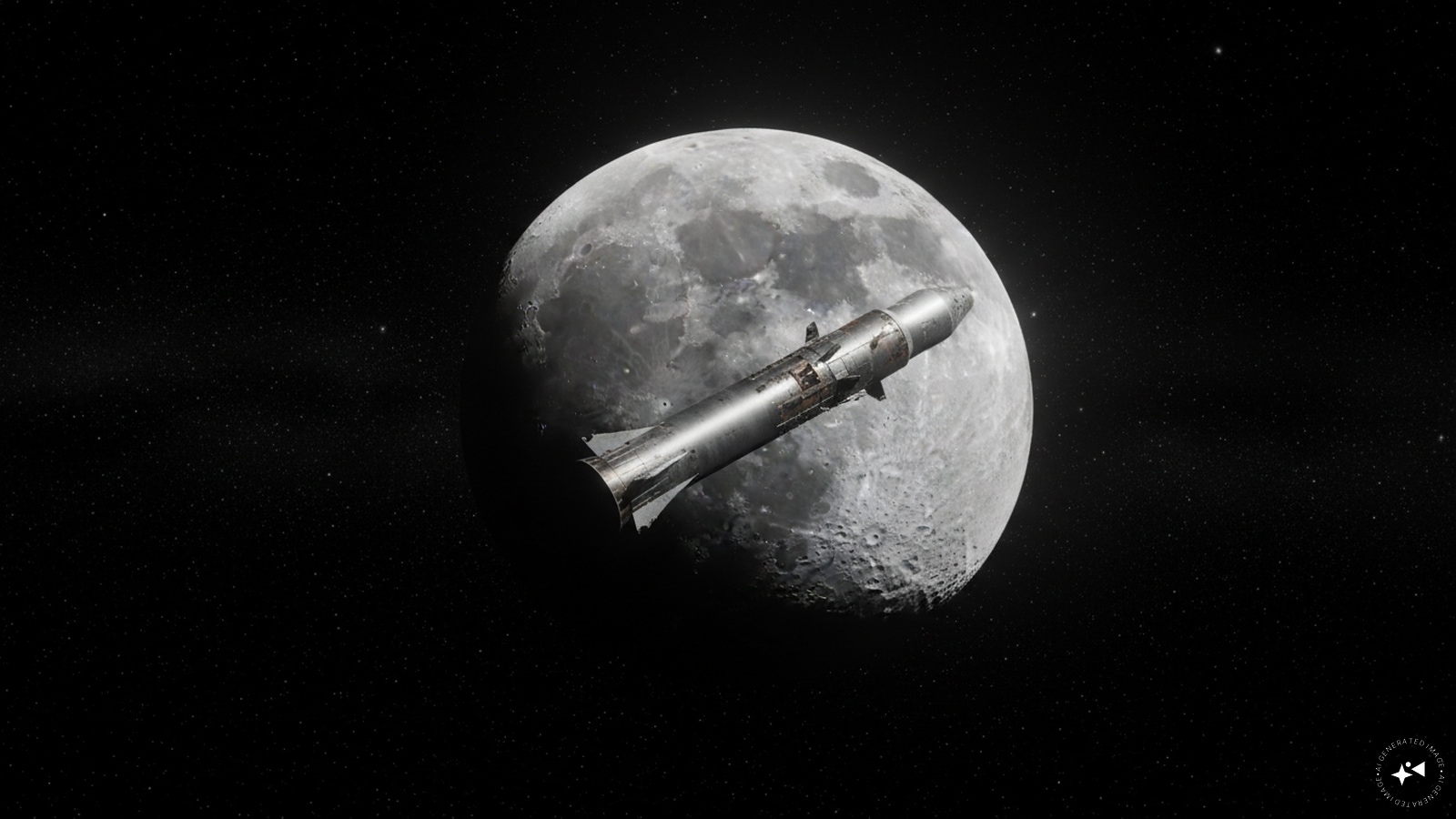
The headlines screamed about a rogue SpaceX booster careening toward the Moon like a cosmic bullet. Punctuation marks bled panic. Pious pundits wrung their hands over orbital debris, space trash, and the defilement of our pristine lunar neighbor. You read it, felt a familiar twinge of sci-fi dystopia, and nodded along with the lazy consensus that private enterprise is trashing the heavens.
You were sold a narrative built entirely on scientific illiteracy and pearl-clutching.
That discarded piece of metal striking the lunar surface wasn't a tragedy. It was a high-velocity impact experiment handed to us on a silver platter. Planetary scientists would normally have to spend half a billion dollars and a decade of bureaucratic wrangling to engineer an artificial impact of that scale. Instead, the universe dropped a four-ton kinetic hammer onto a basaltic plain, and we got a front-row seat for free.
Let us dismantle the hysteria.
The Geography of Orbital Garbage
First, get the pedigree right. The object in question was a Falcon 9 second stage from a 2015 Deep Space Climate Observatory (DSCOVR) launch. It did not bounce off Earth's atmosphere, it did not threaten the International Space Station, and it certainly did not pose a hazard to humanity. It drifted into a chaotic orbit around the Earth-Moon system, trapped in a gravitational tug-of-war until the moon well and truly caught it.
When it hit, it traveled at roughly 2.5 kilometers per second. That sounds terrifying until you understand what the Moon deals with on a daily basis.
The Moon is a cosmic pin cushion. It has been battered by high-speed impactors for four and a half billion years. Micro-meteorites pepper it constantly. Every single day, tons of space debris hit the lunar surface without an atmosphere to slow them down. A four-ton piece of hollow aluminum-lithium rocket alloy is a drop in an ocean of hyper-velocity violence. It left a crater roughly twenty meters wide. To put that in perspective, the lunar surface covers nearly 38 million square kilometers.
Calling this an ecological disaster is like accusing someone of dirtying the Pacific Ocean by spitting in it.
Why the Panic Industry Loves a Boogeyman
The media loves a space junk panic because it marries two very profitable anxieties: corporate overreach and environmental doom.
I have watched aerospace companies burn billions of dollars trying to solve problems that regulators invented in a conference room. Every time a rocket stage leaves low Earth orbit, committees start hyperventilating about Kessler Syndrome. Now, let us be precise. Kessler Syndrome is a very real, very terrifying threat in Low Earth Orbit (LEO). In LEO, thousands of satellites zip around at seven kilometers per second, where a collision creates shrapnel clouds that turn orbit into a shooting gallery.
Cis-lunar space is not low Earth orbit.
The space between Earth and the Moon is unimaginably vast. The probability of an object colliding with another piece of debris out there is close to zero. Treating an abandoned booster heading toward deep space with the same panic as a dead satellite clogging a critical orbital slot in LEO is pure category error. It is a sign of analysts who learned orbital mechanics from Hollywood blockbusters rather than physics textbooks.
The Gift of the Crater
What did we actually gain from this impact? We gained ground-truth data on planetary geology.
When a rocket body impacts a celestial body, it behaves differently than a natural asteroid. We know the exact mass, the exact composition, the exact structural integrity, and the exact velocity of that Falcon 9 stage. We know it was mostly empty fuel tanks and heavy rocket engines.
When astronomers look at the resulting double crater through spectroscopic instruments, they are calibrating their models for how planetary crusts respond to hyper-velocity impacts. We learned something about the subsurface density of the lunar regolith at that specific coordinate. Planetary defense agencies like NASA and ESA spend years trying to model kinetic impactors—think of the DART mission that smashed into an asteroid to test deflection techniques. Every real-world data point we collect on how dead metal deforms rock is a priceless brick in the foundation of future space operations.
We did not trash the Moon. We punch-tested it.
The Real Orbital Threat Nobody Mentions
If you want to panic about space debris, look down, not up.
Stop worrying about the deep space wanderers and start paying attention to the low-altitude graveyard orbits and the mega-constellations currently choking our skies below 600 kilometers. That is where the operational risk lives. That is where dead communications satellites and untracked paint flecks threaten to blind our astronomical instruments and take out billion-dollar weather monitoring assets.
The obsession with the lunar booster was a distraction. It allowed people who do not understand orbital energy states to feel righteous indignation about corporate waste while ignoring the actual logistical nightmares unfolding right above our heads.
Space is not a pristine museum display case. It is a violent, dynamic, high-energy environment. We are an spacefaring species now, which means we need to graduate from treating every piece of stray hardware like a sacrilege.
The booster hit the dust. The dust settled. The science was gathered.
Get over it.