Every few months, tech media loses its collective mind over a mechanical biped sprinting down a straight track. The headlines write themselves: a robot sprinter shatters a 100-meter record, sparks fly, metal joints flex, and PR teams pop champagne. The lazy consensus says we are watching the dawn of a new athletic era, that humanoid mobility is finally arriving, and that Usain Bolt should start looking over his shoulder.
It is absolute theater. And it is completely useless engineering.
I have spent the last decade watching venture capitalists throw billions of dollars at bipedal locomotion vanity projects. They fund spectacle because spectacle sells micro-transactions on social media. Meanwhile, the actual logistics and manufacturing floors are drowning in simple, boring problems that a $50 wheeled cart solves better than a million-dollar biped ever could.
Building a machine that can run a straight line on flat rubber without snapping its own actuators is not a breakthrough. It is a party trick.
The Physics Fallacy Of Bipedal Speed
Let us look at the mechanics. Human sprinting is an exercise in controlled falling, energy storage in elastic tendons, and massive ground-reaction forces managed by neural feedback loops operating at millisecond speeds.
When a humanoid robot tries to replicate this, engineers face a brutal mathematical wall. Electric motors are heavy. Batteries are dense and lack energy density compared to a turkey sandwich and a glucose stream. To make a machine accelerate hard enough to break a sprint record, you need immense torque. That requires heavy gearboxes. Heavy gearboxes mean high inertia. High inertia means when the robot trips—and it will trip—it does not just fall; it self-destructs.
The competitor articles love to focus on the top speed or the raw seconds shaved off a timer. They never talk about thermal throttling. Most of these record-breaking runs are single-effort stunts. The robot sprints for ten seconds, and then its speed controllers overheat, or its lithium pack sags under the amperage spike.
Ask yourself a simple question: What happens when you ask that same robot to run a 100-meter dash, turn around, walk back, and do it again fifty times without a fifteen-minute cool-down period and a complete software reboot?
It melts. Or it snaps a titanium-aluminum ankle bracket.
We are measuring progress with the wrong yardstick. A 100-meter dash is a legacy metric designed for biological organisms with a specific center of mass and compliant biological tissue. Forcing a machine to mimic that arbitrary geometry is like designing a car with mechanical legs because horses used to pull carriages.
Why Wheels Won The War And Why Labs Refuse To Admit It
Nature uses legs because biological evolution cannot evolve a continuous rotary axle. Biology does not have bearings that can handle high-speed rotation without a blood supply to cool them.
We, however, do.
Wheels and continuous tracks are mathematically superior for almost every terrestrial transport task ever invented. They distribute load, they require fewer moving parts, they have dramatically higher energy efficiency, and they do not require a supercomputer just to keep from falling over while standing still.
Yet, labs keep building humanoids. Why? Because a warehouse floor does not care about your humanoid aesthetic.
I've watched logistics companies blow millions on pilot programs featuring bipedal stock pickers, only to quietly pivot back to autonomous mobile robots with differential drive wheels. Why? Because the biped breaks down every four hours, requires specialized maintenance technicians who charge three hundred dollars an hour, and moves at the speed of a cautious toddler on ice.
The obsession with the robot sprinter stems from a fundamental misunderstanding of utility. We want science fiction. We want C-3PO jogging down the hallway. Because human imagination is lazy, we assume the machine must look like us to work for us.
It is the exact opposite. The best machines look nothing like us because they are optimized for physics, not nostalgia.
The Real Breakthrough Is Being Ignored
While the media chases the shiny object of a bipedal robot crossing a finish line, real engineering breakthroughs are happening in places that never trend on social media.
We are seeing advancements in tactile sensing arrays, decentralized actuator control, and ultra-lightweight carbon composites that actually reduce energy consumption. But none of those things make good video clips. You cannot package a revolutionary algorithmic torque-vectoring update into a twelve-second TikTok that gets a million likes.
When a robot breaks a sprinting record, it proves one thing only: the engineers programmed a rigid open-loop trajectory well enough to keep it upright for five seconds on a predictable surface. It has nothing to do with intelligence, adaptability, or real-world capability.
If you put that same sprinting robot on a gravel path with a slight slope and a patch of oil, it would fold like a cheap lawn chair.
Stop Designing For The Timeline Start Designing For The Factory
If we want useful machines, we need to abandon the humanoid fetish.
The companies winning in automation right now are not the ones building bipedal sprinters. They are the ones building task-specific form factors that leverage multi-axis arms, omni-directional wheels, and passive compliance. They build things that look like industrial appliances because industrial appliances do not need a PR department to justify their existence.
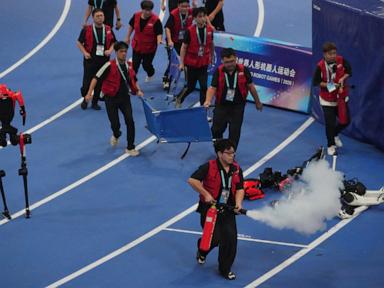
The next time you see a headline about a machine shattering a running record, look past the sparks. Ask what problem it solved. Ask what it costs to build, what it costs to maintain, and how long it can run before it needs a fire extinguisher.
You will find there is nothing there. Just expensive metal falling forward very, very fast.
Stop funding the circus. Build the machine.