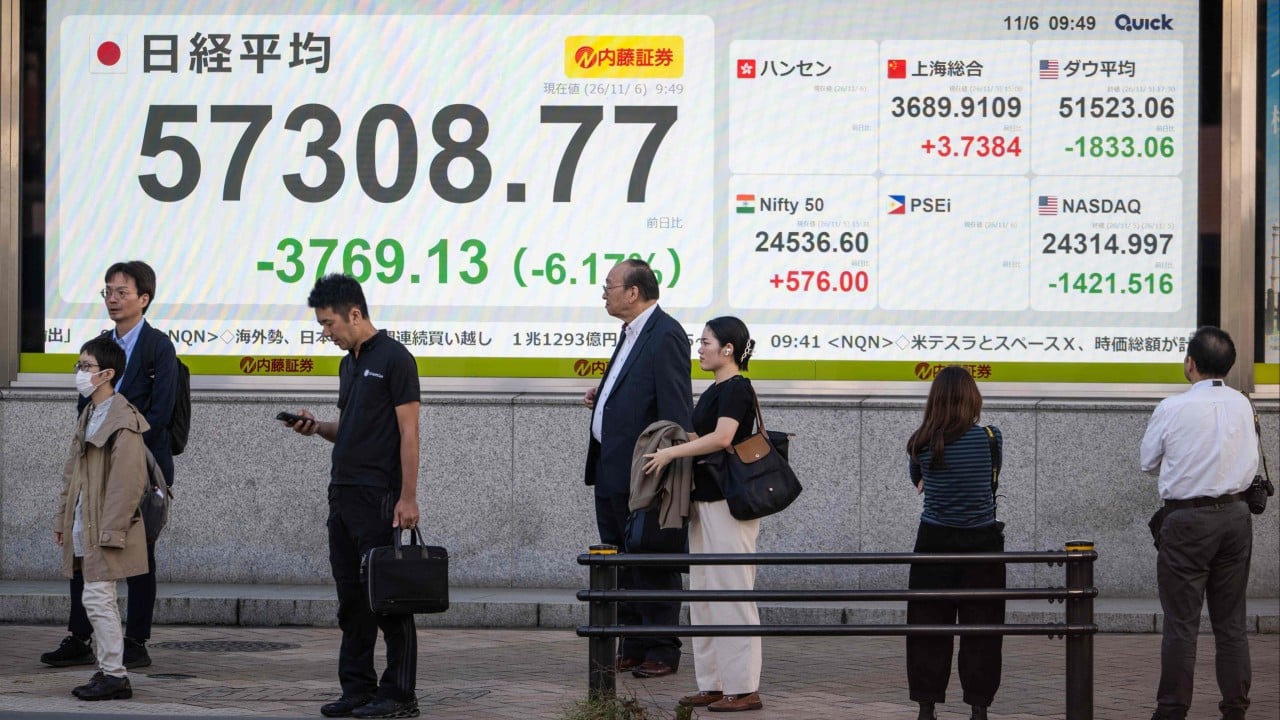
Every time Asian semiconductor equities take a nosedive right after a Washington election cycle, financial reporters reach for the same tired playbook. They blame geopolitical uncertainty. They point at tariff rhetoric. They wring their hands over post-midterm regulatory gridlock and claim that sudden "AI worries" are spooking institutional desks in Tokyo and Seoul.
It is lazy journalism. Worse, it is expensive advice if you actually manage capital. For a more detailed analysis into this area, we suggest: this related article.
When shares of memory giants, lithography suppliers, and testing equipment makers bleed red in the Nikkei and the KOSPI following a US midterm election, Washington is merely the excuse, never the catalyst. Institutional algorithms need a narrative trigger to execute profit-taking rotations that were scheduled months in advance. If you believe a handful of congressional committee shakeups suddenly invalidated the multi-year capital expenditure roadmaps of hyperscale data centers, you do not understand how hardware supply chains actually function.
The Washington Red Herring
Let us look at the mechanics of what actually happens during these post-election selloffs. Political commentators love to imagine that a shift in the House or Senate immediately threatens export controls, CHIPS Act subsidies, or cross-border semiconductor licensing. The reality on the ground in Hsinchu, Suwon, and Tokyo is entirely different. For broader information on the matter, extensive analysis can also be found on MarketWatch.
- Capex cycles move in three-to-five-year arcs, not two-year election cycles. A fab does not pour concrete, install extreme ultraviolet lithography machines, and calibrate cleanrooms based on who won a swing district in Pennsylvania.
- Export controls are bipartisan consensus. Whether Democrats or Republicans hold the gavel, the strategic containment of advanced compute hardware remains identical. Markets priced that reality in years ago.
- Subsidy clawbacks are a myth. Once federal grants are obligated and matched by private balance sheets, reversing them triggers legal warfare that neither party has the appetite to fight.
I have sat across from portfolio managers in Singapore and Hong Kong who blew millions chasing these political shadows. They dumped high-margin Asian equipment makers the morning after US election results came in, convinced that new congressional oversight would choke off AI server demand. Six weeks later, they had to buy those exact same shares back at a twelve percent premium once quarterly foundry utilization rates proved that order books hadn't budged by a single wafer.
What Actually Pummels Tokyo and Seoul
If Washington politics isn't driving the selloff, what is? Look at the unglamorous, brutal physics of hardware economics: inventory digestion, currency carry trades, and depreciating silicon.
The Yen and Won Liquidity Trap
Asian tech equities do not trade in a vacuum; they trade as high-beta proxies for global currency liquidity. US midterm elections almost always coincide with shifting Treasury yield expectations as bond markets reprice fiscal spending projections. When US yields spike or flatten unexpectedly, the US dollar moves sharply against the Japanese yen and the South Korean won.
For foreign funds holding massive positions in Tokyo-listed semiconductor equipment firms or Seoul-listed high-bandwidth memory manufacturers, currency volatility forces immediate risk-off rebalancing. When a fund manager in New York sees currency headwinds eating into their unhedged Asian returns, they hit the sell button on their most liquid winners. AI hardware stocks happen to be the most liquid winners on the board. The headlines blame "AI worries," while the trading desk is actually managing foreign exchange exposure.
The Silicon Depreciation Wall
There is a deeper, structural tension inside the AI hardware trade that mainstream financial press routinely ignores. Hyperscalers are spending tens of billions of dollars on GPU clusters and custom ASICs. Yet, the software revenue generated directly by those clusters still lags behind the hardware outlay.
Every six months, institutional investors run a simple sanity check on capital efficiency. They look at the massive capital expenditures flowing into South Korean high-bandwidth memory and Japanese wafer fabrication equipment, and they ask a blunt question: Where is the enterprise software cash flow to pay for the next upgrade cycle?
When that gap looks too wide, smart money trims hardware exposure. They rotate out of pure-play chipmakers and move into power infrastructure, cooling systems, or enterprise software firms that actually capture the margin. Timing that rotation right after a major political event provides convenient cover, allowing funds to exit crowded trades without triggering a panic among retail holders.
Dismantling the Investor Panic
When markets drop, retail investors and junior analysts flood search engines with predictable, flawed questions. Let us break down what people usually ask during these dips—and why the premise of those questions is usually broken.
Are US export restrictions killing Asian chipmakers?
This question assumes Asian suppliers are helpless bystanders dependent on unrestricted access to every global buyer. In truth, restricted markets have already been stripped out of forward revenue guidance by every major firm from Tokyo Electron to SK Hynix. Furthermore, export restrictions artificially tighten global supply for advanced nodes, which actually increases pricing power for the remaining compliant buyers. Restriction creates scarcity, and scarcity protects gross margins.
Is the AI hardware boom finally peaking?
Asking if AI hardware is peaking confuses a digestive pause with a structural collapse. Semiconductor markets are notoriously cyclical. Even during massive secular expansions—like the smartphone buildout of the 2010s or the cloud migration of the late 2010s—chip stocks regularly suffered twenty to thirty percent drawdowns every eighteen months. Customers buy aggressively, pause to integrate and deploy the hardware they just bought, and then resume ordering. Calling a routine digestion quarter "the end of the boom" is amateur hour.
Should you rotate out of Asian tech into US software after midterms?
Blindly rotating across borders based on political calendars is a guaranteed way to buy high and sell low. US software companies cannot scale without the physical compute layer built in East Asia. If Asian foundries and memory makers truly entered a terminal decline, US cloud and software giants would hit a physical compute wall within two quarters. You cannot separate the brains from the nervous system.
The Uncomfortable Truth About Memory and Equipment
To understand why Seoul and Tokyo react so violently to minor shifts in sentiment, you have to understand where they sit in the value chain. They are the picks and shovels of the compute economy, which is both a blessing and a curse.
In a gold rush, selling shovels guarantees early profits. However, once every miner on the mountain owns two shovels, shovel sales stall until the first batch breaks. High-bandwidth memory, advanced packaging substrates, and extreme ultraviolet photoresists operate under ruthless supply-and-demand elasticity. A two percent drop in projected server shipments at the hyperscale level translates into a ten percent drop in component orders upstream—a phenomenon supply chain economists call the bullwhip effect.
As Martin Christopher, emeritus professor of marketing and logistics at Cranfield School of Management, famously documented in his research on supply chain dynamics, small fluctuations in end-consumer demand amplify exponentially as they move upstream toward raw materials and equipment manufacturers.
When a US cloud provider delays a data center deployment by just sixty days—perhaps waiting on local power grid interconnects rather than anything happening in Washington—that delay ripples backward. First, it hits the server assemblers. Next, it hits the foundry. Finally, it slams into the Japanese chemical suppliers and Korean memory fabs. By the time the stock market notices, the shares in Tokyo and Seoul are already pricing in a phantom recession.
The Contrarian Playbook
If you want to survive—and profit from—these manufactured panics, stop reading political tea leaves and start tracking physical bottlenecks. Here is how institutional insiders actually play post-election Asian tech selloffs:
- Ignore the macro headlines and watch spot memory prices. DRAM and NAND spot prices do not lie. If equity prices in Seoul are plunging while spot memory prices remain flat or tick upward, the equity selloff is purely technical noise. Buy the divergence.
- Track lead times on lithography and testing equipment. If Japanese equipment makers still have order backlogs stretching twelve to eighteen months out, near-term stock dips are liquidity events, not fundamental deteriorations.
- Watch power and transformer backlogs. The real bottleneck in AI deployment today is not politics or even silicon—it is electrical grid capacity and high-voltage transformers. If utility bottlenecks ease, deferred chip orders snap back violently.
The Risk You Have to Own
Even the sharpest contrarian thesis carries real downside, and pretending otherwise is dishonest. Betting against a sentiment-driven selloff in Asian semiconductors requires surviving severe short-term volatility.
Because foreign institutional ownership in top Korean and Japanese tech names often exceeds forty to fifty percent, these stocks act as automated teller machines whenever global hedge funds face margin calls elsewhere. You can be dead right about five-year silicon demand and still watch your position drop another fifteen percent over three weeks simply because a multi-strategy fund in London needed to raise cash. If your time horizon is measured in days rather than quarters, the market's irrationality will liquidate you before your thesis plays out.
Stop Trading the Noise
The financial media needs a daily villain to explain red numbers on a screen. Following a US midterm election, blaming Washington politics for a slump in Tokyo and Seoul is easy, clickable, and completely detached from reality.
Chips do not care who controls the House Ways and Means Committee. Electrons do not slow down because a senator gave a speech about domestic manufacturing. Compute demand is governed by thermodynamics, power grids, wafer yields, and balance sheet math.
Next time you see headlines claiming that American political drama is destroying Asian tech stocks, close the browser tab, pull up the forward order backlogs and memory spot prices, and take the other side of the trade.