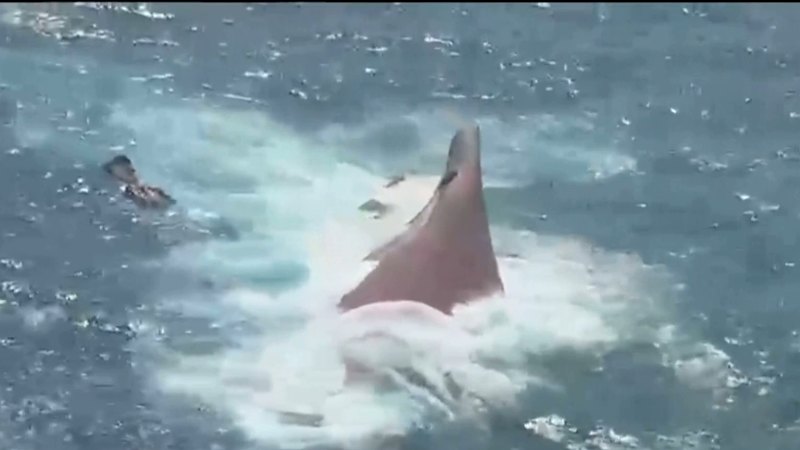
Every time an overcrowded passenger ship rolls over in the Java Sea or capsizes off the coast of Sulawesi, the media script is depressingly identical. Meteorologists point to high waves, local officials mutter about rogue operators, and Basarnas launches frantic helicopter sweeps while grieving families crowd port terminals holding laminated photographs. Editorial boards publish solemn columns about maritime safety enforcement in an island nation spanning thousands of miles.
Everyone nods solemnly. Everyone agrees that something must change. And nothing changes.
That is because the standard narrative is a comforting fairy tale. It allows regulators, operators, and observers to point fingers at sudden squalls and bad luck, absolving them of systemic complicity. Weather does not capsize a properly engineered and ballasted vessel operating within safe loading thresholds. Waves are a constant variable in archipelagic navigation; they are not an unpredictable anomaly. When a ferry rolls over because of a 2.5-meter swell, the failure happened long before the ship ever cleared the harbor breakwater.
I have spent years analyzing maritime logistics across Southeast Asia, watching operators juggle impossible financial equations while regulators look the other way until a tragedy forces a temporary crackdown. I have seen companies burn through capital trying to maintain aging hulls while state-mandated ticket caps strangle their operating margins.
To understand why rescue agencies are perpetually searching for missing souls across the Indonesian archipelago, you have to strip away the emotional noise and examine the brutal economic and structural reality that mainstream reporting consistently ignores.
The Myth of the Rogue Operator
The lazy consensus is that these disasters are driven by greedy, corner-cutting captains defying common sense and loading vessels until the gunwales touch water. While rogue operators certainly exist, framing this as a rogue problem is intellectually lazy. It treats systemic failure as individual moral depravity.
When a passenger ship leaves port with twice its authorized manifest, ask yourself a basic question: why did port authorities wave it through? Why did ticket vendors operate openly in broad daylight?
The answer is simple. The system relies on over-capacity to function.
Indonesia is an archipelago of more than 17,000 islands where maritime transit is the economic lifeblood for millions who cannot afford air travel. Ferries are the equivalent of commuter buses and interstate freight trucks combined. But governments across the region have historically enforced strict price controls on passenger tickets to keep travel affordable for rural populations.
At the same time, global fuel prices fluctuate wildly, maintenance parts are priced in hard currencies, and dockside fees climb year after year.
Imagine a scenario where a ferry operator is legally mandated to charge a flat, heavily suppressed ticket price for a twelve-hour crossing, while diesel costs double and marine insurance rates spike. The math does not work. Operating a vessel at exact legal capacity under those financial conditions guarantees bankruptcy.
Overcrowding is not an accidental oversight by a careless crew. It is the hidden economic subsidy that keeps domestic maritime transport solvent. The extra passengers and cargo stacked on the upper decks represent the exact margin between staying in business and liquidation. When regulators pretend that enforcement alone can solve this, they are treating a gunshot wound with a bandage. You cannot police away an economic necessity. If you criminalize the only margin keeping a route alive without subsidizing the deficit, operators will simply take greater risks to hide their overloads.
The Physics of Architectural Collapse
Let us talk about the engineering reality that gets buried beneath emotional human-interest reporting. When a ship capsizes rather than sinks—such as vessels found floating upside down with air pockets trapped in their hulls—the culprit is almost always compromised stability metrics.
Naval architecture relies on the concept of metacentric height, which measures the initial stability of a floating body. When you stack passengers, motorbikes, commercial freight, and unverified deck cargo onto a superstructure, you raise the vessel's overall center of gravity.
As the center of gravity climbs, the righting arm shrinks. Under calm conditions, the ship feels sluggish but stays upright. Introduce a routine Java Sea swell or a sudden wind shear, and the elevated weight shifts violently to one side. The hull loses its restoring torque. Once the angle of heel exceeds the critical threshold, water floods the main deck through unsealed vehicle ramps or ventilation ports, and the ship turns turtle in minutes.
The common public misconception is that ships sink because water fills the bottom. In these archipelagic disasters, ships capsize because top-heaviness destroys their natural equilibrium long before the hull breaches.
This is where the standard safety inspections fail catastrophically. Port authorities check paperwork. They count life jackets stacked in shrink-wrap in storage lockers. They rarely inspect the actual weight distribution, cargo lashing discipline, or ballast tank levels. A piece of paper signed by a harbor official certifying that a ship is safe to sail is entirely worthless if the cargo loader stacked fifty tons of bulk goods on the top deck to maximize freight fees.
The Bureaucratic Tollbooth
Regulatory agencies like Basarnas and the Ministry of Transportation perform heroic work when disaster strikes, deploying naval vessels, helicopters, and dive teams to scour rough waters for survivors. Their search and rescue operations are executed under brutal conditions, battling high winds and dangerous currents. But their institutional mandate is reactive, trapped downstream from systemic failures they have no power to fix.
Upstream, the regulatory apparatus functions less like an engineering safety guarantor and more like a bureaucratic tollbooth.
Compliance is often treated as a transactional hurdle. Obtaining safety certifications involves navigating layers of administrative fees and inspections where stamps can be acquired through unofficial channels if an operator knows the right local friction points. When compliance becomes a cost center rather than a verifiable engineering standard, safety culture evaporates.
Furthermore, enforcement agencies are politically captured. In many regional ports, local economic stability depends entirely on the continuous movement of goods and people. If a stringent port captain decides to ground every vessel that fails strict stability audits, local commerce halts instantly. Supply chains freeze. Food prices spike on outer islands. Politicians panic, call the harbor master, and pressure mounts to ease restrictions.
The safety audit becomes a theater of compliance. Everyone plays their assigned role: the operator signs the manifest, the official stamps the paper, the passengers board, and everyone crosses their fingers that the weather holds. When it does not, the same officials who signed off on the compromised departure hold somber press conferences expressing shock.
Dismantling the Rescue Fetish
There is another uncomfortable truth we need to confront: our collective obsession with search and rescue operations.
When a ferry goes missing or capsizes, media coverage immediately pivots to the drama of the search. We track the number of naval ships deployed, the flight hours of surveillance helicopters, and the miraculous survival stories of passengers who clung to floating debris for thirty hours.
While every saved life is a victory for the rescue crews, this relentless focus on rescue creates a dangerous moral hazard. It turns maritime disasters into a spectator sport of survival rather than an indictment of systemic failure.
We romanticize the heroism of the divers and the resilience of the survivors while ignoring the fact that prevention is infinitely cheaper, safer, and morally superior to pulling bodies from a wreck. Every dollar spent on massive multi-agency search operations after a catastrophe is a confession of failure upstream.
If governments redirected a fraction of the resources currently poured into emergency rescue infrastructure toward mandatory structural redesigns, real-time telemetry loading monitors, and direct public operational subsidies for remote island routes, the disasters would plummet. But emergency response makes for compelling television; quiet regulatory enforcement and infrastructure funding do not.
What Real Reform Requires
If we are serious about stopping the recurring cycle of maritime tragedies across island nations, we have to stop offering polite recommendations and start dismantling the structural incentives that breed danger.
First, dismantle flat-rate price controls on essential maritime routes unless the state is willing to fully subsidize the delta between operating costs and capped revenue. You cannot legislate economic reality out of existence. If the cost of moving a human being safely from point A to point B is a specific amount, someone has to pay it. If the passengers cannot afford it and operators cannot absorb it, the government must cover the gap as public infrastructure, exactly as it does for rural highway maintenance or bridge construction.
Second, automate and decentralize load monitoring. Stop relying on manual manifests filled out by clerks at ticket counters. Every commercial passenger vessel should be fitted with load-cell sensors connected to automated ballast systems and GPS telemetry that transmit real-time weight distribution directly to an independent maritime oversight body. If a vessel exceeds its stability threshold, the automated system locks port departure clearances. Take human discretion and bureaucratic bribery out of the equation entirely.
Third, criminalize corporate negligence with penalties that pierce corporate veils. When an overloaded ship rolls over due to compromised stability, the penalty cannot be a modest fine or the suspension of a minor permit. It must involve direct personal and criminal liability for executives and operators who treat passenger safety as an acceptable variable in their profit calculation.
Until these structural changes occur, every search operation launched in the wake of another capsized hull is merely a high-tech cleanup crew for a disaster manufactured by economic neglect and regulatory cowardice.
Stop blaming the wind. Stop acting surprised when the math catches up with the water. Fix the economics, enforce the physics, or accept the grim reality that the next tragedy is already scheduled for departure.