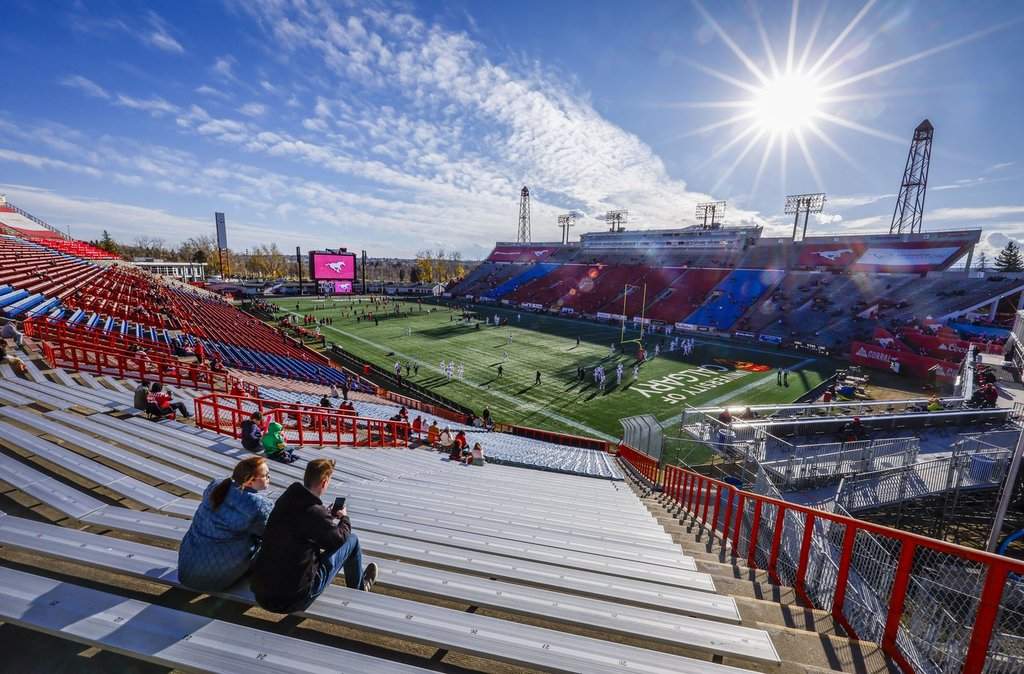
Every time the Grey Cup rolls through Calgary, the exact same chorus of local pundits, sports radio hosts, and civic boosters starts singing from the same tired hymnal. They look at 66-year-old McMahon Stadium, wrinkle their noses at the concrete concourses, complain about the bathroom lines, and declare that Calgary is falling behind. They point to Regina’s Mosaic Stadium. They point to Winnipeg’s Princess Auto Stadium. They point to the shiny new Scotia Place rising for the Flames. Then they deliver the punchline: taxpayers need to write another nine-figure cheque to build a brand-new football stadium.
They are completely wrong.
Building a new stadium for the Calgary Stampeders and the University of Calgary Dinos is not a civic necessity. It is a generational financial trap disguised as civic pride. The lazy consensus says McMahon is an embarrassment that must be bulldozed to save professional football in southern Alberta. The reality of modern sports economics says that replacing a paid-off, structurally sound outdoor venue with a $500-million debt anchor would do more to kill the franchise than a decade of bad quarterbacks.
The Myth of the Crumbling Concrete Bowl
Let’s separate aesthetic snobbery from structural engineering. McMahon Stadium opened in 1960. It was built in 103 days for $1.05 million. It is a classic, utilitarian, open-air concrete bowl. Does it have heated luxury skyboxes with private sommeliers? No. Does it have wrap-around LED ribbon boards that blind you from the upper deck? No.
What it does have is near-zero capital debt, prime real estate directly on the Red Line LRT, massive surface parking lots that actually allow for real tailgating, and sightlines that put fans closer to the turf than almost any modern bowl design.
I have watched municipal governments across North America fall for the "world-class facility" pitch, and I have watched them bleed money for thirty years afterward. When sports media talk about a stadium being "obsolete," they are rarely talking about safety or fan enjoyment. They are talking about ancillary revenue extraction—the industry term for squeezing an extra $45 out of every ticket holder through club-level surcharges, premium seat licenses, and corporate hospitality suites.
You do not need a half-billion-dollar monument to fix narrow concourses and outdated washrooms. You need targeted capital expenditure.
The CFL Math Nobody Wants to Do on the Radio
Here is the brutal math that stadium boosters conveniently ignore: the Canadian Football League is a gate-driven, regional broadcast league, not the NFL.
In the National Football League, franchises print money through national television contracts worth over $10 billion a year before a single fan walks through the turnstiles. In the CFL, national broadcast rights cover a fraction of a team’s operating budget. Teams survive on ticket sales, local sponsorships, and stadium concessions.
Look at what happened when other CFL cities took the plunge on new builds:
- The Debt Service Trap: Mosaic Stadium in Regina cost roughly $278 million when it opened in 2017. In 2026 dollars, accounting for post-pandemic construction inflation, supply chain markups, and commercial borrowing rates, a comparable 33,000-seat open-air stadium in Calgary would easily clear $550 million to $650 million. If you put a roof on it—which Calgary’s November weather always tempts politicians to consider—you are staring down a $1 billion price tag.
- The Utilization Problem: A football stadium sits empty 345 days a year. The Stampeders play nine regular-season home games and one preseason game. Add in a potential playoff game, a handful of University of Calgary Dinos games, and maybe two summer stadium concerts. You are spending upwards of $600 million for an asset that generates primary revenue roughly 15 to 18 times a year.
- The Ticket Price Death Spiral: When a team moves into a new venue, ticket prices jump to service the debt and justify the "upgraded experience." In a market where the Stampeders have already struggled to consistently sell out McMahon’s 35,400 seats over the past few seasons, raising average ticket prices by 30% to pay for cup holders and wider aisles is commercial suicide.
Economists like Roger Noll at Stanford and Andrew Zimbalist at Smith College have spent decades studying public stadium subsidies. Their findings are unanimous and devastating: new sports stadiums do not generate net new economic growth for a city. They merely cannibalize existing entertainment spending. Money spent on a Friday night Stampeders ticket and a $14 beer is money not spent at a restaurant on 17th Avenue or a pub in Kensington.
The Scotia Place Hangover
Timing matters in municipal politics, and Calgary’s timing could not be worse for a stadium handout.
The City of Calgary, the Province of Alberta, and Calgary Sports and Entertainment Corporation (CSEC) are already deep into the financial commitment for Scotia Place, the new NHL arena replacing the Scotiabank Saddledome. Between the arena itself, infrastructure upgrades, demolition costs, and surrounding public realm investments, public entities are already on the hook for hundreds of millions of dollars.
Asking Calgary taxpayers to fund a second major sports venue while the concrete is still curing on the first one is politically toxic and fiscally reckless. Yet, whenever the Grey Cup comes to town, the league office and local commentators treat the event like an audit of Calgary’s civic self-worth.
They ask, "How can Calgary host the Grey Cup in a 66-year-old stadium?"
The answer is simple: effortlessly. McMahon Stadium has hosted multiple Grey Cups, the 1988 Winter Olympics opening and closing ceremonies, and the 2011 NHL Heritage Classic. Fans do not fly to Grey Cup week to marvel at architectural steel trusses. They come for the festival, the parties, the history, and the football. When the game kicks off, nobody cares how old the concrete under their boots is—they care whether the beer is cold, the lines move fast, and the product on the field is worth watching.
Answering the Questions People Actually Ask
When fans and taxpayers debate McMahon’s fate, the conversation gets bogged down in false choices. Let’s dismantle the most common arguments head-on.
Does McMahon Stadium actually need to be replaced for safety reasons?
No. Old does not mean unsafe. The University of Calgary, which owns the facility through the McMahon Stadium Society, conducts regular structural inspections and maintenance. Concrete bowls built in the mid-20th century were over-engineered by modern standards. Worn-out plumbing, cramped concourses, and dated press boxes are operational annoyances, not structural failures. You do not tear down a house with a rock-solid foundation because you hate the 1970s kitchen cabinets.
Won't a new stadium bring bigger concerts and international events to Calgary?
This is the oldest lie in the stadium developer playbook. Tour routing for mega-stars like Taylor Swift or Metallica is dictated by geography, routing logistics, and market size—not whether your washrooms have touchless faucets. Furthermore, the 18,000-seat Scotia Place will already capture the vast majority of major indoor touring acts, while Commonwealth Stadium in Edmonton (capacity 56,000+) will continue to win massive summer stadium tours simply because it holds 20,000 more people than any realistic Calgary football stadium ever would. Building a 32,000-seat stadium in Calgary does not make the city competitive for global stadium tours; it just leaves you in an awkward no-man's-land too big for arenas and too small for mega-tours.
What about the Foothills Athletic Park redevelopment?
For years, CSEC and the city floated the "CalgaryNEXT" concept—a massive, multi-sport complex on the West Village site—which eventually died under the weight of its own $1.8 billion price tag and creosote contamination cleanup costs. Now, talk has shifted back to redeveloping the existing Foothills Athletic Park lands surrounding McMahon. While keeping the stadium on its current transit-connected footprint is infinitely smarter than moving it to a contaminated brownfield site, tearing down the existing bowl just to build a slightly shinier version of the exact same footprint is still a terrible allocation of capital.
The Contrarian Fix: Surgical Modernization
If you want to actually improve the fan experience at McMahon Stadium without bankrupting the franchise or fleecing taxpayers, stop thinking like a real estate developer and start thinking like an operator.
Imagine a scenario where Calgary takes $80 million—roughly 15% of the cost of a new stadium—and executes a surgical, ruthless modernization of McMahon over two offseasons.
Here is what that $80 million actually buys:
- Modular Concourse Expansion: Instead of tearing down the bowl, you build out the perimeter concourses using prefabricated steel structures. You double the square footage behind the stands, eliminating the halftime bottleneck where fans currently miss half the third quarter just trying to use the restroom or buy a hot dog.
- High-Throughput Plumbing and Concessions: Rip out every single washroom and concession stand down to the studs. Install modern, high-capacity facilities with frictionless grab-and-go checkout technology. Fan satisfaction in outdoor stadiums correlates directly with wait times, not architectural awards.
- Targeted Premium Inventory: You do not need 50 luxury suites that sit half-empty on a rainy Thursday night in October. You take a specific section of the lower or mid-bowl on the west side, install wider, heated seats with direct access to a renovated indoor club lounge, and price it for the corporate buyers who actually exist in Calgary’s post-consolidation energy sector.
- Acoustic and Visual Upgrades: Replace the sound system with modern directional line-array speakers so announcements are actually intelligible, upgrade the field lighting to broadcast-grade LEDs, and overhaul the locker rooms and training facilities so the Dinos and Stampeders have elite athletic infrastructure.
The Uncomfortable Truth About This Approach
I will be the first to admit the downsides of keeping and renovating McMahon.
First, a renovated 1960 stadium will never win an architecture award. It will never look like SoFi Stadium in Los Angeles or Allegiant Stadium in Las Vegas. If your primary goal as a civic leader is vanity—having a gleaming postcard backdrop for drone shots during a national broadcast—a renovation will leave you unsatisfied.
Second, McMahon will remain an open-air stadium in a northern city. In late October and November, fans will still have to dress for the weather. Some casual fans will inevitably stay home on their couches watching on 4K televisions when the temperature drops below minus ten.
Third, renovating an older structure always carries the risk of unforeseen engineering headaches once you start opening up walls and rerouting utilities.
Those trade-offs are real. They are also completely acceptable compared to the alternative.
Stop Confusing Real Estate With Football
The obsession with shiny new stadiums is a symptom of a sports industry that has forgotten what its actual product is. Great sports environments are built on tradition, community, affordability, and winning—not quartz countertops in the club lounge.
Look at college football across the United States. Programs like Michigan, Penn State, and Wisconsin play in massive, concrete bowls built in the 1920s with bench seating and zero luxury frills, yet they generate the greatest game-day atmospheres on earth because the experience is authentic and accessible to ordinary fans. Look at Lambeau Field in Green Bay, which has survived and thrived for nearly 70 years not by abandoning its historic concrete bowl, but by incrementally upgrading its perimeter concourses and fan amenities while preserving its soul.
Calgary already has a stadium with deep roots, unbeatable transit access, tailgating culture that is the envy of the CFL, and zero debt.
The next time a Grey Cup broadcast cuts to a panel of experts wringing their hands over the "future of McMahon Stadium," recognize the performance for what it is. It is not a serious infrastructure assessment. It is a lobbying effort to transfer hundreds of millions of dollars from public coffers into private construction contracts.
Keep the concrete. Fix the bathrooms. Upgrade the concourses. Drop the ticket prices. Fill the seats. The future of football in Calgary does not require a wrecking ball—it just requires the discipline to ignore the people begging for one.