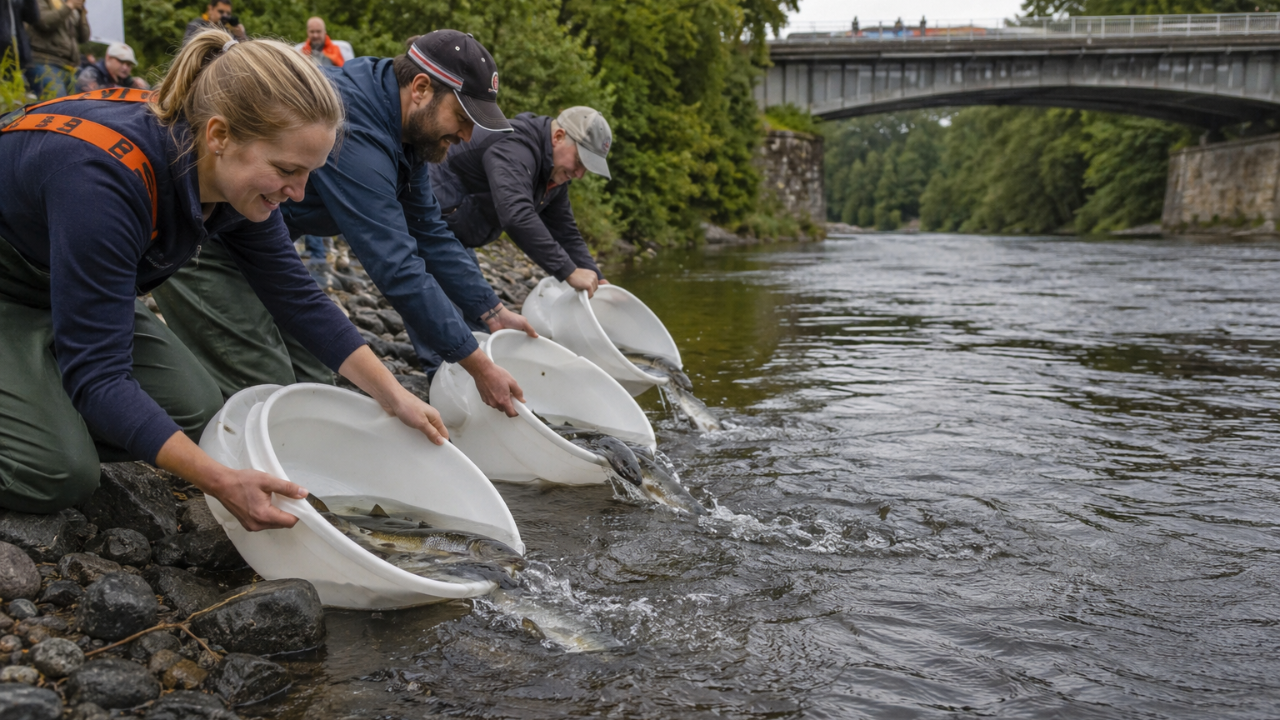
Walk past the Swedish Parliament or the grand Baroque walls of Stockholm's Royal Palace in late spring, and you might stumble onto a bizarre sight. People crowd around the stone embankments of Strömmen, watching thick plastic pipes pump thousands of squirming, silver flashes directly into the urban waterways.
It looks like a public stunt. It isn't. Every single year, the City of Stockholm intentionally releases roughly 10,000 sea trout and a massive influx of Atlantic salmon right into the heart of the capital.
Most major global cities treat their central rivers as industrial dumping grounds or scenic backdrops meant only for tour boats. Stockholm treats its water as a thriving wild habitat. If you want to understand how a modern metropolis can balance dense urban living with raw, wild nature, you have to look at what's swimming beneath the surface of the Swedish capital.
The 1973 Pact That Fixed the Water
This isn't a new eco-trend or a recent public relations campaign. Stockholm has been dropping juvenile fish into these waters since 1973.
Go back a few decades before the project started, and the picture wasn't so pretty. Industrial runoff and raw sewage had choked the life out of the city's central streams. You wouldn't want to touch the water, let alone eat anything swimming in it.
The city turned things around by overhauling its wastewater treatment facilities and cleaning up industrial practices. Once the water quality rebounded, fisheries officials realized they faced a different bottleneck: infrastructure.
Stockholm sits exactly where the massive freshwater Lake Mälaren flows out into the salty Baltic Sea. It's a natural bottleneck. Centuries of building dams, bridges, locks, and concrete retaining walls wiped out the shallow, gravelly shallows that migratory fish need to lay their eggs.
According to Oliver Karlöf, a fisheries consultant for the City of Stockholm, the wild populations simply can't handle natural reproduction alone anymore because the physical landscape has changed too much. If the city stopped stocking the water, the central migratory fish populations would collapse. The annual release keeps the biological ecosystem alive.
Rebalancing the Food Chain Right Under the Parliament
Throwing thousands of young fish into an urban stream sounds like a buffet invitation for local birds and seals. It's true that mortality rates are high, but the sheer volume ensures a resilient core survives.
These young fish, called smolts, are raised in specialized hatcheries until they're hardy enough for life in the wild. Once they hit the fast-moving currents of Norrström and Stockholms Ström, they head out toward the Baltic Sea to feed, grow, and mature.
This isn't just about giving tourists something cool to look at from the bridges. Salmon and sea trout are apex aquatic predators. By introducing a steady supply of these species, Stockholm manages the populations of smaller fish, like herring and sticklebacks.
It's a top-down ecological strategy. Strong predator numbers prevent smaller species from overgrazing on zooplankton, which in turn keeps algae blooms under control. The presence of these fish indicates a clean, balanced water column that ripples positively through the entire regional ecosystem.
Free World Class Sport Fishing with No License
The most practical byproduct of this ecological project is something that drives anglers from other countries crazy with envy. You can catch a twenty-pound Atlantic salmon right in front of the King's official residence, and you don't need to pay a single Krona for a license.
Angling in the central streams of Stockholm is completely free for the public. It's one of the few capital cities on earth where you can take the subway to work, hop off at Gamla Stan with a fly rod, and hook into a world-class sport fish during your lunch break.
The hot spots are easy to find. Fishermen regularly line up along the Strömparterren terrace, a small riverside park tucked between the Royal Palace and Parliament. When the water gates from Lake Mälaren open and the current rips through the concrete channels, the fishing hits its peak.
Because the drop from the stone piers to the water can be three to five meters high, landing a fighting salmon requires serious skill and a long-handled net. It's a communal sport; total strangers will routinely scramble down to help you land a catch.
How to Experience Stockholm's Wild Waters
If you want to see this urban fishery firsthand, you don't necessarily need to pack a tackle box. You just need to know where to look.
- Watch the Spring Release: Keep an eye on local Stockholm news outlets or municipal updates in late April and early May. The fish releases near the Royal Opera and the Royal Palace are open to the public, and watching the silver juveniles rush into the stream takes just a few minutes.
- Walk the Strömparterren: Head down to the waterfront benches below the Norrbro bridge. It's the absolute best vantage point to watch local fly fishermen wading into the fast currents right where the freshwater meets the sea.
- Rent a Kayak: If you want to get closer to the action, grab a rental kayak from central docks like Djurgården. You can paddle through the outer edges of the fishing zone and see the clarity of the water for yourself.
Stockholm's commitment to releasing thousands of fish every year shows that urban development doesn't have to mean ecological death. By maintaining this artificial lifecycle, the city keeps its historic core wild, vibrant, and remarkably alive.