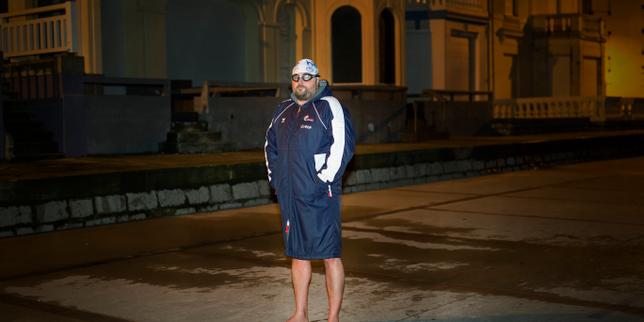
Most people treat swimming as a casual Saturday morning activity or a mild aerobic workout. For Stève Stievenart, it’s a high-stakes negotiation with mortality. You might know him as the Frenchman who churns through freezing water for days on end, but to the few who actually understand open-water extremes, he’s a benchmark.
Stève Stievenart, often called "Stève le Phoque" (Stève the Seal), isn't your typical athlete. He doesn't look like an Olympic swimmer crafted in a laboratory. He looks like a guy who knows how to survive. He understands that while others worry about their pace, he’s busy worrying about hypothermia, erratic currents, and the literal weight of his own body fighting the ocean.
The obsession with the Triple Couronne du Bout du Monde
Forget the standard "Triple Crown of Open Water Swimming" that most marathon swimmers chase. That involves the English Channel, the Catalina Channel, and the Manhattan circumnavigation. Those are popular, well-supported, and relatively controlled.
Stievenart aimed for something darker. He set his sights on the "Triple Couronne du Bout du Monde" (The Triple Crown of the End of the World). This isn't a leisure swim. It’s a gauntlet set at the literal bottom of the planet.
This challenge involves the Beagle Channel, the Strait of Magellan, and the Rio de la Plata. These waters are unforgiving. We’re talking about 8-degree Celsius water, unpredictable weather that shifts in minutes, and currents that can turn a swimmer around and spit them back out within seconds. When he conquered the Strait of Magellan recently, he described it as a "washing machine." He wasn't exaggerating. He spent nearly two hours battling, getting dragged by the tide, and fighting through thick kelp that threatened to snare him like a trap.
The cold reality of survival
If you want to understand why Stievenart succeeds where others fail, you have to look at how he manages his body. He’s famous for his approach to nutrition. He doesn't survive on energy gels and electrolyte drinks alone. He builds a layer of fat. It sounds counterintuitive in a world obsessed with shredded abs, but in the middle of a channel, body fat is life.
He adopted a nutritional strategy that mimics the physiology of the marine mammals he admires. This isn't about being lazy; it's about thermodynamics. When you are in water that hovers just above freezing, your core temperature is your biggest asset. If you burn through your reserves, your brain stops functioning. You don't just get tired; you become confused, clumsy, and then unconscious. Stievenart treats his body like an engine, carefully managing fuel, temperature, and mental focus.
The mental game of being alone
You can train your muscles for years, but the ocean doesn't care about your VO2 max. Marathon swimming is 90% psychological. When you are two miles out, freezing, with no land in sight, and the currents are pushing you the wrong way, your brain will scream at you to quit.
Stievenart handles this by stripping away the noise. He doesn't listen to music while he swims. He doesn't have a screen in front of his face. He is left with nothing but his own thoughts, his breathing, and the sound of the water. He practices meditation and mental discipline, which he likely honed during his earlier years in competitive sports like jet-skiing and marathon running.
This mental toughness is what differentiates a weekend warrior from a legend. He doesn't swim to set records; he swims to push the boundary of what he considers possible for his own life. It’s a brutal, honest pursuit.
Why this matters for the rest of us
You don't have to swim the Strait of Magellan to learn from Stève Stievenart. The value in his journey is the absolute commitment to a goal that most people would call insane.
Most of us quit when we get uncomfortable. When a project at work gets difficult, or a fitness routine stops feeling "fun," we look for the exit. Stievenart reminds us that discomfort is just data. It’s information telling you where your limits currently are, not where they have to stay.
If you ever find yourself facing a hurdle that seems insurmountable, remember the "washing machine" of the Strait of Magellan. He didn't quit when the currents pushed him backward. He kept swimming until the tide turned. He trusted his preparation and his body.
The water will always be cold, and the currents will always be unpredictable. You can’t control the ocean, but you can control how you prepare for it. Whether you are building a business, training for a race, or just trying to survive a bad week, the lesson remains the same. Manage your fuel, respect the environment, and keep your head in the game long after your body tells you to stop.
Stève Stievenart isn't a superhero. He’s just someone who decided that the only way to find out what he was capable of was to jump into the freezing dark and start swimming. You don't need a wetsuit to apply that kind of grit to your own life. You just need the willingness to endure the cold until you reach the other side.