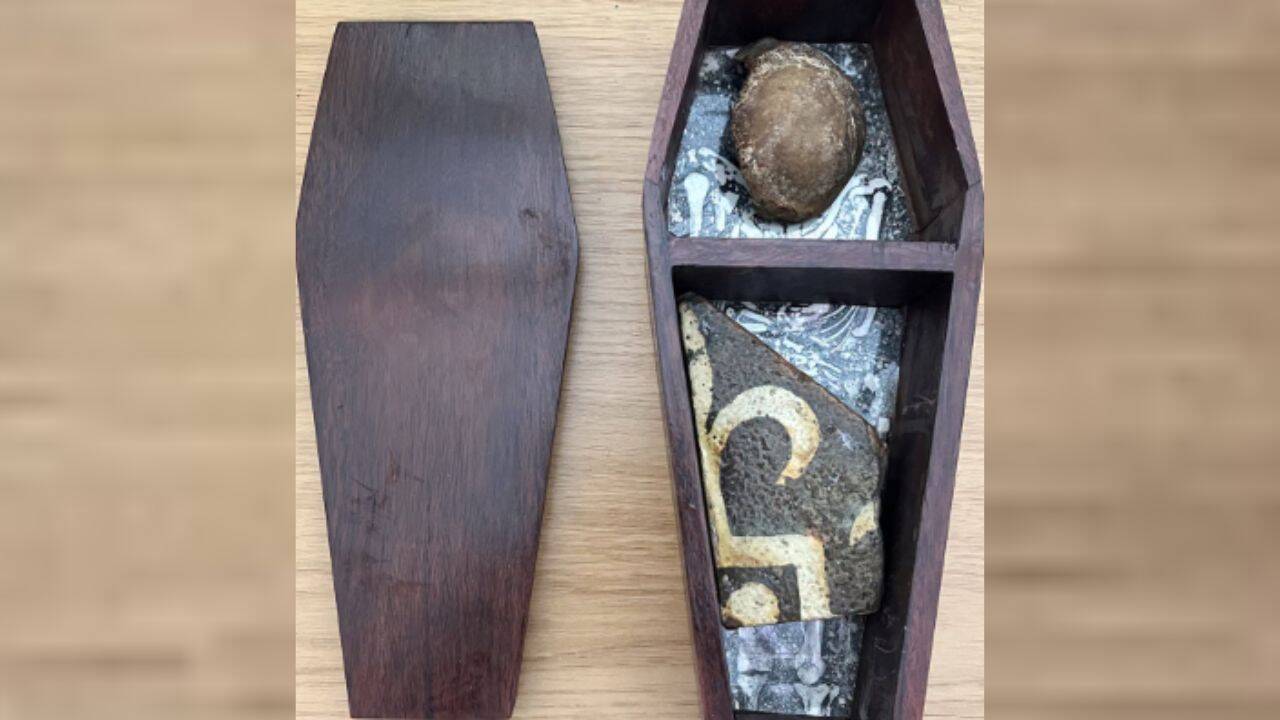
Everyone loves a neat, tidy morality tale. A kid does something stupid in 1956, pockets a 3,000-year-old human kneecap from a dusty display case, spends decades feeling guilty, and his widow dutifully hands the relic back to the institution so order can be restored to the universe. Headline writers salivate over this stuff. It checks every box for a heartwarming human interest story about accountability, heritage, and the sanctity of historical preservation.
It is also complete nonsense.
Let us look at what actually happened through an unfiltered lens. An eleven-year-old boy walked into an underfunded, half-ignored local archive in the mid-fifties, lifted a piece of skeletal anatomy that was likely sitting in an unsealed wooden tray with a faded paper label, and kept it safe in a drawer for seventy years. Meanwhile, thousands of actual artifacts in public trust institutions across the country during that exact era were being lost to bureaucratic incompetence, water damage, unrecorded deaccessioning, or outright dumpster disposal during basement cleanouts.
If you want to talk about custody, let us talk about institutional negligence. The lazy consensus says the boy committed a crime against history. The reality is that the boy accidentally rescued an anatomical fragment from decades of civic neglect, institutional apathy, and bureaucratic decay.
The Myth of the Pristine Archive
Walk behind the velvet ropes of any mid-tier regional museum, university basement, or historical society storage facility. I have spent my career auditing these spaces. What you find behind closed doors would shock anyone who believes museums are sterile, hyper-secured vaults of historical purity.
You find boxes of uncatalogued Roman pottery stacked against damp exterior walls. You find organic remains degrading under flickering fluorescent bulbs because the climate control system broke down during the Carter administration and nobody had the budget to fix it. You find provenance records written on cocktail napkins that vanished forty years ago.
When people hyperventilate over a stolen relic, they operate under a childish assumption: that institutions are inherently better caretakers of history than individuals. History tells us the exact opposite. Private collectors, eccentric hobbyists, and yes, even remorseful kids who pocketed a souvenir, have routinely preserved historical fragments that institutional gatekeepers allowed to rot, misplace, or forget.
Let us break down the standard narrative piece by piece and watch it crumble under the weight of actual archival history.
The Accountability Trap
The widow returning the kneecap is hailed as a triumph of moral clarity. She did the right thing. She handed back state property.
Ask yourself a brutal question: what is the museum going to do with it now?
Put it back in a drawer. Maybe, if they are lucky enough to secure a municipal grant that does not get slashed by next Tuesday, they will scan it into a digitized database that three researchers a year will look at. Or, more likely, it will sit in a conservation box for another century until a new wave of interns reorganizes the collection and wonders what random bone fragment is taking up space in drawer four.
Institutions love to claim moral high ground over rogue collectors, but their own preservation metrics are dismal. Millions of artifacts sit in purgatory, completely inaccessible to the public, gathering dust while administrators justify their existence through sheer inventory mass.
Imagine a scenario where every historical item locked away in a dark municipal basement was actually in the hands of someone who cared enough to look at it, dust it, and wonder about its story every single day. The cultural footprint of those objects would expand a thousandfold. Instead, we worship the concept of ownership over utility. We prefer objects to rot in a climate-controlled tomb rather than exist in the wild where human curiosity can actually interact with them.
The Real Crime Was the Security Theater
Let us address the 1956 angle. An eleven-year-old could walk up to a display and walk away with a human skeletal component. That is not a testament to the cunning of a middle schooler. That is a damning indictment of mid-century curatorial standards.
If a museum cannot secure its own physical perimeter against a pre-teen with zero specialized tools, they had no business holding human remains in the first place. Yet, whenever an item goes missing, the blame is uniformly funneled onto the bad actor while the institution escapes scrutiny for running a glorified antique shop with zero operational rigor.
We romanticize the return because it lets the institution off the hook. It shifts the narrative from systemic operational failure to individual redemption. It is a brilliant public relations pivot. The museum gets free press, a touch of nostalgic publicity, and zero accountability for the fact that their security protocols seventy years ago were less sophisticated than a neighborhood convenience store.
The Re-Enshrinement Racket
Why do we care so much about returning historical items to the exact shelf they were stolen from?
It is because we suffer from an irrational spatial fetishism. We believe an object only has value if it occupies a specific geographic coordinate sanctioned by a board of trustees. If a kneecap sits in an archive, it is history. If it sits in a private home, it is illicit contraband.
The substance of the object has not changed. Its chemical composition is identical. Its historical epoch is the same. The only variable is the stamp of institutional approval.
When you strip away the moralizing, the return of this relic is a non-event dressed up as a cultural milestone. It is a distraction from the broader systemic rot eating away at our public heritage infrastructure. While we applaud an old widow for returning a bone, thousands of uncatalogued antiquities are quietly disintegrating in municipal storage units across the globe right now because nobody is funding proper conservation.
Stop celebrating the return of objects to broken systems. Start demanding that the systems fix themselves before they lecture anyone else about stewardship.
The boy in 1956 didn't steal history. He liberated it from a place that would have eventually thrown it in a dumpster during a routine inventory audit.