We forget that we live inside the atmosphere of a star.
Down here, shielded by a fragile soup of nitrogen and oxygen, the sun is a familiar fixture. It rises on schedule. It turns the morning clouds pink. It warms the skin on a Tuesday afternoon. We treat it like a friendly streetlamp, distant and well-behaved, managed by the laws of an orderly clockwork universe.
That illusion died quietly on a clean laboratory monitor.
Imagine standing in a darkened control room where the air smells of chilled server racks and stale coffee. Dr. Sarah Lindqvist, an astrophysicist who has spent two decades staring at solar data until her eyes ache, clicks a mouse. On the screen, a patch of the sun's surface snaps into focus.
It is not smooth. It is not uniform.
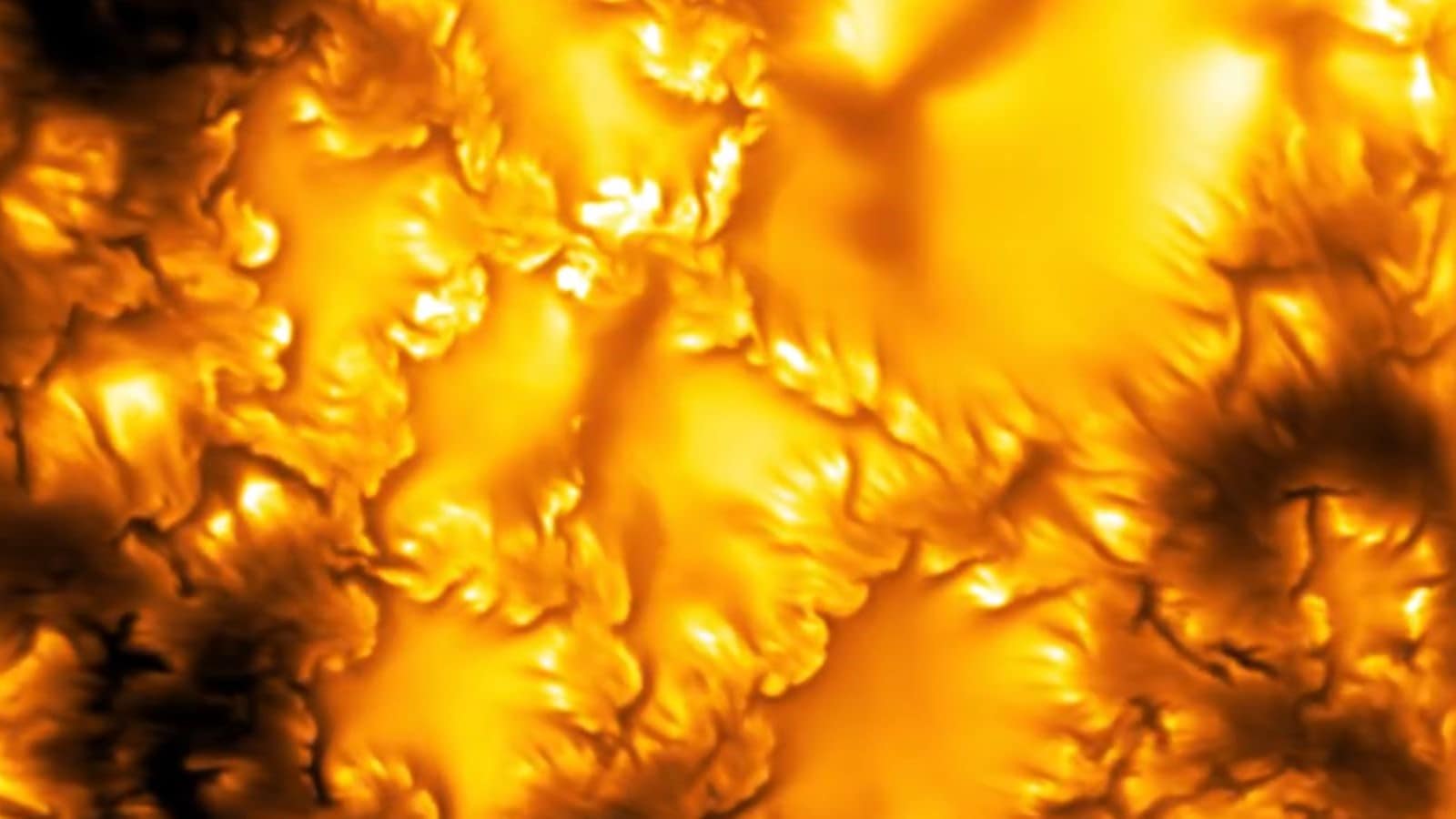
What appears on the display looks less like a star and more like a churning, boiling ocean of incandescent plasma, textured with granules the size of Texas. Every single cell of that golden broth is rising, cooling, and sinking, driven by heat boiling up from a nuclear core millions of miles below. But it is the fine detail that steals the breath from your throat. For the first time in human history, we are looking at structures on the solar surface smaller than the length of Manhattan.
We are peering into the machinery of an engine that could swallow a million Earths, and watching its gears turn.
The Invisible Storm
For centuries, astronomers studied the sun the way a medieval physician might check a pulse by holding a hand a few inches above the wrist. They saw the broad rhythms. They tracked sunspots swelling and shrinking over eleven-year cycles. They knew the beast breathed, but they could not see the individual hairs on its hide.
Ground-based telescopes fought a losing battle against our own atmosphere. Earth's air acts like a dirty, smudged windowpane, blurring the view through trillions of swirling thermal currents. No matter how large you build the mirror on a mountain peak, the air always wins. The sun remains an impressionist painting.
Then came the new images, captured by advanced orbital and high-resolution solar observatories capable of resolving features down to tens of kilometers.
Consider what happens when that resolution drops into crisp focus. The quiet corona, long thought to be a uniform halo of superheated gas, resolves into a chaotic tangle of magnetic ropes and braiding plasma loops. These are not static lines drawn by an artist. They are whip-crack energetic wires, carrying millions of amps, thrashing violently as they twist past one another until they snap.
When they snap, they unleash solar flares.
We live under the shadow of a thermonuclear furnace that shoots invisible daggers across the solar system daily. Most miss us. Some hit our magnetic shield, painting the polar skies in curtains of green and violet light. But every once in a while, a massive eruption aims directly at our technological cradle.
We call this space weather. It sounds sterile, like a mild inconvenience for satellite operators. It is not.
The Fragile Grid
In March 1989, a coronal mass ejection slammed into Earth's magnetic field. It was not even the largest storm on record, but it was enough. Within ninety seconds, the entire electrical grid of Quebec collapsed. Six million people plunged into darkness in the dead of winter. Transformers melted in substations. Satellites tumbled out of control. Compass needles spun wildly in laboratories across the globe.
That was decades ago. Since then, we have wrapped the Earth in a delicate web of copper, silicon, and fiber optics. We have moved indoors, trusting our lives to GPS satellites orbiting thousands of miles above, power grids spanning continents, and communication networks that cross ocean floors.
We have built a house of glass beneath an active volcano.
When researchers examine these new, ultra-fine images of the sun, they are not engaging in abstract astronomy. They are mapping the enemy's terrain. Those tiny, newly visible magnetic braids on the solar surface are the birthplace of the very storms that threaten our modern civilization. By seeing the fine detail of how magnetic fields tangle and rupture at the microscopic scale of a star, scientists hope to crack a decades-old mystery: how the sun heats its outer atmosphere, the corona, to millions of degrees while its visible surface sits at a relatively cool six thousand.
It is the equivalent of standing next to a bonfire and finding that the air a few feet away is hotter than the flames themselves.
The Weight of Light
There is a profound humility in watching scientists pore over these new frames. Lindqvist points to a dark, intricate thread winding through a sunspot cluster, thinner than a pencil line on the scale of the sun, yet carrying enough energy to power a continent for a year.
She does not speak in jargon. She speaks in the quiet, measured tone of someone who understands how thin the ice is.
"We used to guess," she says, leaning back from the screen. "Now we can see the fuse."
This is why these images matter. They transform the sun from a distant philosophical symbol into a physical neighbor with a temper. They remind us that our brilliant civilization—with all its stock markets, medical databases, and instantaneous global messaging—is tethered to a volatile ball of burning gas ninety-three million miles away.
We are astronauts on a medium-sized rock, spinning through the dark, warmed by a fire we are only just beginning to understand.
Look up at the sky today. The light hitting your face left the sun eight minutes and twenty seconds ago. It crossed the freezing void of space, slipped past the dancing ribbons of the aurora, punched through our sheltering atmosphere, and landed on your skin.
It feels gentle. It feels permanent.
Beneath that golden surface, miles of plasma are churning, magnetic fields are tightening like steel cables, and the star is breathing its ancient, restless breath. We are watching it now, clearer than ever before, waiting to see what it does next.