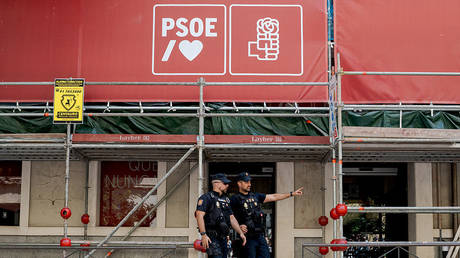
The sight of Spain’s elite Civil Guard unit marching into the Madrid headquarters of the ruling Socialist Party (PSOE) isn't just bad optics. It's a political nightmare. On May 27, 2026, agents from the UCO—the force tasked with taking down complex, high-level financial crime—demanded documents and digital files right from the heart of the party's machine on Calle Ferraz.
This isn't a minor administrative hiccup. It's a full-blown crisis hitting Prime Minister Pedro Sánchez exactly where it hurts, shattering any remaining illusions of a clean, untouchable administration.
For months, the government tried to brush off mounting allegations as right-wing noise or standard political theater. You can't do that when the national court sends police officers to your front door. The raid strikes at the core of a massive, multi-layered corruption scandal that is rapidly destabilizing Spain's minority government.
What the Ferraz Headquarters Raid Is Actually About
If you think this is just another generic kickback scheme, you're missing the real story. Investigating judge Santiago Pedraz isn't just looking for missing cash. The court order explicitly states that the operation targets a ring designed to destabilize judicial processes affecting the ruling party.
Think about that for a second. The accusation isn't just that politicians took bribes; it's that they allegedly built an internal network to sabotage the very judges and investigators trying to police them.
The investigation centers heavily on three former party members and a web of well-connected outsiders. At the middle of the web is Leire Díez, nicknamed "the plumber" by the local press for her behind-the-scenes political maneuvering. The trouble exploded when leaked audio recordings emerged, exposing a plot that reads like a political thriller. In the recordings, Díez allegedly suggested that state prosecutors and lawyers could protect a businessman facing fraud charges. The catch? He had to provide dirt on the anti-corruption investigators who were actively digging into the inner circle of Prime Minister Pedro Sánchez.
To fund this scorched-earth campaign against the judiciary, investigators suspect the party used fake invoices to disguise illicit payments to Díez and others. The legal charges currently flying around include:
- Belonging to a criminal organization
- Influence peddling
- Bribery
- Disclosure of secrets
- Inducement to give false testimony
- Falsification of commercial documents
While Sánchez spoke to reporters from Rome, trying to downplay the incident by pointing out it was a judicial request for specific documents rather than a blind, destructive raid, the political damage was already done. The police didn't just knock on the door; they also searched the homes of senior party figures, including former PSOE Organization Secretary Santos Cerdán, and formally named party manager Ana María Fuentes as a suspect.
The Ghost of Premiers Past: The Zapatero Factor
You can't look at this raid in isolation. It landed just a week after Spain's top criminal court dropped a massive bomb on the PSOE by placing former Socialist Prime Minister José Luis Rodríguez Zapatero under formal investigation.
Zapatero, who ran the country from 2004 to 2011, isn't just a retired statesman. He's Sánchez's political mentor and a heavyweight who still carries immense clout within the party ranks. Seeing him targeted by Magistrate José Luis Calama sent immediate shockwaves through the current government.
The Zapatero probe focuses on an international money-laundering and influence-peddling ring tied directly to a €53 million state bailout granted to Plus Ultra, a minor Spanish airline with deep ties to Venezuela, back in 2021.
The details alleged by the court are incredibly specific. The judge claims Zapatero actively lobbied Sánchez’s cabinet to push through the massive financial rescue for an insignificant airline in exchange for hefty kickbacks. To hide the money, the former premier allegedly ordered the creation of a shell company in Dubai to siphon off a 1% cut of the bailout—roughly €530,000.
The court intercepted communications showing a network stretching across Spain, Venezuela, China, and the United Arab Emirates. In total, Zapatero and his daughters allegedly pocketed up to €2 million masked as "consultancy services."
Zapatero denies everything. He released a video statement insisting his public and private actions have always been fully legal. But inside the party, the mood is grim. Heavyweights are openly admitting to being completely flabbergasted by the speed and scale of the downfall.
A Minority Government Gasping for Air
Sánchez is a political survivor. He has climbed out of deep political holes before, but the walls are closing in fast. The timing of this judicial onslaught could not be worse for his leftist coalition.
The PSOE is still nursing its wounds after devastating losses in regional elections, particularly in its traditional stronghold of Andalusia. Now, the party is fighting a multi-front war against corruption scandals that point directly at Sánchez's own inner circle.
- His Wife: Begoña Gómez faces an active judicial probe into corruption and influence peddling.
- His Brother: David Sánchez is facing a trial for alleged influence peddling and tax crimes.
- His Mentor: Former PM Zapatero is summoned to testify on June 2, 2026.
- His Party Machine: Current and former organization secretaries are tied to the Leire Díez disinformation plot.
The conservative opposition, led by Popular Party (PP) chief Alberto Núñez Feijóo, is smelling blood in the water. Feijóo didn't hold back after the Ferraz raid, publicly stating that the government "stinks" of corruption and demanding immediate early elections.
The reality is that Spain's political system is locking up. A minority government requires immense political capital to pass budgets and pass laws. Sánchez simply doesn't have the leverage anymore. Every ounce of energy the executive branch possesses is being burned on damage control, legal defense, and surviving the next news cycle.
The Hypocrisy Trap That Could Destroy the PSOE
To understand why this hits the Socialists so hard, you have to look back at how Pedro Sánchez became prime minister in the first place. In 2018, he pulled off a historic maneuver by ousting the conservative PM Mariano Rajoy through a vote of no confidence.
The weapon Sánchez used to destroy Rajoy's government? The infamous Gürtel case—a massive, decade-long kickback-for-contracts scandal that saw prominent conservative businessmen bribe PP officials for public contracts, turning the ruling party into a "lucrative entity" funded by slush funds. Sánchez marched into office on a righteous crusade to clean up Spanish politics. He promised transparency, an end to under-the-table backhanders, and a total separation of powers.
Fast forward to mid-2026. The PP is still dealing with its messy past, with Rajoy recently testifying in the "Kitchen Case" to deny setting up a rogue police operation to destroy incriminating evidence held by his party's former treasurer. But the public doesn't care about past scandals when the current ruling party's headquarters are being actively picked apart by the Civil Guard.
By using anti-corruption as his core brand, Sánchez trapped himself. When your entire political identity is built on not being the other guys, you don't get to look the other way when your own managers, ministers, and family members are being targeted by judges. The narrative that corruption was an isolated conservative problem has completely shattered.
What Happens Next on the Political Chessboard
The political calendar over the coming weeks is packed with explosive flashpoints that will dictate whether this government survives the summer. Keep a close eye on these specific developments:
- The June 2 Court Testimony: Zapatero's scheduled appearance before Magistrate José Luis Calama will dominate the media. Any leaked details about the Dubai shell companies or Venezuelan transactions will instantly weaken Sánchez.
- The Digital Forensic Clues: The UCO didn't just take paper documents from the Ferraz offices on Wednesday; they seized electronic records. In modern financial investigations, WhatsApp threads and deleted emails are where cases are won or lost. If those files implicate active ministers in the judicial sabotage plot, resignations will be unavoidable.
- The Coalition Fractures: Watch the smaller regional parties that keep Sánchez in power. Left-wing and separatist allies will stick around only as long as the government can pass policy. If the PSOE becomes too toxic, those minor parties will pull the plug to save their own skin in their home regions.
Forget the generic corporate talking points about "collaborating with the courts." The Spanish judiciary has shown it isn't afraid to walk straight into the halls of power. If you want to see if Sánchez can survive, watch how his fragile coalition handles the fallout from the digital files seized this week. If those files reveal that the rot goes deeper than a few rogue "plumbers," Spain is heading straight to the polling booths before the year is out. Keep your eyes on the court leaks; they are the real roadmap for where Spain's leadership is heading.


