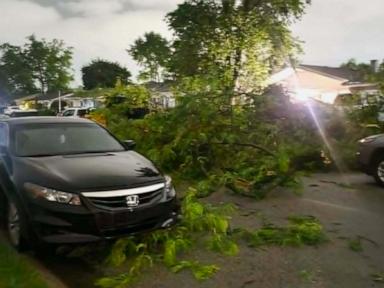
The air changes first. It is not a sudden drop in temperature or a sudden burst of wind, but a heavy, metallic weight that settles over the porch. It smells like copper and wet dust. Anyone who has spent a lifetime in the American Midwest knows this smell. It is the scent of an atmosphere tearing itself apart.
When the sirens finally wail across the state lines of Illinois and Indiana, they do not sound like a warning. They sound like an evacuation of hope.
Standard news dispatches will tell you the cold data of the storm. They will report that a line of severe thunderstorms swept through the mid-Mississippi Valley, producing multiple tornadoes, damaging structures, and triggering massive search-and-rescue operations. They will list the counties affected, the wind speeds recorded, and the estimated times of touchdown.
But a list of numbers cannot capture the sound of a family’s life cracking open.
Imagine a kitchen table. It is scratched at the edges from twenty years of family dinners, homework sessions, and late-night bills. Within ninety seconds, that table is no longer furniture. It is airborne shrapnel, reduced to splinters along with the walls that sheltered it. The true cost of a disaster is never found in the initial damage estimates. It is found in the quiet, agonizing space that follows the roar.
The Geography of Ruin
The storms did not respect borders. They tore through rural communities and suburban subdivisions alike, cutting a jagged path from the flat fields of eastern Illinois straight into the heart of Indiana. For the emergency crews arriving on the scene in the pre-dawn darkness, the landscape was unrecognizable.
Flashlights caught the jagged edges of what used to be bedrooms. Insulation hung from shredded oak trees like gray moss.
First responders face a specific, haunting reality in the immediate aftermath of a tornado. The task is not merely to clear debris; it is to listen. They shut down the engines of their rigs. They silence their radios. They stand in the mud, under a dripping, bruised sky, and they wait for a human voice.
Sometimes it is a whimper from beneath a collapsed drywall panel. Sometimes it is the barking of a dog trapped in a cellar. Mostly, it is just the hiss of broken gas lines and the dripping of water from shattered pipes.
The structural damage is the easiest thing to quantify, yet it means the least to the person standing in the driveway. When a roof is lifted off a home, the physics are straightforward. High-velocity winds create a massive pressure differential. The house essentially explodes outward under the lifting force of the vortex. To a structural engineer, it is a failure of load paths and anchoring systems. To the family huddled in the basement, it sounds like a freight train driving through their living room.
The Invisible Network of Survival
While the search dogs track scents through the wreckage, an entirely different kind of rescue operation begins. It is quiet, largely invisible, and entirely dependent on human grit.
Neighbors who may not have spoken in months suddenly find themselves working side by side. A man with a chainsaw becomes the most important person on the block. A woman with a trunk full of bottled water becomes a lifeline.
This is the hidden mechanics of a disaster zone. Long before the federal aid packages are debated, and days before the insurance adjusters arrive with their clipboards, the immediate survival of a community rests on the shoulders of the people who live there. They form human chains to move heavy timbers. They share generators to keep insulin cold.
Consider the logistical nightmare that follows a major weather event:
- Communications collapse as cell towers lose power or buckle under the wind.
- Physical access is blocked by miles of downed power lines, turning roads into obstacle courses.
- Water treatment facilities go offline, turning a basic necessity into a scarce resource.
The standard news narrative frames these events as tragedies, and they are. But focusing exclusively on the destruction misses the point of what happens next. The real story is the immediate, instinctive refusal of a community to stay broken.
The Long Road After the Cameras Leave
By day two, the national news trucks begin to pack up. The aerial footage of crumpled warehouses and tossed vehicles has been broadcast to millions of screens, digested, and forgotten as the next news cycle takes hold.
For the people in Illinois and Indiana, the true disaster is just beginning.
The emotional trajectory of a tornado survivor follows a predictable, painful curve. The initial shock carries an adrenaline rush that fuels the cleanup effort. There is a sense of gratitude just to be breathing. But as the days turn into weeks, the adrenaline fades. The reality of the paperwork sets in.
The insurance claims, the temporary housing arrangements, the realization that heirlooms cannot be replaced by a check—this is where the real exhaustion lives.
We often treat weather events as isolated anomalies, freak occurrences that happen to other people in distant places. This perspective is a comforting lie. The atmosphere does not care about zip codes or political boundaries. The systems that drove these storms are part of a broader, shifting pattern of intensity that is rewriting the rules of emergency preparedness across the country.
The old assumptions about "tornado alley" are decaying. The risk is spreading, pushing further east into heavily populated areas that are historically less prepared for the violence of a major touchdown.
What Rains Down
Late in the afternoon, after the worst of the system had pushed eastward into Ohio, a strange quiet fell over a small township on the Illinois-Indiana border. The ground was littered with the mundane fragments of a hundred different lives. Receipts from a grocery store thirty miles away. A child’s spelling test with a red star at the top. A faded photograph of a wedding in 1984.
These items travel for miles in the updraft of a tornado, carried high into the stratosphere before falling back to earth like strange, sorrowful rain.
A man was walking through what remained of his backyard, picking up these fragments of strangers' lives. He didn't know whose wedding picture he was holding. He didn't know the child who earned the red star. But he placed them carefully in a plastic bin, preserving them with the stubborn hope that someday, someone would come looking for them.
The wreckage will eventually be hauled away. The fields will be replanted, and new rafters will be nailed to new foundations. But the memory of the night the sky broke will remain etched into the dirt, and into the minds of the people who stood in the quiet that followed.