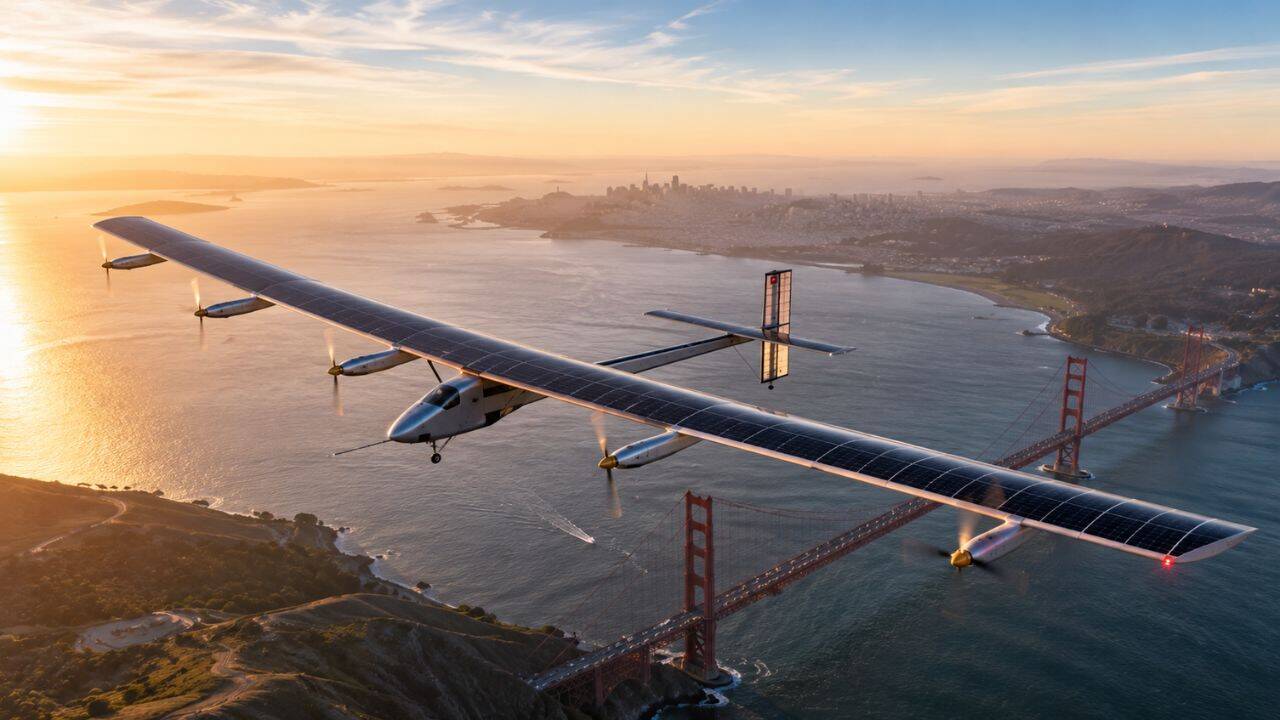
Solar Impulse 2 completed its 40,000-kilometer fuel-free circumnavigation of the globe in July 2016 through a radical combination of ultra-lightweight carbon fiber engineering, 17,248 high-efficiency solar cells, custom lithium-polymer battery storage, and grueling pilot endurance management. Swiss visionaries Bertrand Piccard and André Borschberg proved that zero-emission flight across open oceans was physically possible, logging 505 hours in the air across 17 distinct legs. Yet, a decade after its historic takeoff from Abu Dhabi, commercial aviation remains almost entirely bound to fossil fuels. The physical realities that made Solar Impulse 2 an engineering triumph simultaneously exposed why solar-powered passenger aviation remains a structural impossibility.
The Brutal Physics of Solar Aviation
Aerospace design is a ruthless accounting exercise governed by energy density. Jet A-1 fuel packs roughly 12,000 watt-hours of energy into a single kilogram. Standard aviation-grade lithium-ion batteries, by contrast, yield fewer than 300 watt-hours per kilogram. To bridge that vast gap without burning a single drop of fuel, the engineers behind Solar Impulse 2 had to build an aircraft with the wingspan of a Boeing 747-8 but the weight of an average sport utility vehicle.
The aircraft weighed just 2,300 kilograms. Achieving that required a custom carbon-fiber skeleton whose structural skin weighed less than standard printer paper. Covering the massive 72-meter wing surface were thousands of monocrystalline solar cells, each measuring a mere 135 microns in thickness. These cells gathered sunlight to power four electric motors during the day while charging 633 kilograms of dense lithium-polymer batteries packed into the motor nacelles.
It worked. But the margins were terrifyingly slim.
During daylight hours, the aircraft climbed to an altitude of 28,000 feet, soaking up maximum solar radiance to store gravitational potential energy alongside electrochemical energy in the batteries. Once night fell, the pilot throttled back, gliding slowly down to 5,000 feet over several hours before relying on battery power to sustain low-altitude flight until sunrise. The vehicle consumed roughly the same energy as a motor scooter.
That extreme conservation revealed the core commercial dead end. Solar Impulse 2 could only carry one human being, no cargo, and zero tolerance for severe weather.
The Hawaii Battery Overheat Disaster
Public relations surrounding the project emphasized smooth gliding and ecological hope, but behind the scenes, the operation faced technical failures that nearly doomed the mission in the middle of the Pacific Ocean.
The most severe crisis struck during the record-breaking leg from Nagoya, Japan, to Kalaeloa, Hawaii. Pilot André Borschberg spent 117 consecutive hours aloft—nearly five days and nights—setting an endurance record for non-stop solo flight. What the public tracking map did not show was that the aircraft's thermal management system had critically failed within the first few hours of ascent.
The battery packs, insulated inside custom enclosures to withstand the minus 40-degree temperatures of high altitude, overheated during the steep climb out of Japan. The flight monitoring team in Monaco watched temperatures spike into dangerous territory, unable to alter the thermal design mid-flight. Borschberg was forced to fly across thousands of miles of empty ocean with cooking batteries that threatened thermal runaway.
The aircraft landed safely in Hawaii, but the power units were destroyed beyond immediate repair.
The damaged batteries forced a nine-month grounding in Oahu. The team had to re-engineer the cooling systems and source replacement cells, delaying the entire global schedule. The incident served as a stark reminder of energy storage limits. Batteries do not merely weigh down an airframe; under continuous high-load cycles, managing their heat requires thermal infrastructure that adds even more dead weight.
Ground Crew Infrastructure and Atmospheric Vulnerability
Media coverage focused on the solitary pilot sitting in an unpressurized cockpit, but keeping Solar Impulse 2 in the sky required a massive ground operation that rivaled a commercial airline deployment.
A traveling support team of 90 engineers, meteorologists, logisticians, and communications technicians followed the aircraft across four continents. Because the lightweight carbon structure could not sustain wind gusts above a few knots while grounded, the team had to haul a custom mobile inflatable hangar across the globe to protect the plane at every stopover.
Weather windows were absurdly narrow. Standard airliners fly directly through turbulence, heavy rain, and moderate icing conditions using brute engine thrust and heavy aluminum structures. Solar Impulse 2 was essentially a delicate atmospheric sensor. A single encounter with severe clear-air turbulence or an unexpected downdraft could snap its gossamer wings.
Meteorologists spent days calculating flight paths to ensure the plane avoided cloud cover. Clouds meant no solar collection, which meant battery drain, which meant an emergency bail-out over open water.
Consider the operational contrast. A standard commercial airliner operates 16 hours a day regardless of cloud cover, carrying hundreds of passengers at 500 knots. Solar Impulse 2 traveled at an average ground speed of roughly 40 knots—slower than a highway driving speed—and required weeks of meteorological forecasting before committing to a single oceanic leg.
The Unforgiving Limits of Payload Capacity
To understand why solar energy will never power commercial passenger jets, one must calculate the available surface area of an aircraft relative to its mass.
As an aircraft scales up in size, its volume and weight scale cubically, while its surface area scales only quadratically. A commercial jetliner capable of carrying 200 passengers requires vastly more power than its top wing surface could ever gather from the sun, even assuming 100 percent solar cell efficiency.
- Available Solar Flux: Sunlight hits the Earth's surface with a peak solar irradiance of roughly 1,000 watts per square meter under ideal atmospheric conditions.
- Photovoltaic Efficiency: Modern commercial solar cells convert roughly 20 to 24 percent of that sunlight into usable electrical energy.
- Total Power Budget: A wing area the size of a football field yields roughly 100 to 150 kilowatts of continuous electrical power under ideal noon sunlight.
- Jet Engine Requirement: A modern turbofan engine produces the equivalent of tens of megawatts during takeoff.
The basic math does not work. To power a standard regional airliner entirely on solar energy, the wings would need to extend for several kilometers, creating a structure far too heavy to lift off the runway.
Solar energy on airframes can only ever serve as an auxiliary power system, running cabin electronics or flight deck displays, rather than providing primary propulsion.
What Solar Impulse 2 Actually Accomplished
If solar-powered airliner fleets were always a physical impossibility, what was the real point of the $170 million project?
The value of the expedition was never about creating a prototype for future passenger jets. Its primary contribution lay in pushing the boundaries of extreme energy efficiency, lightweight material manufacturing, and ultra-low-power electric propulsion.
The structural carbon-fiber technologies developed for the airframe directly informed new manufacturing methods for lightweight composites now used in modern aerospace construction. The custom electric motors achieved an energy efficiency rating of nearly 97 percent, demonstrating the incredible potential of high-torque electric drivetrains.
Furthermore, the project proved the viability of long-duration, high-altitude operational management. The strategies developed by the mission control team to monitor pilot fatigue—using self-hypnosis, tailored polyphasic sleep patterns, and real-time biometric tracking—have been absorbed into military and space flight research programs.
The project also proved that heavy industry partners could collaborate across non-traditional boundaries. Solvay provided advanced polymer materials, Omega developed lightweight micro-instrumentation, and Schindler applied structural engineering lessons to urban mobility projects.
The Real Path to Zero Emission Aviation
The legacy of Solar Impulse 2 is not a fleet of solar-powered passenger planes. Instead, it served as the conceptual catalyst for modern zero-emission aviation projects that rely on far denser power sources.
Engineers seeking to decarbonize flight have largely abandoned direct solar propulsion in favor of two primary alternatives.
Hydrogen Electric Propulsion
Liquid hydrogen offers an energy density per unit of mass that far exceeds conventional jet fuel, though it requires significant volume and specialized cryogenic storage tanks. Fuel cells convert hydrogen into electricity with zero carbon emissions, emitting only water vapor. Regional aircraft designs utilizing hydrogen fuel cells are currently undergoing active flight testing, targeting short-haul regional routes.
Sustainable Aviation Fuels
For long-haul international flights, synthetic jet fuels derived from captured carbon dioxide and green hydrogen represent the only immediate path forward. These fuels can be dropped directly into existing turbofan engines and airport refueling infrastructure, avoiding the need to re-engineer entire commercial fleets from scratch.
Solar power plays a critical role in this future, but not from the wings of an airplane. Solar panels installed on the ground—covering thousands of acres of desert land—generate the massive quantities of renewable electricity required to produce green hydrogen and synthetic fuels.
Solar Impulse 2 remains one of the most remarkable aeronautical achievements in history. Bertrand Piccard and André Borschberg flew around the globe without burning a drop of fuel, achieving what elite aerospace engineers once deemed impossible. They proved that human ingenuity can stretch physical limits to incredible boundaries. But they also drew a clear line in the sky between symbolic technological demonstrations and the unyielding engineering requirements of global commercial transport.