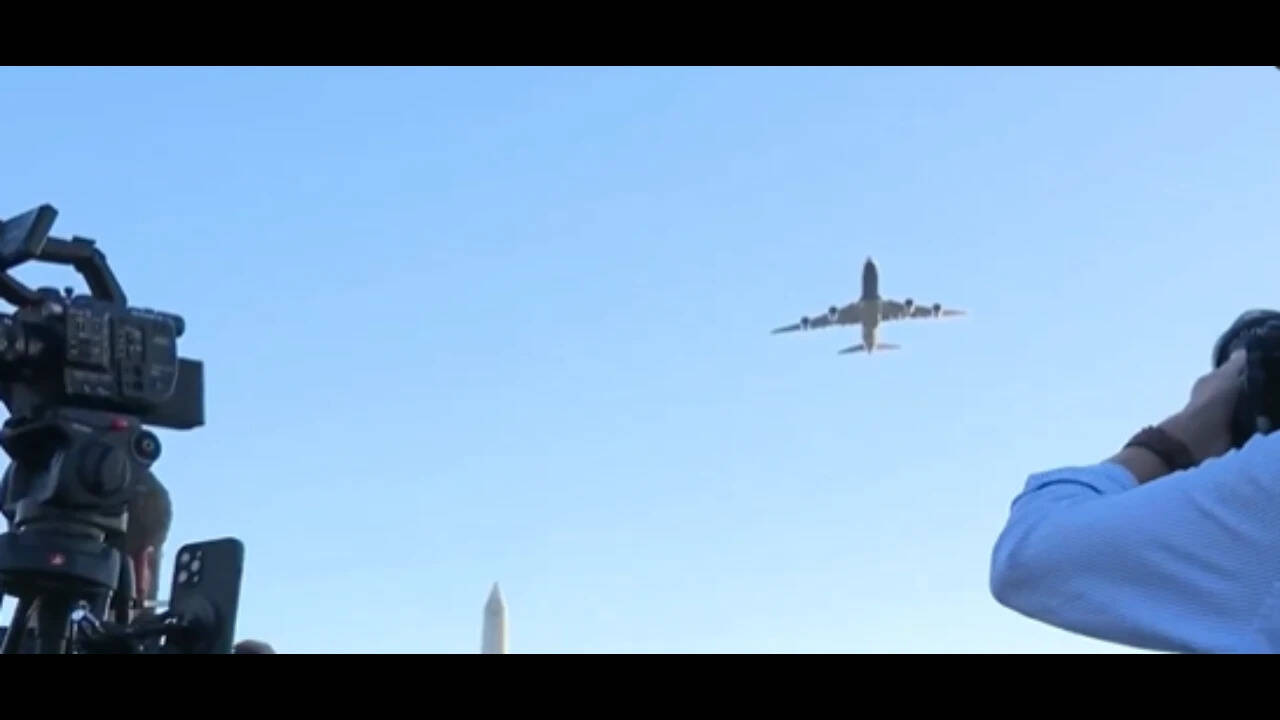
Thunder.
Not the slow, rolling rumble of an autumn storm gathering over the Potomac, nor the distant clatter of a commuter train rattling across a bridge, but a heavy, vibrating roar that presses against your eardrums and makes the coffee mug on your kitchen counter hum before your eyes even register what is happening above your roof.
In Washington, D.C., a sudden roar from above does not just startle you. It hijacks your nervous system.
When a low-altitude flyover by Air Force One swept over the nation's capital around Halloween, turning an afternoon of crisp autumn air and costume preparations into a surge of frantic 911 calls from residents who feared a plane crash, the story looked on paper like a simple mismatch between spectacle and expectation. A presidential aircraft flies low. People on the ground get scared. Dispatch lines light up.
Yet reducing that moment to a punchline or a three-paragraph wire brief misses the real weight pressing down on the city. In Washington, the sky is not empty space. It is memory, muscle memory, and a quiet, unspoken bargain between the people who live beneath the flight paths and the institutions that command them.
What a Low Jet Sounds Like When You Live Under the Flight Path
To understand why a low-altitude pass by a massive jet triggers panic in the District, you have to know what living in the capital actually feels like on a normal day. I have stood on sidewalks in Foggy Bottom, Dupont Circle, and across the river in Arlington when an aircraft comes in lower than expected, and the first reaction is never analytical. It is physical. Your shoulders climb toward your ears. Your fingers tighten around whatever you are holding. For two or three seconds—seconds that stretch like taffy—you are not thinking about aviation schedules or ceremonial flyovers. You are calculating distance, altitude, and glass.
To make the human friction of that moment concrete, consider a hypothetical afternoon scene—a composite of how sudden overhead noise plays out across neighborhoods when a large jet drops low without advance warning in a resident's daily routine.
Picture a hypothetical resident, Maya, standing in a third-floor walk-up near Columbia Heights with a grocery bag in one hand and a toddler's Halloween cape draped over her forearm. Outside, dry leaves scrape across the pavement while neighbor kids test out plastic masks on front stoops. Then comes the sound: a deep, chest-rattling turbine growl that seems too close to the brick facade across the street. Maya looks up through the window and sees an unmistakable widebody silhouette banking lower than she is used to seeing commercial airliners fly over the bowl of the city. Her phone is on the counter. Her heart is already hammering against her ribs. Within sixty seconds, neighbors are stepping onto balconies, squinting into the glare, and wondering whether to grab a child and head for an interior hallway or dial emergency dispatch.
That reaction is not foolishness. It is conditioning.
Think of the sky over Washington as a glass bowl that holds twenty-five years of history. You cannot pour new sound into an old vessel without stirring up everything that settled at the bottom. For anyone old enough to remember the morning of September 11, 2001—or anyone who grew up hearing the stories from parents who watched smoke rise across the river toward the Pentagon—a large aircraft descending at low altitude over monumental Washington carries a charge no ordinary city shares. Even younger residents who were toddlers or not yet born in 2001 absorb the atmosphere: the restricted airspace rules, the fighter patrols, the heightened vigilance around federal landmarks, and the constant awareness that the capital is a high-value target.
When a Halloween flyover by President Donald Trump's Air Force One cuts low across that backdrop, the visual and acoustic contrast is jarring. Halloween is a holiday built on play-acting, jump scares, and controlled illusions—cobwebs taped to porch railings, cardboard gravestones, kids pretending to be ghosts. A multi-ton jet roaring low overhead is not a trick. It is raw kinetic power invading a neighborhood street.
The Invisible Stakes of a Surprise in Restricted Airspace
Why do low-altitude flyovers spark fear when they catch residents off guard? Because context is everything in acoustics and threat perception. A scheduled airshow over an open coastal airfield or a well-publicized military demonstration where local alerts have already pinged phones sets a frame: This is planned. This is safe. When a massive aircraft appears low without that frame of expectation, the brain treats the absence of warning as a sign of danger.
Let us be honest about the uncertainty in moments like this. When a low jet passes overhead and no siren or push alert has preceded it, even seasoned city dwellers can feel a flicker of doubt. Is this an official presidential movement or Air Force One operation? Is it a training run? Could an engine be in trouble? That brief window of ambiguity—often lasting less than a minute—is where 911 calls are born. Dispatchers hear from callers who see a large plane low in the sky, hear an unfamiliar volume of engine noise, and report a potential crash because, from a ground-level vantage point between buildings and trees, altitude and trajectory are notoriously hard to judge accurately.
Here, a simple metaphor helps clarify why perception on the ground so often diverges from reality in the air. Imagine watching a fast car from behind a row of hedges: without a clear reference point for speed and lane position, a vehicle moving normally can look as though it is swerving straight toward the curb. Looking up at a large jet through urban canyons and shifting light creates a similar optical and auditory trick—the aircraft can feel practically on top of you even when it is following a designated flight corridor.
That gap between what happens in the cockpit and what is felt on the sidewalk is where the invisible stakes live.
First, there is the strain on emergency infrastructure. Every unnecessary call tied to a startling flyover occupies a dispatcher's attention and bandwidth, even if only briefly. Emergency communications systems are designed to absorb spikes, and call-takers are trained to triage rapidly, yet real emergencies do not pause because a jet flew low for a holiday surprise or presidential showcase.
Second, there is trust. Residents in Washington already navigate tight security perimeters, road closures, motorcades, and airspace restrictions as the price of living in the seat of government. Most accept those friction points with a shrug; it comes with the zip code. What wears down patience—and feeds anxiety—is feeling blindsided by something loud and imposing right above your home.
Third, there is political and public-relations friction. A dramatic flyover is often intended to project strength, presence, or festive flair—especially around a recognizable moment like Halloween. Yet when the immediate public response in the neighborhoods below is alarm rather than awe, the spectacle sends a mixed signal. Instead of projecting effortless command, a surprise low pass can make leadership look tone-deaf to the lived nerves of the people living beneath the flight path.
Why Washington Reacts Differently Than Almost Any Other City
If a large jet flew low over a quiet farming county or a sleepy beach town, people might step onto their porches, wave, or pull out their cameras without thinking twice. Washington is not a quiet farming county. It is a dense, hyper-aware capital where sirens, helicopters, and security protocols are woven into daily life.
Historically, capitals and seat-of-government cities have always had a complicated relationship with aerial displays. From early twentieth-century exhibition flights over European capitals to modern military flyovers above national monuments, leaders have long used the sky as a stage. Aircraft are dramatic. They command eyes upward. They turn an ordinary calendar date into a visual event.
Yet there is a recognized behavioral pattern in urban psychology and crisis communication: unannounced high-intensity stimuli trigger threat-scanning before rational reappraisal kicks in. In plain terms, your survival alarm rings first, and your logical explanation arrives second. In a city where people have spent decades hearing that vigilance is essential around government hubs, that survival alarm is tuned hair-trigger sensitive.
Consider how small details amplify the effect around Halloween. Dusk comes earlier as autumn deepens. Shadows lengthen between rowhouses. Decorations—some eerie, some chaotic—already prime people's senses for edge-of-the-seat moments. Add a sudden, booming aircraft overhead, and the sensory mix flips from playful to startling in an instant.
Some residents shrug it off quickly once they realize it is Air Force One or a presidential flyover rather than a catastrophe. Others feel a lingering spike of adrenaline that takes half an hour to fade. Neither reaction makes someone weak or dramatic; both are human responses to a jarring shift in the environment.
The Bridge Between Spectacle and Consideration
We do not have to choose between honoring aviation traditions or presidential movements on one side and caring for civilian peace of mind on the other. The tension is not inherent in the aircraft itself. It lives in how surprise is managed.
When authorities and event planners communicate clearly—using familiar local channels, timely advisories, and plain language before low-altitude flights occur—the emotional math changes dramatically. A resident who knows in advance that a low pass is scheduled may still look up at the roar, still feel the rumble in their chest, and still marvel at the sheer scale of the jet, but their first thought is There it goes, not Is something about to crash?
Clear communication also protects 911 centers from avoidable confusion. When neighbors understand what is happening overhead, fewer people dial emergency lines in a panic over a plane that is simply flying low as planned.
At the same time, leaders and planners benefit from remembering who lives in Washington. The capital is not merely a backdrop of marble columns and government offices where people clock in at nine and leave at five. Real families sleep in those rowhouses. Older adults sit in those apartments. Children walk home from school down those tree-lined blocks. Treating the city as a stage set rather than a living neighborhood is where misunderstandings start.
Even when a Halloween surprise is meant to be bold or memorable, consideration is what keeps bold from tipping into frightening. A moment of awe hits much harder when it isn't tangled up in a racing heart and a call to emergency dispatch.
High above the rooftops, the jet banks away, its engines receding until the autumn wind and distant traffic reclaim the street, leaving behind quieted porches, phones slowly lowered from the sky, and a city catching its breath under a very loud ceiling.