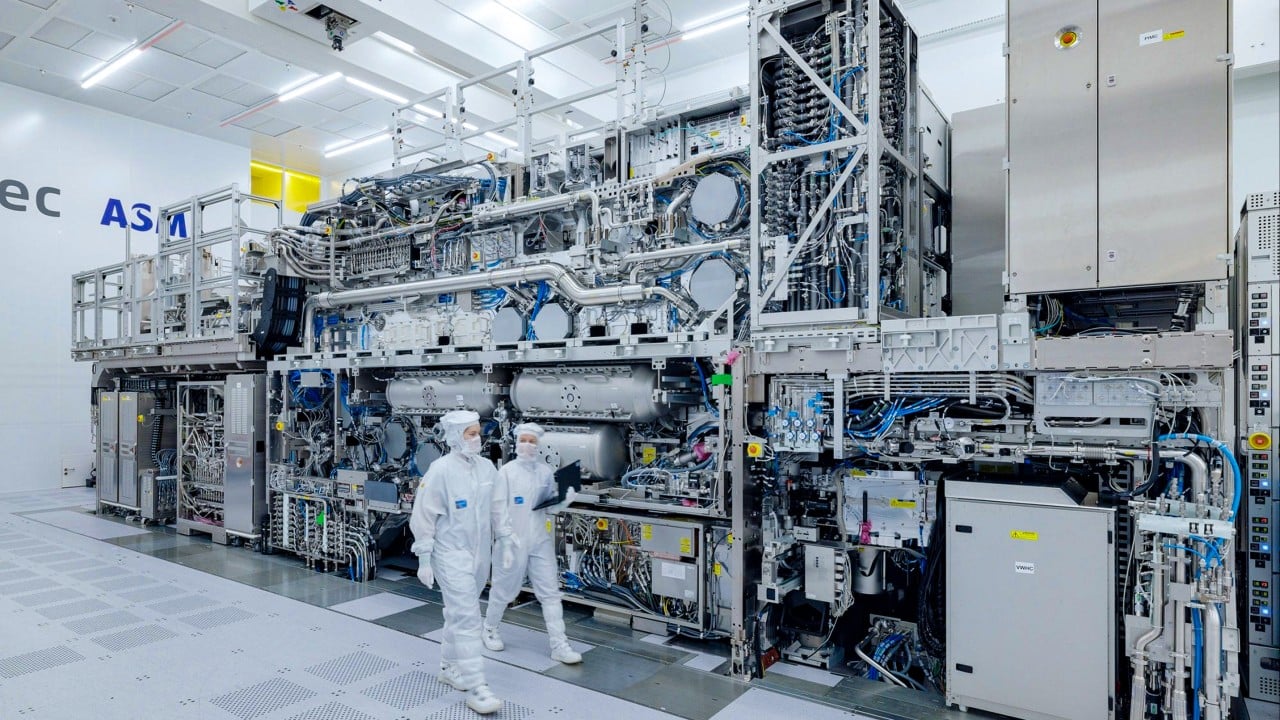
Listen closely to the hum of a cleanroom in Shenzhen or Veldhoven. Beneath the whisper of laminar air filters and the steady click of robotic arms moving three-hundred-millimeter silicon wafers, a quiet revolution is colliding with geopolitical gravity. On paper, the headline reads like a dry accounting footnote: ASML's chip equipment sales to China soared 109% despite Washington's export curb push.
Numbers like 109% sound neat on a quarterly earnings slide. Clinical. Contained. If you enjoyed this article, you might want to read: this related article.
They are anything but.
When a single Dutch company—the sole supplier on Earth of extreme ultraviolet lithography machines capable of etching the tiniest, most advanced microchips—sees its revenue from a restricted market more than double in a stretch where policymakers tried to slam doors shut, you are not looking at a mere spreadsheet anomaly. You are watching human ingenuity, market incentives, and state power wrestle in real time over the physical foundation of modern life. For another angle on this story, check out the latest update from Ars Technica.
I have spent years covering industrial supply chains and sitting in rooms with engineers who talk about nanometers the way poets talk about starlight. Honestly, even for those of us who watch this space daily, the sheer scale of what happens inside a lithography tool can feel dizzying. A single speck of dust—invisible to the naked eye, roughly one-hundredth the width of a human hair—can ruin a circuit path narrower than a virus. Trying to explain why a machine weighing over a hundred tons and costing hundreds of millions of dollars matters to the phone in your pocket, the electric car in your driveway, or the tension between Beijing and Washington is hard work. And I will admit right up front: anyone who claims to have every angle of this geopolitical chess match completely sorted out is selling certainty where there is genuine friction.
To feel why that 109% jump sends tremors through boardrooms and ministries alike, let us step inside the tension.
The Architecture of a Chokepoint
To understand how a shipment from the Netherlands becomes a flashpoint across the Pacific, you first have to picture what a lithography machine actually does.
(Note: The following explanation uses a metaphor to clarify a complex manufacturing process.)
Think of a silicon wafer as a blank canvas stretched across a spinning potter's wheel, and think of lithography as painting microscopic cathedrals using a beam of light so focused that a single miscalculation blurs the entire spire. Deep ultraviolet—known in the industry as DUV—uses light at a shorter wavelength than older tools, letting factories carve intricate circuits onto silicon. Extreme ultraviolet, or EUV, goes even further, demanding mirror surfaces polished so smooth that if you scaled a single mirror up to the size of Germany, the highest hill and deepest valley would measure less than a millimeter.
ASML holds a monopoly on EUV. Not a market lead. A monopoly. No other company on the planet builds commercial EUV lithography tools at scale.
When Washington began tightening export controls to slow China's access to advanced chipmaking capabilities, the goal was strategic containment: keep frontier artificial intelligence chips and cutting-edge fabrication tools out of reach where they could strengthen military modernization or lock in technological supremacy. Yet export rules rarely move in a straight line. Regulations evolve in waves, definitions shift around immersion DUV versus older DUV tools, grace periods exist for prior orders, and manufacturers rush to fulfill backlogs before new restrictions bite.
That timing gap is oxygen for demand.
(Note: The characters below are hypothetical composites created to illustrate realistic pressures felt by people working inside this supply chain.)
Picture Lin Mei, a hypothetical process engineer in Guangdong whose days are measured in yield percentages and delivery schedules. For two years, her team has watched headlines about licenses, compliance reviews, and shipping delays. When a shipment of non-restricted or previously cleared lithography equipment clears customs and arrives at the fab floor, relief is immediate and tangible. Every tool installed on time means thousands of wafer starts per month—chips destined for automotive controllers, industrial sensors, power management units, and everyday consumer electronics that keep factories running and paychecks arriving.
Now place Henrik on the other side of the ledger—a hypothetical compliance and logistics coordinator in Eindhoven. His inbox is a labyrinth of regulatory filings, customer audits, and shipping windows. To Henrik, a 109% surge in China sales is not a triumph of defiance; it is the visible consequence of customers pulling orders forward, buying mature and mid-tier equipment still permitted under existing rules, and racing against regulatory clocks while keeping global supply chains fed.
Both Lin Mei and Henrik are caught inside the same mechanical reality: you cannot freeze a global technology ecosystem overnight without creating violent eddies along the edges.
Why Export Curbs Collide With Market Gravity
Policy often assumes that when you block one door, the room goes quiet. Economics says the room simply gets louder near every other door.
Consider what happens next when restrictions target the most advanced nodes while leaving room—at least initially—for older or less restricted lithography systems. A chipmaker barred from acquiring the newest EUV tools does not simply pack up and go home. Instead, demand pivots toward immersion DUV and legacy DUV systems that remain legally shippable under current frameworks. Simultaneously, buyers accelerate deliveries on contracts signed before tighter rules took effect, and domestic players invest heavily in building out capacity wherever international supply allows.
The result looks paradoxical on first glance. Headline narratives warn of isolation and decoupling, while quarterly numbers show sales to China surging by 109%.
Why does that contradiction persist? Because semiconductor manufacturing is a marathon built on multi-year capital cycles, not a light switch. Fabs take years to construct, calibrate, and qualify. Equipment ordered today might not produce commercial chips at full volume for quarters to come. When buyers anticipate tighter future curbs, rational actors buy earlier and more aggressively while the window is open.
There is also a quieter truth that gets lost in grand geopolitical slogans: the world runs on mature and mid-range chips just as much as it runs on bleeding-edge AI accelerators. A modern car contains hundreds or even thousands of semiconductors handling braking, battery management, infotainment, and driver assistance. Industrial robotics, medical monitors, telecom gear, and household appliances depend on steady flows of chips made on DUV and legacy lines. If those supply chains snap abruptly, the shockwave hits factories and consumers everywhere—not just in one capital.
Still, watching a 109% jump unfold forces uncomfortable questions in Washington, Brussels, The Hague, and Beijing alike. Are export controls slowing the pace of frontier catch-up, or are they accelerating domestic self-reliance and reshaping global trade routes in ways no single decree can fully control?
The Human Stakes Beneath the Nanometers
It is easy to treat semiconductor trade disputes like a board game played with tiny plastic pieces. Move the piece to Taiwan. Block the piece in the Netherlands. Counter-move in Beijing.
Real life does not come with reset buttons.
In towns across Europe, engineers and suppliers build sub-assemblies—precision lenses, vacuum chambers, laser sources, software control systems—that form an intricate web of interdependence. In East Asia, tens of thousands of technicians work shifts under bright white lights, tending wafer cassettes and calibrating optical alignments measured in fractions of a nanometer. Families mortgage homes, students choose engineering degrees, and regional economies rise or stall based on whether capital keeps flowing and orders stay on track.
When headlines announce a 109% surge in sales despite export curb pushes, people react emotionally before they parse the fine print. Some feel vindicated that commerce finds a way. Others feel alarmed that restrictions appear porous or reactive. Many simply feel anxious—wondering whether another round of rules will trigger layoffs, supply bottlenecks, or higher prices on goods they rely on every week.
That anxiety is real, even when the jargon is dense. You do not need a degree in solid-state physics to grasp what happens when two superpowers treat critical technology as a matter of national survival: every shipment carries political weight, and every delay carries a human price tag.
Where the Pressure Points Lead
Look closely at where the real friction sits right now, and you will see three forces pulling in opposite directions.
First is regulatory ratchet effect. Governments rarely loosen export controls once imposed; instead, they watch where loopholes or surges emerge and debate whether to close them further. Each tightening round alters corporate planning, forcing equipment makers to walk a razor's edge between legal compliance, customer obligations, and national security expectations.
Second is the race for indigenous alternatives. Every restriction creates an enormous financial incentive to develop domestic tools, materials, and software. Even when catching up to decades of accumulated optical and plasma physics takes years—or proves harder than expected—determined investment changes the long-term balance of capability.
Third is the fragility of single-point bottlenecks. Having one company monopolize EUV lithography is a testament to extraordinary engineering achievement, yet it also concentrates immense vulnerability in a single chokepoint. A single policy shift, supply disruption, or geopolitical flare-up reverberates across the entire planet.
None of these forces is going away quietly. They are woven into the fabric of how modern technology is made.
Out on the factory floor, the cleanroom air keeps circulating, silent and relentless, carrying away every stray particle while light carves invisible pathways into polished silicon—a glittering disk of sand and human ambition turning at the center of a world that cannot agree on who gets to shape tomorrow.