The cobblestones of Rome remember every footstep. They have felt the sandals of emperors, the heavy boots of legions, the shuffling slippers of pilgrims seeking absolution for sins they carried across continents. But today, the stones are listening to something rarer.
They are listening to silence. Don't miss our previous post on this related article.
Then, the silence breaks.
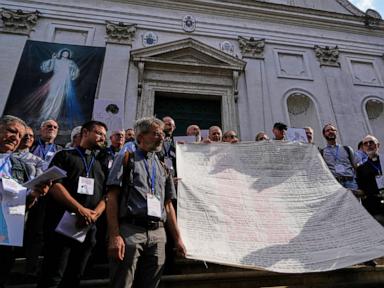
A chant rises, thin and reedy at first, carried on the breath of women and men whose lives were built around whispered prayers and quiet chapels. They wear black wool, stark white collars, rough brown habits tied with knotted rope. These are the people who chose withdrawal from the clamor of the earth. They took vows of enclosure, poverty, and obedience. They are nuns, priests, and friars who spent decades kneeling on cold stone floors, interceding for a broken world they rarely touched with their own hands. To read more about the history here, USA Today offers an excellent breakdown.
Today, their hands hold banners. Their feet march toward the heavy stone borders of the Vatican.
They have come because distance is no longer an alibi.
To understand why a nun who has not left her cloister in twenty years is now walking past espresso bars and police barricades, you have to understand the geography of grief. Gaza is thousands of miles across the Mediterranean, a narrow strip of earth squeezed between a blockaded sea and an unyielding border. Yet, to those inside the Catholic and Christian communities of the Levant, the distance collapses. They know the names of the streets being ground into powder. They know the courtyards of the Latin parish of the Holy Family in Gaza City, where children once played football beneath olive trees until the shrapnel arrived. They know the priests and sisters who stayed behind, tending to the wounded in basements illuminated by flickering phone screens and dying generator fumes.
When the bombs fall on a church shelter, the shockwave ripples through every monastery in Europe. When a convent hospital runs out of gauze and infant formula, the Sisters of Mercy in Rome feel the shortage in their bones, even with full pantries behind them.
For months, the institutional church walked a tightrope of diplomatic caution. Statements were issued. Prayers for peace were offered from high balconies under the golden light of papal windows. Words like restraint and proportionality were measured out in smoke-filled offices, carefully balanced so as not to offend secular powers or fracture delicate alliances.
But piety has a breaking point.
Sister Teresa walks near the front of the procession. She is seventy-four years old, her face lined like old parchment, her spectacles sliding down a nose reddened by the crisp Roman air. For forty years, her world was confined to a small convent outside Milan, caring for orphans and tending a vegetable garden. She never thought she would march anywhere except behind a coffin or a processional cross.
"Prayer without action is an insult to God," she says, her voice steady, cutting through the low rumble of city traffic. "When children are pulled from concrete, kneeling in a chapel while keeping silent in the public square becomes a sin. We swore an oath to protect the vulnerable. That oath does not stop at our cloister gates."
Beside her, Father Marco adjusts his clerical collar. He spent five years working in Jerusalem, walking the narrow alleys of the Old City, drinking bitter coffee with Palestinian Christians and Israeli peace activists alike. He knows the smell of dust after an explosion. He knows the look in a mother’s eyes when she realizes her home is no longer a shelter, but a target.
"People ask why we are here," Marco says, gesturing broadly at the crowd of religious habit-clad marchers filling the avenue. "They think religion belongs in the sacristy. They want us to stay quiet, to pray behind closed doors, to comfort the dying after the politicians finish killing them. But Jesus did not stay in the temple. He walked into the street. He overturned the tables of those who profited from suffering. If we claim to follow him, we cannot stand by while entire neighborhoods are erased."
The march swells as it approaches St. Peter’s Square. Tourists stop, mouths open, dropping their gelato cones or raising smartphones in disbelief. For generations, the imagery associated with this piazza has been one of solemn reverence: crowds waving yellow and white flags, waiting for an angelus blessing, weeping with joy during papal visits. Seeing hundreds of Catholic clergy demanding an end to what they explicitly term genocide transforms the sacred space into something raw and urgent.
Police officers in riot gear stand shoulder-to-shoulder, their expressions unreadable beneath dark visors. But even they lower their batons slightly as an elderly Franciscan friar, his brown robe gray with dust from the march, walks up to the metal barrier and presses his palm against it.
There are no megaphones booming hateful slogans here. Instead, there is the rhythmic recitation of the Rosary, the beads clicking between calloused fingers, but the prayers sound different today. They are not petitions for personal salvation. They are indictments. Each Hail Mary is hurled like a stone against the fortress of international indifference.
The logistics of war are cold. Numbers scroll across television screens in sterile white fonts: death tolls, displacement statistics, tonnage of ordnance dropped in a twenty-four-hour cycle. The human mind builds defensive walls against such numbers. After a certain point, statistics stop sounding like human beings and start sounding like weather reports.
This march is an attempt to tear down those walls.
By inserting their physical bodies—vulnerable, aging, cloaked in the traditional symbols of moral authority—into the public eye, these priests and nuns are forcing an uncomfortable confrontation. They are asking a simple, devastating question: If the houses of God are no longer safe, if the priests sheltering orphans are targets, if the nuns distributing bread are buried beneath the rubble, what is left of our shared humanity?
The institutional hierarchy watches from behind tall windows. Vatican diplomats work behind the scenes, making quiet phone calls, drafting communiqués, trying to navigate a geopolitical minefield where every word carries the weight of centuries. Diplomacy is slow. It requires compromise, nuance, and endless patience.
Bombs do not require patience.
That is the chasm between the palace and the street. While cardinals debate canonical phrasing, children in Gaza are learning to identify the incoming whistle of artillery shells by pitch alone. While diplomats draft peace proposals that die in committee rooms, parishioners in the Holy Land are digging graves in church courtyards because municipal cemeteries are too dangerous to reach.
The clergy on the pavement know this. They feel the intolerable weight of the contrast.
As dusk falls over Rome, the autumn chill settles deep into the stone. The streetlights flicker on, casting long, fractured shadows across the piazza. The crowd does not disperse. They sit on the steps, wrap shawls around their shoulders, and hold small wax candles that flicker against the rising wind.
A nun begins to sing. It is an ancient chant, mournful and low, echoing off the travertine marble of the colonnade. Others join in, harmony building upon harmony until the heavy air vibrates with sound. It is a song of lamentation, the kind sung by people who have lost their homes, their sanctuaries, and their certainties, yet refuse to abandon their hope.
In that moment, the grand architecture of the Vatican ceases to feel like a monument to earthly power. It feels small. It feels like a stage upon which history is judging everyone who watched and chose to look away.
The candles burn low. Wax drips onto cold stone, hardening instantly. The wind whispers through the arches of Bernini's colonnade, carrying away the last notes of the hymn, leaving behind only the steady, unyielding breath of those who refused to keep their peace.