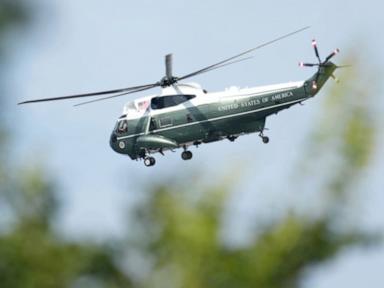
The rotor blades do not merely turn; they beat against the heavy air with a rhythmic, thunderous pulse that you feel in the marrow of your bones long before the aircraft touches down. Standing on the South Lawn, the wind whipped by the twin engines of Marine One catches your coat, flattening the fabric against your ribs. It is a calculated display of absolute command. This machine, painted in its iconic gloss green and stark white, is more than a helicopter. It is a flying fortress, a symbol of unyielding presidential authority, and a floating bridge to the continuity of the American government.
Yet, machinery is mortal. And steel, no matter how meticulously forged, is vulnerable to the quiet, creeping entropy of a severed circuit.
Imagine standing inside that cabin during a routine transit. The noise is a constant, deafening roar, a mechanical ocean that requires crew members to communicate through specialized, noise-canceling headsets wired directly into the aircraft’s avionics. You look out the oval window as the gray concrete of Washington gives way to the emerald canopy of the Maryland suburbs. Everything is steady. Everything is routine. Until the sound inside your ears drops out.
Not a static hiss. Not a gradual fade. Complete, abrupt nothingness.
When a Marine One communication failure occurs, the mythology of infallible presidential transit instantly collides with the gritty, terrifying vulnerability of high-altitude flight. We rarely consider the invisible architecture keeping these flights safe. We see the dramatic arrivals, the brisk salutes, the solemn dignity of the commander-in-chief stepping onto foreign soil or returning to the White House under the cover of dusk. We assume the tether holding that aircraft to the ground—and to the vast, watchful apparatus of national security—is unbreakable.
It is not.
To understand what happens when the lines go dead, we have to look past the gloss. The VH-3D Sea King and the newer VH-92A Patriot are not ordinary helicopters. They are airborne command posts packed with classified frequencies, encrypted satellite uplinks, and redundant systems designed to survive localized electromagnetic interference or component failure. The military builds these birds with layers of failsafes, stacking backups upon backups precisely because the stakes could not possibly be higher. If the president is in the air, the executive branch must remain instantly reachable, capable of issuing orders that can alter the geopolitical map within minutes.
So when a communication failure strikes, even for a matter of seconds, it triggers a cascade of protocol that the public rarely witnesses.
Let us be clear about the mechanics. (Note: The following operational breakdown is a logical deduction based on standard military rotary-wing emergency protocols and declassified descriptions of presidential transport contingencies). In the event of an internal intercom or external radio blackout, the flight crew does not panic. They are Marines. They are handpicked from Marine Helicopter Squadron One, known as Nighthawks, representing the absolute pinnacle of aviation precision.
When the voice links sever, the physical language of flight takes over. Hand signals, established emergency visual cues in the cockpit, and pre-programmed flight path continuations become the immediate order of the day. The primary objective shifts instantly from mission completion to containment and immediate risk mitigation. If the secure radio link to the White House Situation Room or the nuclear command structure drops, the pilot must execute strict, unyielding protocols. They rely on visual flight rules if conditions permit, or immediately head toward the nearest secure landing zone—whether that is a pre-surveyed backup site or a rapid return to Joint Base Andrews.
The public reaction to such an incident, when it leaks past the wall of military discretion, is usually one of disproportionate alarm. Headlines flash across screens with urgent warnings of security breaches and vulnerabilities at the highest levels of government. But this friction reveals a deeper truth about our relationship with power. We desperately want our leaders to be untouchable. We construct elaborate narratives of invulnerability around them, wrapping the presidency in a cocoon of titanium, encryption, and ceremonial pageantry.
When a communication wire frays or a software handshake fails, that illusion fractures.
We are reminded that the most powerful person on earth is still riding in a machine governed by physics, prone to the exact same mechanical fatigue as a commuter flight or a rusty pickup truck on a rural highway. There is a strange, sobering comfort in that realization, even if it makes security officials sweat through their uniforms. It grounds the office in our shared human fragility.
Consider the crew in those moments of sudden silence. The pilot’s knuckles tighten on the cyclic. The co-pilot's eyes sweep rapidly across analog and digital gauges, hunting for the culprit—a tripped circuit breaker, a software glitch in the encryption module, a blown fuse in the avionics bay. There is no shouting over the roar of the engines because the headsets are dead. There is only the synchronized, silent language of professionals who have practiced this exact catastrophe in simulators until their reactions are baked into muscle memory.
They do not drop out of the sky like a stone. Aviation is built on the premise that things will break, which is why aircraft are engineered to glide, stabilize, and land even when their digital nervous systems go dark. The redundancy is the soul of the machine.
Yet, every glitch leaves a mark. It forces engineers back to the drawing boards at Sikorsky and Patuxent River. It prompts grueling debriefs where every microsecond of the anomaly is dissected, measured, and inverted to ensure it never happens twice. The modern presidential helicopter fleet is a living organism, evolving continuously through the scars of past failures. Every dropped signal, every lost frequency, and every stuttered transmission writes a new line in the unwritten safety manuals of military aviation.
When you see Marine One cutting a low, heavy arc across the twilight sky, remember the invisible web holding it aloft. Beneath the polished green paint and the blinding white cabin roof lies a fragile balance between raw mechanical power and human vigilance. It is a reminder that safety is not a permanent state granted by technology, but a fierce, unbroken struggle against chaos waged silently every single day by people whose names we will never know, in skies we will never see.