Water does not care if you can hear it.
To dive is to enter a domain stripped of horns, sirens, alarms, and the chaotic hum of modern civilization. Down there, the loudest sound is the steady, mechanical hiss of your own breath, a metronome keeping time with the blue. But for most of human history, the underwater realm has been fiercely guarded by sound. Instructors shouted commands. Dive buddies tapped metal tanks to signal trouble. The certification process itself was built on verbal cues, spoken briefings, and auditory checks that erected an invisible, impenetrable wall between the sport and the deaf community.
Then came the history makers.
Consider what happens when an individual dives into a world where spoken communication is entirely useless anyway. Above water, the world belongs to the hearing. Ears dictate pace, command authority, and mediate safety. Below the surface, however, everyone is rendered temporarily deaf and mute. Hand signals, eye contact, and touch replace the spoken word. In this weightless environment, a deaf diver does not have a handicap. They have an advantage.
The Language of the Abyss
We often mistake sound for connection. On land, words can muddle intent, create friction, or get lost in the noise. When you submerge twenty, forty, fifty feet beneath the waves, language shifts entirely.
Training a deaf scuba diver requires a dismantling of traditional instruction. Standard scuba agencies historically clung to rigid, auditory-dependent protocols. Instructors stood on boats shouting directions. They administered listening-heavy safety quizzes. They assumed that because communication relied on sound on land, it must rely on sound everywhere.
That assumption was shattered by pioneers who refused to accept the ocean as an exclusive club.
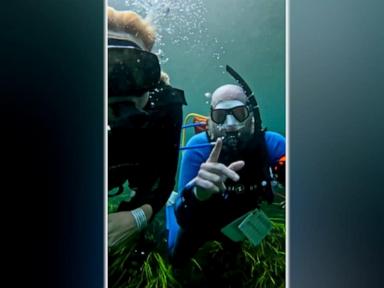
When you strip away the voice, the human body adapts with startling grace. Peripheral vision sharpens. The slightest shift in a dive buddy's shoulder blade becomes a flashing neon sign of intent. Communication transforms into an intricate choreography of American Sign Language adapted for neoprene and bubbles, finger-spelling keywords against the backdrop of a coral reef, flashing dive computers to signal remaining air, and using wrist taps to command attention.
It is a quiet revolution. And like most quiet revolutions, it happened far away from the headlines before breaking through the surface to capture the world's attention.
Breaking the Barrier
When a deaf scuba diver makes history by earning elite certifications, setting endurance records, or leading deep-water expeditions, the mainstream media often frames it as a miracle of overcoming personal tragedy.
That framing is wrong.
Deafness is not a tragedy waiting to be cured by a wetsuit and a tank. It is a different way of experiencing reality. The historic dives that break records are not triumphs over a broken body; they are triumphs over a broken system. They expose the bureaucratic friction of institutions that were slow to modernize, slow to translate materials, and slow to trust that a person who cannot hear a regulator click can still master buoyancy, navigation, and emergency decompression protocols.
Think about the sensory profile of a deep dive. The pressure changes in your inner ear. The way sunlight bends through the water column, turning green to indigo to absolute black. The sudden, heart-stopping appearance of a manta ray gliding past like a shadow. None of these require ears to appreciate. In fact, without the distraction of surface noise, a deaf diver often possesses a heightened attunement to the physical environment. They feel the current long before it shifts. They notice the subtle darkening of the water that signals an incoming thermocline.
They are listening with their skin.
The Ripple Effect
History is rarely made in a vacuum. When a barrier falls for one person, it crumbles for thousands.
In the wake of these milestone dives, dive shops around the world are rewriting their manuals. Instructors are learning sign language. Equipment manufacturers are experimenting with visual and haptic alert systems—vibrating masks, flashing strobe lights inside dive computers, and tactile signals designed to replace the traditional tank-taps.
What started as an individual pursuit of freedom has mutated into a blueprint for true accessibility. It turns out that designing a dive course for a deaf person simply forces instructors to become better teachers for everyone. When you cannot rely on shouting instructions across choppy surface water, you have to be precise. You have to be visual. You have to teach mindfulness, situational awareness, and absolute clarity.
The ocean does not ask for your credentials, your background, or your auditory range. It only asks for respect.
Far below the crashing waves, where the sunlight fades into a quiet, eternal twilight, there are no categories of hearing and non-hearing. There are only human beings suspended in fluid space, breathing compressed air, sharing a silent language that transcends dictionaries. The history makers did not just conquer the depths. They proved that the most profound human adventures happen the moment we stop listening to the noise of the world above and start paying attention to what is right in front of us.