The rain in Tokyo does not just fall; it slicked the black asphalt of the Ministry of Defense like a second skin, reflecting a gray sky that felt entirely too heavy for a Tuesday. Inside the briefing room, the air smelled faintly of damp wool and industrial floor wax. Ministers and generals sat beneath harsh fluorescent lights, their posture so rigid they might have been carved from cedar.
To the casual observer tuning into the evening broadcast, the press conference was a standard exercise in geopolitical chess. Words like "deterrence," "regional stability," and "proportional response" bounced off the soundproofed walls.
But if you watched the hands of the defense minister, you saw a different story.
His fingers gripped the edge of the podium with white-knuckled intensity. Every time the word militarism was leveled by a foreign reporter—a word heavy with the blood and ash of Japan’s mid-century ruin—his shoulders dropped a fraction of a millimeter. It was the subtle, physical manifestation of a nation wrestling with its own ghost.
For nearly eight decades, Japan has lived under a self-imposed vow. The constitution, drafted in the wake of a devastating defeat, turned a global empire into a pacifist sanctuary. Generation after generation grew up believing that the ultimate virtue was restraint.
Now, the water in the Taiwan Strait is growing warm. The horizon is crowded. The vow is cracking under the weight of reality.
The Weight of the Neighborhood
To understand why a defense minister must stand before the world and defend his country’s innocence, you have to look past the diplomatic scripts and stare directly at the map.
Imagine a small, tightly packed apartment building. For decades, the tenant in 4B has kept his door locked, minded his own business, and refused to buy so much as a deadbolt, relying instead on the neighborhood watch. But lately, the neighbor across the hall has been moving heavy, unmarked crates into the corridor. The crates are stacked to the ceiling. They smell of gunpowder. When asked what is inside, the neighbor simply smiles and says it is none of your concern.
That neighbor is Beijing.
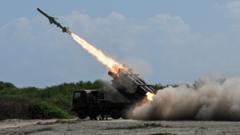
The defense minister did not mince words about the sheer scale of the buildup happening just across the East China Sea. We are looking at an arsenal that is not just expanding; it is transforming. Hypersonic missiles that can outrun radar. Aircraft carriers sliding out of shipyards with terrifying regularity. Nuclear stockpiles growing in the dark.
It is easy to look at numbers on a spreadsheet—300 naval vessels here, 2,000 ballistic missiles there—and feel a detached sense of clinical concern. But spend a night on a Japanese radar outpost in Yonaguni, the westernmost inhabited island of the archipelago, and those numbers become heartbeat-skipping realities.
From Yonaguni, on a clear day, you can see the coast of Taiwan. You can also see the gray hulls of foreign warships slicing through the waves. The fishermen who have worked these waters for forty years now find their nets tangled in the wake of massive naval exercises. They return to port with empty holds and quiet, worried faces.
The minister’s defense was not an act of aggression. It was an act of profound, desperate anxiety.
The Myth of the Reawakened Giant
When Japan announces a bump in its defense budget, the reaction from its critics is instantaneous and choreographed. The old tropes are dragged out of the historical closet. We hear warnings of a rising sun, of a return to the imperial march that terrorized Asia in the 1930s and 40s.
This narrative is not just wrong; it completely misunderstands the psychology of modern Japan.
The ordinary citizen in Osaka or Fukuoka has zero appetite for empire. They are worried about inflation. They are worried about a shrinking population and towns where the schools are closing because there are no children to fill them. The idea that Tokyo is secretly plotting a return to conquest is a phantom designed to justify the aggression of its neighbors.
Consider the reality of Japan’s Self-Defense Forces. The clue is in the name. They do not possess long-range bombers. They do not have nuclear submarines. Their entire military doctrine is built around a single, defensive concept: making the island too painful to swallow.
But the line between defense and offense is blurring in the modern age. When a neighboring country can launch a missile that lands inside your exclusive economic zone within minutes, sitting back and waiting for the impact is no longer a strategy. It is suicide.
The minister stood at that podium to draw a line in the sand. He argued that upgrading radar systems, purchasing standoff missiles, and tightening alliances is not militarism. It is basic mathematics. If the fire next door is growing higher, you do not burn your own firehose out of a sense of purity. You buy a stronger pump.
The Quiet Room and the Loud Horizon
The real tragedy of this escalating tension is found in the silence of those who remember the alternative.
In a small home in Hiroshima, an elderly woman watches the news on a flat-screen television. She is one of the last hibakusha—the survivors of the atomic bomb. Her life has been defined by a singular prayer: Never again. To her, and to millions of her generation, any talk of expanding military capabilities feels like a betrayal of the peace they bought with unimaginable suffering.
The defense minister knows this woman exists. Every politician in Tokyo knows she exists. Her voice is the moral anchor of the country.
Yet, leaders cannot govern solely by the light of memory when the present is growing so dark. The dilemma is torturous. How do you honor a legacy of peace when your neighbor is building a war machine designed to rewrite the rules of the world?
The defense minister’s critique of China’s "huge arsenal" was not just a complaint to the international community. It was a plea for recognition. It was an admission that Japan can no longer afford to live in a vacuum of historical idealism. The world has changed, and the rules that kept the peace for eighty years are fraying at the edges.
The Unwritten Next Chapter
The press conference eventually ended. The cameras clicked off, the reporters packed away their laptops, and the minister retreated behind the heavy doors of his office. The official record will show that Japan reaffirmed its defensive posture while expressing deep concern over regional military expansions. Dry. Standard. Forgettable.
But out in the gray waters of the Pacific, the tension remains.
A Japanese destroyer cuts through the swells, its crew staring at radar screens filled with unfamiliar blips. They are young men and women, born long after the empire fell, raised on anime, convenience store snacks, and the quiet comforts of a peaceful society. They do not want a war. Their country does not want a war.
As the ship rolls with the tide, a shadow passes beneath the waves—a foreign submarine, silent, massive, and close.
The defense minister’s words were not an opening salvo. They were a warning flare sent up into an increasingly dark sky, a desperate attempt to ensure that the peace bought so dearly in the last century is not lost to the silence of the next.