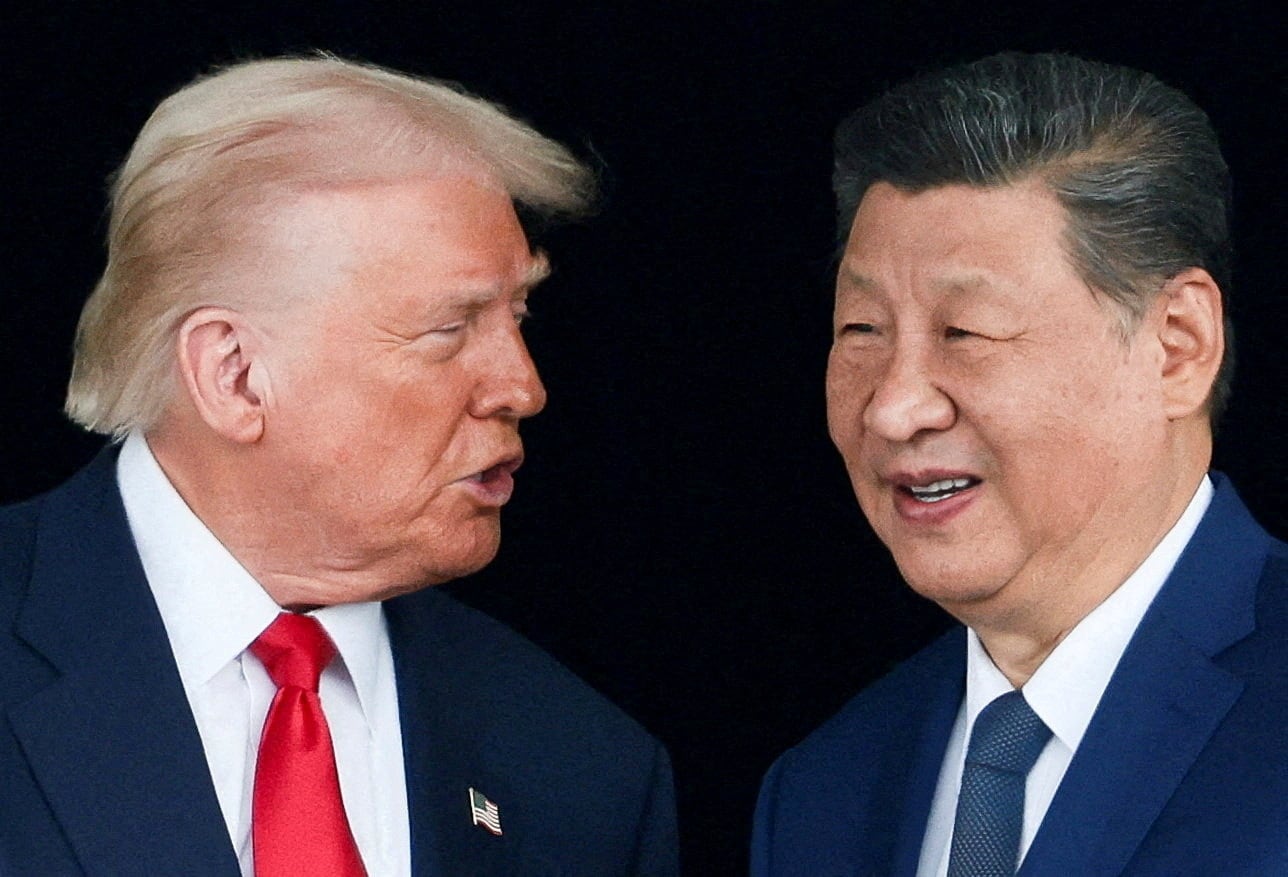
The upcoming summit between Donald Trump and Xi Jinping is frequently framed as a diplomatic theater of tariffs and trade deficits, but the actual friction points are buried deep within the silicon wafers of the world’s most advanced foundries. While the public focus remains on agricultural exports or currency valuation, the survival of the global tech supply chain depends on two specific flashpoints: the strangulation of high-end AI chip access and the battle for dominance over legacy semiconductor manufacturing. If these issues aren't resolved, the result won't just be a trade war, it will be a permanent technological schism that forces every global corporation to choose a side.
The stakes are absolute. For the United States, maintaining a "small yard, high fence" around advanced computing is a matter of national security. For China, breaking through that fence is a matter of national survival. Meanwhile, you can explore similar stories here: The Sky is Falling and We Only Have Seconds to Catch It.
The AI Chip Chokepoint and the Failure of Export Controls
Washington’s current strategy relies on a simple premise: if you stop the flow of high-end GPUs, you stop the development of Chinese military AI. This has manifested in a series of escalating export controls targeting Nvidia and AMD. However, the reality on the ground in Shenzhen and Beijing suggests that these bans are producing unintended consequences that may actually hurt U.S. long-term interests.
China has responded to the chip ban by pouring hundreds of billions of dollars into domestic alternatives. They are not trying to catch up to Nvidia’s latest H100 benchmarks anymore; they are building an entire ecosystem designed to bypass Western architecture altogether. By cutting off Chinese firms from legitimate purchases, the U.S. has inadvertently removed the incentive for China to play by international intellectual property rules. To understand the complete picture, check out the excellent report by Engadget.
We are seeing a massive surge in "gray market" chip smuggling through Southeast Asia and the Middle East. More importantly, Chinese tech giants like Huawei and Biren Technology are being forced into a hyper-accelerated R&D cycle. When you take away a company’s ability to buy, you force them to build. History shows that state-backed industrial pushes, while inefficient in the short term, eventually yield results. The "flashpoint" here isn't just about who gets the chips today, but who owns the standards of tomorrow. If China successfully develops a non-Western AI stack, the U.S. loses its primary tool of economic statecraft: the ability to set global technical standards.
The Legacy Chip Trap Nobody is Watching
While the media obsesses over 3-nanometer chips and generative AI, a much more dangerous crisis is brewing in the world of "legacy" chips. These are the 28-nanometer and 40-nanometer components that power everything from your car’s braking system to medical devices and washing machines.
China is currently flooding the market with these older-generation semiconductors. This is a deliberate strategic move. By subsidizing the production of legacy chips to the point where Western competitors cannot compete on price, China is creating a global dependency. If the Trump-Xi summit ignores this, the U.S. might find itself in a position where it has successfully protected its AI secrets but lost the ability to build a toaster or a truck without Beijing's permission.
The risk of a "dumping" campaign in the legacy chip sector is high. If Chinese foundries capture 70% or 80% of the global market for these basic components, they gain a "kill switch" over the global economy. This is the leverage Xi brings to the table. He knows that while the U.S. holds the keys to the future (AI), China holds the keys to the present (infrastructure).
The Great Decoupling Delusion
Many analysts argue for a total decoupling of the two economies, but this ignores the physical reality of the hardware. You cannot simply move a multi-billion dollar fabrication plant from Taiwan or Shanghai to Ohio and expect it to work overnight. The specialized labor, the chemicals, and the precision lithography equipment are part of a fragile, interconnected web.
Trump’s approach has historically been transactional. He views tech as a bargaining chip to get concessions elsewhere, perhaps on fentanyl or the South China Sea. Xi, conversely, views tech as an existential pillar. This fundamental mismatch in how both leaders value the industry is why previous summits have failed to produce lasting peace. To Xi, a "tech truce" that leaves China dependent on U.S. software is a defeat. To Trump, a deal that doesn't immediately shrink the trade deficit is a loss.
The Taiwan Factor and the Silicon Shield
Every discussion about tech flashpoints eventually leads back to the Taiwan Strait. TSMC (Taiwan Semiconductor Manufacturing Company) remains the single most important company on earth. It produces the vast majority of the world's most advanced chips.
The "Silicon Shield" theory suggests that China will not invade Taiwan because doing so would destroy the very foundries China needs to survive. However, as the U.S. pushes for "onshoring" and encourages TSMC to build plants in Arizona, that shield thins. If the U.S. achieves self-sufficiency in high-end chips, the strategic value of Taiwan shifts. This creates a terrifying window of instability.
During the summit, the underlying tension will be about the "red lines" surrounding Taiwan’s tech exports. If Trump demands that Taiwan stop all shipments to China, it could trigger an immediate economic collapse in Beijing, forcing Xi’s hand. This is the high-stakes poker game that rarely makes the headlines but dictates the entire flow of the meeting.
Data Sovereignty as a Weapon
Beyond the hardware, the way data is handled serves as a secondary flashpoint. China’s Data Security Law and the U.S. moves against TikTok are two sides of the same coin. Both nations are moving toward a "walled garden" approach to the internet.
This isn't just about privacy; it's about training data for AI. Whoever has the most data wins the AI race. By restricting the flow of data across borders, both leaders are essentially trying to starve the other's algorithms. This balkanization of the internet means that global companies will soon have to maintain two entirely separate versions of their products: one for the "West" and one for the "East." The costs of this duplication are astronomical and will be passed directly to the consumer.
The Hard Truth of Industrial Policy
The U.S. CHIPS Act was a start, but it is an reactive measure. It seeks to replicate what China has been doing for twenty years. The problem is that the U.S. political system is not built for long-term industrial planning. It operates on four-year cycles. China operates on decades.
At the summit, Trump will likely push for a "Grand Bargain." He might offer to ease the ban on certain Chinese tech companies in exchange for massive purchases of American energy or aircraft. This would be a tactical mistake. It treats technology as a commodity rather than the foundational substrate of 21st-century power. Xi is unlikely to take the bait anyway; he has learned that U.S. policy can change with a single election. His goal is "Self-Reliance," a term that appears with increasing frequency in Chinese Communist Party documents.
Why a Deal is Unlikely to Stick
Even if a memorandum of understanding is signed in a gilded ballroom, the "Deep State" in both countries—the security apparatus and the military-industrial complexes—will continue to work against it. The Pentagon sees Chinese tech as a Trojan horse. The PLA sees American software as a surveillance tool.
The two nations are in a classic "Prisoner's Dilemma." Both would be better off cooperating, but neither can trust the other enough to take the first step toward de-escalation. Every "peace" in the tech war has been a temporary ceasefire used by both sides to re-arm.
The Immediate Impact on Global Markets
Investors looking for a definitive "winner" from the summit will be disappointed. The most likely outcome is a series of vague promises followed by a return to the status quo of quiet escalation. However, there are three specific areas where we will see immediate shifts:
- Supply Chain Diversification: Expect to see a massive acceleration of the "China Plus One" strategy. Companies will move assembly to Vietnam or India, but they will still be tied to Chinese components.
- Capital Flight: Uncertainty is the enemy of investment. As long as the tech flashpoints remain unresolved, venture capital will continue to retreat from cross-border deals.
- National Champions: Both governments will double down on their "National Champions"—companies like Nvidia and Palantir in the U.S., and Huawei and SMIC in China. These firms are no longer just businesses; they are instruments of state power.
The semiconductor industry was built on the idea of globalism—that a chip could be designed in California, etched in Taiwan, and packaged in Malaysia. That era is over. The "flashpoints" of the Trump-Xi summit are merely the visible heat from a fire that has been burning for years.
Negotiating over chips is not like negotiating over steel or soybeans. When you control the silicon, you control the ability of your opponent to think, to surveil, and to strike. Neither Trump nor Xi is prepared to give up that control, regardless of what the final communiqué says. The world should prepare for a long, cold winter in the global tech sector, where the only thing being traded is suspicion.
The path forward is not found in a return to the old ways of open trade. It requires a cold-eyed recognition that the technological divide is now a permanent feature of the geopolitical landscape. Companies that fail to adapt to this "two-world" reality will find themselves caught in the crossfire of the next inevitable escalation.