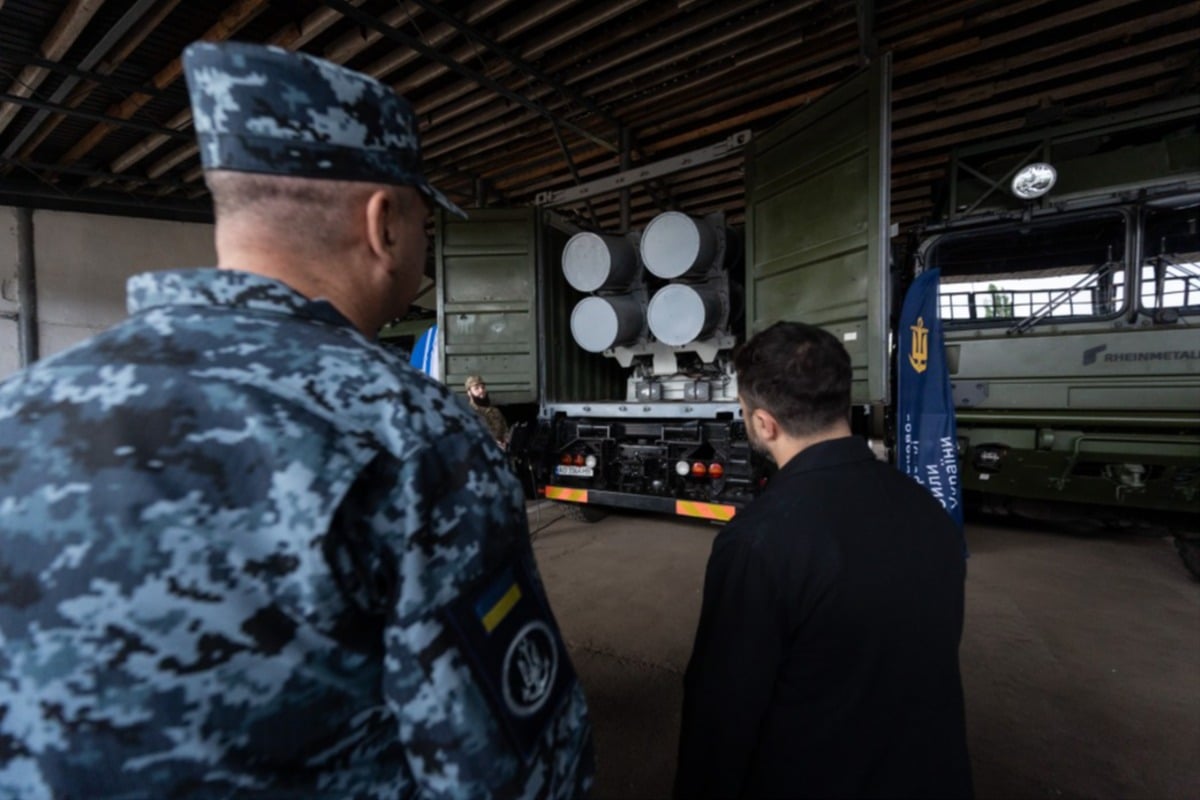
Ukraine has pulled back the curtain on its proprietary coastal defense network, revealing the homegrown anti-ship missile systems and unmanned maritime strike platforms that shattered Russia's naval dominance. This disclosure marks a transition from desperate improvisation to a codified, asymmetric doctrine. By integrating the Neptune cruise missile variant with low-profile drone swarms, Ukraine did not just defend its shoreline; it fundamentally broken the traditional framework of littoral warfare. The strategy forced a blue-water navy into retreat without Ukraine possessing a conventional fleet of its own.
For decades, naval orthodoxy dictated that controlling the seas required tonnage. Big ships, heavy armor, and multi-billion-dollar air defense destroyers were the baseline metrics of maritime power. The conflict in the Black Sea has turned that calculus upside down.
The Mechanics of Asymmetric Denial
Coastal defense is rarely about winning a classic naval engagement. It is about spatial denial. Ukraine realized early that it could not match the Russian Black Sea Fleet hull for hull, so it focused entirely on making the northern Black Sea lethal for any Russian vessel attempting an approach.
The backbone of this strategy rests on the upgraded R-360 Neptune system. Originally designed as a subsonic anti-ship missile based on older Soviet architecture, the modern iteration features advanced target-acquisition radars and low-altitude skimming capabilities. When a Neptune launcher fires from a concealed inland position, the missile drops to mere meters above the water line. This hugs the radar horizon, leaving shipborne automated defense systems like the AK-630 close-in weapon system only seconds to react before impact.
But hardware alone did not clear the western Black Sea. The real breakthrough lies in sensor fusion. A missile launcher is blind without targeting data, and turning on a massive search radar is an invitation to a pre-emptive strike. To bypass this, the defense network utilizes a distributed web of passive sensors, western intelligence feeds, and reconnaissance drones. They calculate the target coordinates before the missile battery even spins up its engines.
The Role of Domestic Production Under Fire
Building high-tech weaponry during a full-scale bombardment presents staggering logistical hurdles. The manufacturing footprint for these coastal defense systems must remain highly fragmented. Component assembly happens in underground facilities, moving frequently to avoid satellite detection.
This decentralized production chain ensures survivability, but it introduces massive quality control friction. A single bad actuator or a sub-spec guidance chip can cause a multi-million-dollar missile to plunge harmlessly into the sea. The fact that production lines continue to output functional guidance systems while under persistent missile threats points to an incredibly agile engineering underground.
Drones as Force Multipliers for Traditional Artillery
Missiles are expensive and limited in supply. To sustain a long-term denial strategy, the coastal command integrated uncrewed surface vessels into the defensive calculus. These are not merely explosive speedboats; they function as remote scouting assets and psychological weapons.
+------------------+     Target Data     +-------------------+
|  Passive Sensors | ------------------> | Mobile Command    |
|  & Intel Feeds   |                     | Center            |
+------------------+                     +-------------------+
                                                   |
                                                   | Fire Order
                                                   v
+------------------+   Low-Altitude Flight   +-------------------+
| Russian Warship  | <---------------------- | Neptune Launcher  |
+------------------+                         +-------------------+
When deployed in coordinated waves, these maritime drones force enemy warships to expend ammunition, reveal their defensive radar frequencies, and perform evasive maneuvers. Once a warship is distracted by maneuvering away from a drone swarm, its vulnerability to a synchronized land-based missile strike increases exponentially.
This combination creates a tactical dilemma for an opposing commander. Focus on the horizon for incoming missiles, and the hull gets breached by a low-profile drone. Focus the optics downward to spot the drones, and the superstructure gets gutted by a skimming cruise missile.
The Logistics of Constant Modification
The cat-and-mouse game on the water moves incredibly fast. When the Russian navy began painting deceptive camouflage on their hulls to confuse optical tracking algorithms, drone programming teams had to rewrite targeting software within days.
This environment demands immediate iteration. If a specific radio frequency gets jammed during an operation, the field engineers swap out the transceivers for the next batch before the week ends. It is a pace of development that traditional, bureaucratic defense contractors cannot match.
Global Implications for Littoral Nations
The operational success of this coastal defense network offers a blueprint for smaller nations facing larger maritime adversaries. Islands and littoral states are studying these engagements to rewrite their own defense procurement lists. The market for massive, slow-moving corvettes is shrinking in favor of mobile, shore-based launchers and autonomous swarms.
However, replicating this success is not guaranteed. The Black Sea is a confined body of water, offering unique geographic constraints that favor land-based spotters. In an open ocean environment, the lack of long-range organic aerial radar would severely limit the effectiveness of shore-based anti-ship batteries. A nation attempting to copy this model without an established, highly resilient satellite or over-the-horizon radar network will find their expensive missile batteries blind when targets move beyond the immediate coastline.
The myth of the invulnerable surface fleet has evaporated. True security along a contested coast no longer belongs to the side with the largest ships, but to the side that can master the invisible web of distributed sensors and rapid, low-altitude strikes from the shadows of the shore.