The water does not care about borders.
It never has. It laps against the concrete pilings of the European Union’s southern edge with a rhythmic, indifferent persistence, carrying salt, seaweed, and the exhausted hopes of thousands. To stand on the shore at Ceuta is to stand at the exact point where an abstract geopolitical theory collides with jagged rock and cold Atlantic spray.
Seventy-two.
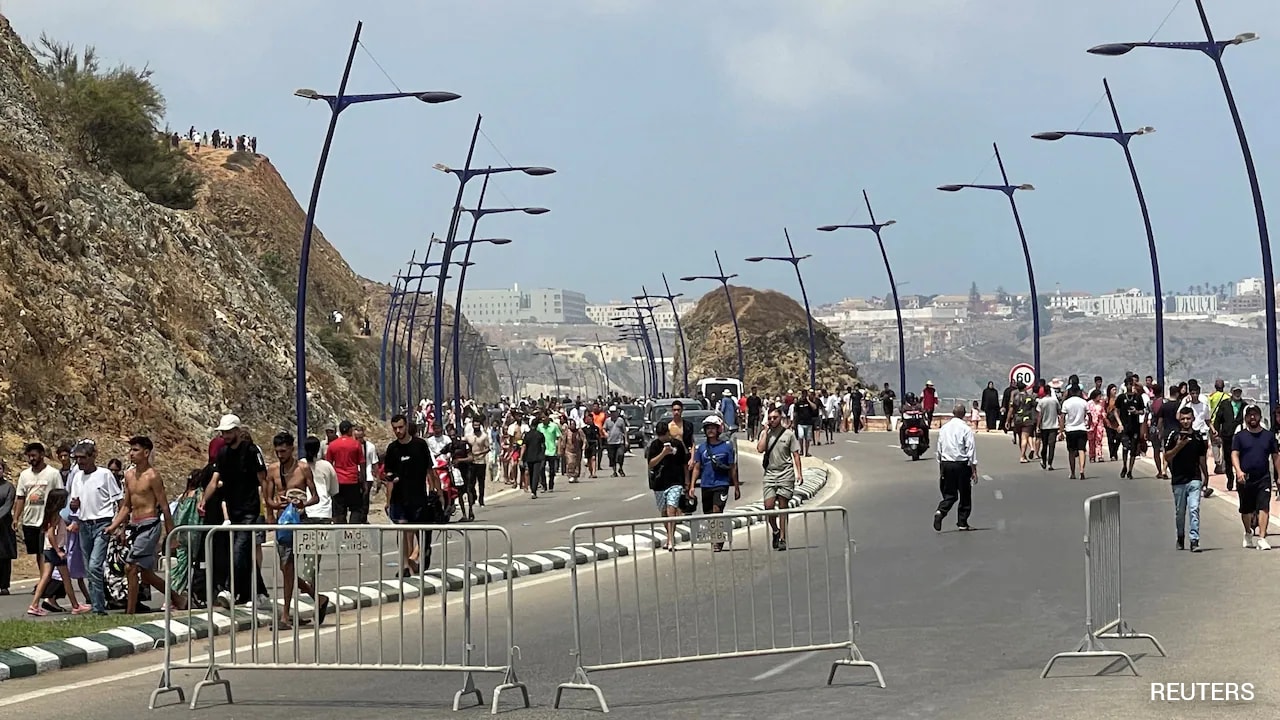
That is the number recorded in the wake of a single, staggering surge. Behind that sterile statistic lie lungs filled with saltwater, limbs bruised against razor wire, and families fractured across continents. Sixty thousand people pressed against Spain’s African enclave in a movement that defied historical precedent, transforming a quiet coastal garrison into the center of a continental reckoning.
Numbers like sixty thousand are easy to throw around in parliamentary debates. They look impressive on spreadsheets. They sound like emergencies when shouted by television anchors. But sixty thousand is not an army. It is a mass of individuals, each carrying a singular, heavy reality.
Consider a hypothetical young man named Tariq, standing ankle-deep in the Mediterranean mud at dawn. He is twenty-four, though the sun and stress have aged him into something older. In his pocket rests a waterproofed plastic bag containing a ruined smartphone and a faded photograph of his mother. He does not know about the Schengen Agreement. He does not care about the geopolitical tensions between Madrid and Rabat. He knows only that the air behind him smells of burning tires and dead ends, while the air ahead smells of a fragile, distant chance at survival.
When the tide of humanity broke over the border fences of Ceuta, it did not happen in a vacuum. It was the culmination of deferred dreams, shifting diplomatic pressures, and the simple, terrifying physics of human desperation.
Water always finds the cracks.
For decades, Europe has treated its southern borders as administrative plumbing. Build a higher pipe. Install a stronger valve. Turn the handle when the pressure gets too high. But borders are not pipes. They are porous membranes made of human choices, economic disparities, and geography. When economic collapse, climate stress, and political instability converge in the Sahel and North Africa, the pressure builds until the infrastructure shatters.
The security forces on the ground faced an impossible math. How do you stop a river with a riot shield?
Eyewitnesses spoke of a surreal dawn where the gray Atlantic met an equally gray wall of humanity. Rubber dinghies scraped against the shore, packed far beyond any safe engineering limit. Children were hoisted above shoulders, dripping wet and crying, handed across barriers to strangers in uniform who wore expressions of grim resignation. There was no joy in the crossing. There was only the stunned silence of people who had survived the impossible, only to realize the labyrinth was just beginning.
History teaches us a harsh lesson about walls. They rarely keep out what they are meant to deter; they merely change the shape of the entry.
When the fences went up higher, the crossings became more perilous. When the patrols multiplied, the routes shifted to deadlier open waters. Every policy decision made in air-conditioned rooms in Brussels or Madrid ripples outward, altering the calculus of survival for a teenager sitting on a curb in Casablanca or Dakar.
We talk about migration as if it were a weather event. A storm front moving across a map. A natural disaster to be endured and cleaned up after.
It is not.
Migration is a symptom. It is the visible feedback loop of a global economy that concentrates wealth in small, heavily fortified pockets while leaving vast regions to wither under the weight of corruption, conflict, and ecological decay. To look at seventy-two bodies pulled from the surf and sixty thousand people breaching a fence as a mere security failure is to misunderstand the entire machine.
It is a human reaction to an unbearable equation.
The silence after the surge is different from the silence of peace. It is the heavy, loaded quiet of a holding cell. In the temporary detention centers, the air is thick with the scent of disinfectant, damp wool, and unwashed skin. Volunteers move quietly between rows of cots, handing out foil blankets that crinkle with every restless turn.
A middle-aged woman sits staring at her hands. She lost her husband somewhere off the coast of Fnideq when their wooden skiff capsized in the dark. She does not weep anymore. Her eyes have taken on the flat, polished look of stones smoothed by centuries of rushing water. She has crossed a continent only to find herself trapped in legal limbo, waiting for a bureaucrat to stamp a paper that will either grant her a tentative future or send her back to the starting line.
This is the hidden cost of the modern frontier.
It is measured not just in euros spent on razor wire or patrol boats, but in the slow erosion of empathy. We grow weary of the images. We scroll past the headlines because the scale of the suffering feels too vast to process. We build our own mental walls, brick by brick, convincing ourselves that distance is a form of safety.
Yet the sea keeps washing ashore.
The geopolitical chess match continues. Accusations fly between capitals. Agreements are signed, broken, and renegotiated in secret rooms. Yet none of these diplomatic maneuvers alter the fundamental truth of the shoreline. People will walk toward light when the dark becomes unlivable.
Dawn breaks over Ceuta again.
The water is calm today. Gulls wheel overhead, crying out in harsh, rhythmic bursts against the wind. The tourists have not yet returned to the beaches, leaving the sand pale and undisturbed save for the faint, crisscrossing tracks of boots and rubber soles.
Out there, beyond the horizon, the tides are turning once more. The pressure is building in the quiet places, out of sight and out of mind, waiting for the next moon, the next crisis, the next desperate calculation.
The wall stands. The water presses on.