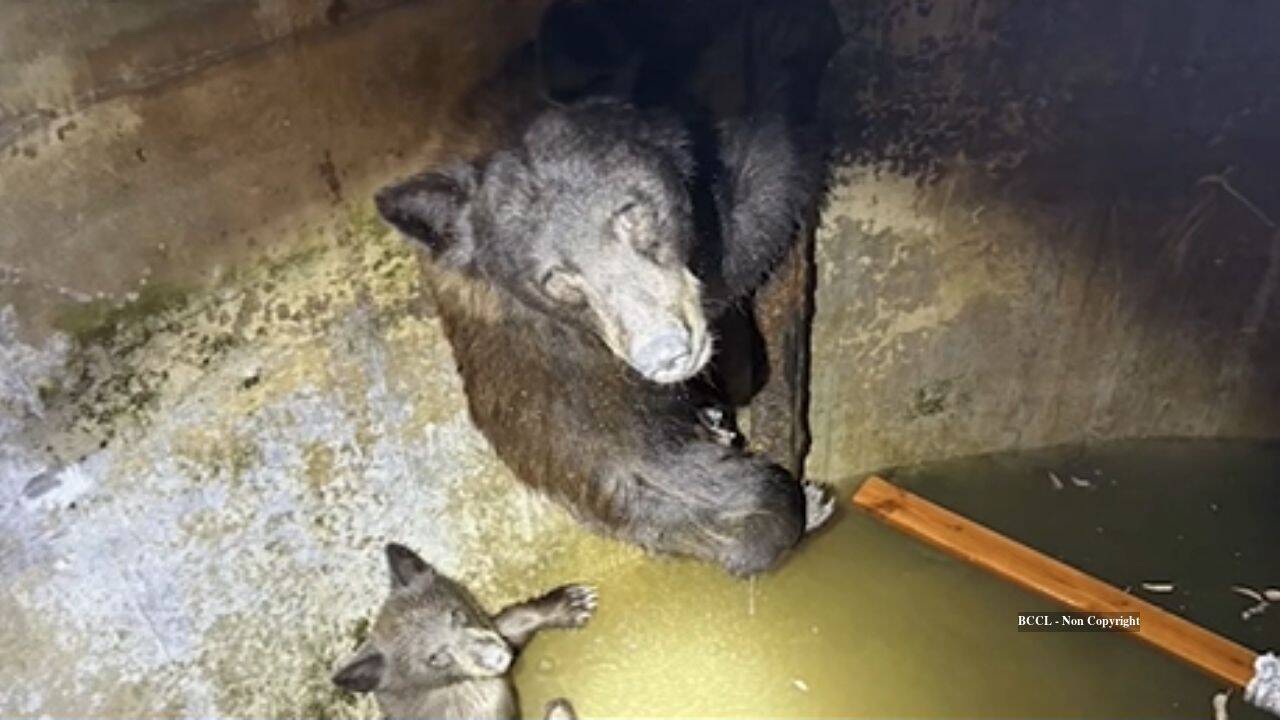
The internet wept over the viral headline. A mama bear and her cubs trapped inside a California water tank, howling for rescue, saved by local authorities just in the nick of time. Cue the applause, the heartwarming social media shares, and the collective sigh of relief from a public that treats wildlife management like an episode of a Saturday morning cartoon.
Stop cheering. For another look, see: this related article.
Every time a municipal crew drops a ladder into an agricultural or residential water storage container to haul out a stranded apex predator, we aren't witnessing a triumph of conservation. We are watching a masterclass in ecological enablement. We are rewarding poor animal navigation with a get-out-of-jail-free card, training urban-adjacent wildlife that human infrastructure is a reliable playground, and shifting the evolutionary burden off the animal onto taxpayers.
I have spent two decades tracking human-wildlife conflict zones across the American West. I have watched billions of dollars and countless man-hours poured into reactive rescues that soothe human emotional fragility while actively harming the very species they claim to protect. We love the drama of the rescue because it makes us feel like heroes. But true stewardship isn't about pulling a bear out of a tank. It is about making the tank inaccessible in the first place, and accepting that nature includes natural selection. Similar analysis on this matter has been published by TIME.
The Lazy Consensus of Feel-Good Conservation
The mainstream narrative surrounding wildlife rescue is built on a comforting lie. The consensus assumes that every animal in distress represents a systemic failure of the environment, and our moral obligation is to intervene, rehabilitate, and release.
This view ignores basic behavioral ecology. Bears are not stupid. They possess cognitive maps that rival those of primates. When a black bear wanders into an open or poorly secured agricultural basin, smells the condensation, and falls in, it learns a lesson. If that lesson ends with a helicopter crew, local sheriff deputies, and a media crew lifting it out safely, what is the reinforced takeaway?
The takeaway is that human infrastructure is a vertical cave system filled with water and high-calorie surprises, complete with an emergency extraction service if things get slippery.
We call this ecological trap amplification. By rescuing every bear that tumbles into a backyard pool or a rural water tank, we short-circuit natural consequence. We ensure that the genetic lines least adapted to navigating modern, human-dominated landscapes survive to breed another generation of urban foragers.
The Mechanics of Structural Negligence
Let us look at the actual engineering failure here, because the blame rarely lies with the animal. Water tanks in rural California are notorious for lacking basic wildlife exclusion measures. A standard, open-topped agricultural storage basin is essentially a death funnel for any mammal weighing over fifty pounds.
Municipalities and private landowners treat water storage as an isolated mechanical asset, ignoring the surrounding biological matrix. They bolt down a lid or string a flimsy mesh netting that a sub-adult bear can shred with a single swipe of a paw, and call it a day.
When a bear falls in, the media focuses on the howls. They frame the vocalizations as cries of despair. From a biological standpoint, those howls are requests for extraction that we foolishly fulfill.
Imagine a scenario where we stopped treating these incidents as heartwarming rescue operations and started treating them as structural code violations. If every rancher or homeowner whose poorly secured water tank required a wildlife extraction faced mandatory, punitive fines covering the full operational cost of the state fish and wildlife department deployment, infrastructure would change overnight.
Heavy-duty, bolted steel covers, escape ramps built into every commercial trough, and perimeter fencing would suddenly become priority investments. Instead, we socialize the cost of stupidity. We let property owners leave death traps sitting in the brush because they know the state will swoop in with a crane and a PR team to fix the mess for free.
The Downside of Our Contrarian Prescription
I am not naive. The approach I am advocating comes with a brutal human cost, and intellectual honesty requires admitting it.
If we stop performing high-profile technical rescues for every animal that blunders into human infrastructure, mortality rates for urban-interface bears will spike. Some animals will drown. Others will starve in concrete bowls before someone notices. For animal welfare advocates, that imagery is stomach-turning.
Furthermore, a hardline hands-off policy risks public backlash. People like their wildlife sanitized, protected, and perpetually rescued. Telling a rural community to let an animal face the consequences of its own exploration sounds callous, even cruel.
Yet, the alternative is worse. The alternative is a compounding population of habituated bears that view human settlements not as barriers, but as safety nets. Every rescued bear is a ticking clock. Studies tracking relocated or rescued urban bears show a depressing recidivism rate. Animals that lose their natural fear of human machinery through repeated close contact invariably end up euthanized a year later after breaking into a kitchen or charging a hiker.
Our rescue obsession is just a slow-motion death sentence disguised as compassion.
Dismantling the FAQs of Wildlife Rescue
People ask: Don't we have a moral duty to help an animal suffering right in front of us?
Our moral duty is to the long-term viability of the ecosystem, not to the emotional comfort of the observer. Individual suffering is a fundamental engine of natural selection. By insulating animals from the physical realities of the habitats they choose to colonize, we degrade the species' overall fitness.
People ask: Aren't humans responsible for destroying their habitat, meaning we owe them safe passage?
This is the most pervasive myth in conservation. Black bear populations across North America are not declining; they are expanding. They are thriving in fragmented, human-altered landscapes precisely because they are generalist omnivores. They are moving into suburbs and agricultural zones because the calories are easy, not because they have nowhere else to go. Blaming habitat loss for a bear falling into a backyard water tank is like blaming urban sprawl for a burglar falling through a skylight.
The Uncomfortable Action Plan
If we want to fix this, we need to abandon the rescue-industrial complex and embrace aggressive prevention.
- Mandate Exclusion Engineering: Pass municipal and state ordinances requiring all commercial and agricultural water containment structures over five hundred gallons to feature permanent, bear-proof hard covers or built-in, textured egress ramps.
- Shift Liability: Make landowners financially liable for any wildlife intervention required due to unsecured water sources. Hit the wallet, and the infrastructure hardens instantly.
- Embrace Lethal and Non-Intervention Realities: Accept that when an animal crosses the line into a man-made hazard due to human negligence or its own poor navigation, intervention should be the rare exception, not the viral rule.
We do not need more heroes with ropes and winches. We need fewer idiots with open buckets of water. Stop celebrating the extraction. Start demanding the lid.