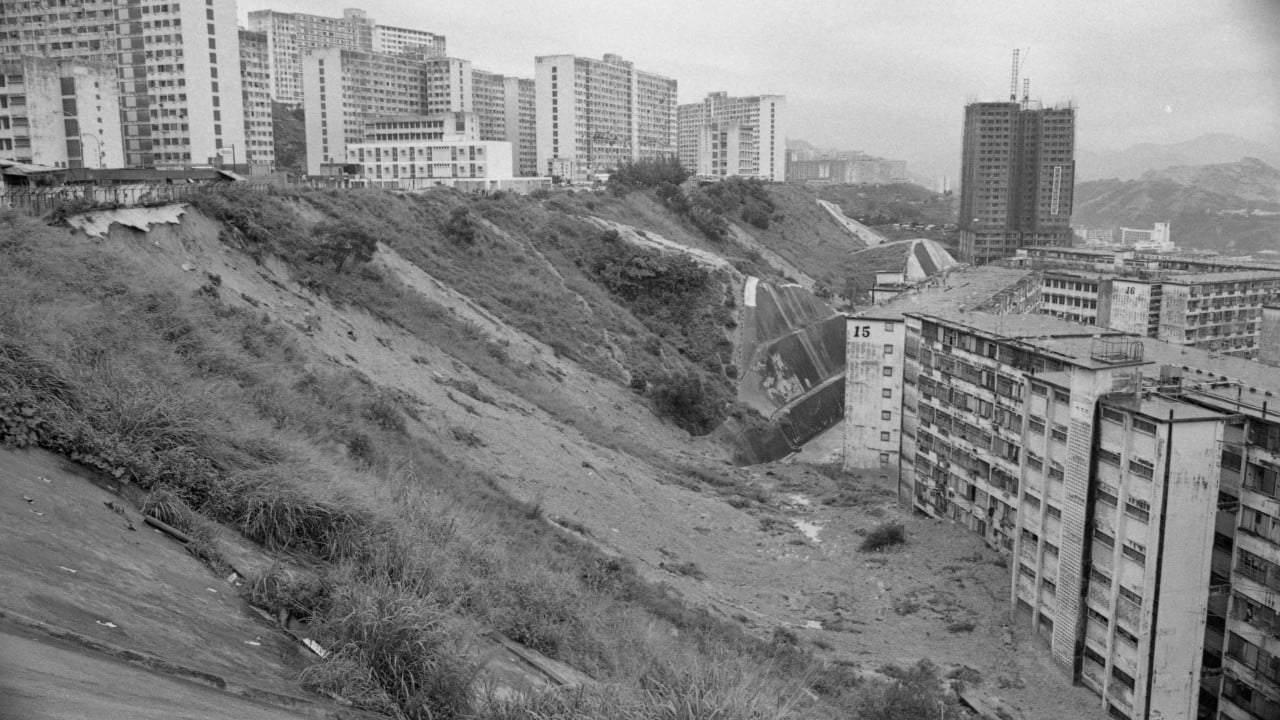
Tons of liquefied mud do not care about your address. On August 25, 1976, torrential rain triggered a catastrophic slope failure behind Block 9 of the Sau Mau Ping Estate in Hong Kong, killing 18 people. Heavy soil smashed directly into the lower residential floors, burying families under mud. It wasn't an isolated anomaly. Just four years prior, a separate slope failure nearby had claimed 71 lives.
Hong Kong learned a brutal lesson those decades ago. Unchecked urban growth on steep, vulnerable hillsides combined with monsoon downpours equals disaster. If you look at how the city handles engineering today, its modern safety protocols were written in the blood of these tragedies.
The Anatomy of the Sau Mau Ping Disasters
Geography in Hong Kong is an ongoing engineering challenge. Hills rise sharply behind dense human settlements. Back in the 1970s, rapid public housing expansion meant engineering standards couldn't always keep pace with the sheer volume of construction.
The 1976 disaster struck close to home for survivors of the June 1972 catastrophe. While the 1972 event wiped out squatter huts with 71 deaths, the 1976 tragedy breached the ground floor of a massive public housing block holding roughly 1,200 residents. Fire services and the military spent entire nights working under searchlights to pull bodies from tons of wet earth.
The primary culprit was fill-slope instability. Engineers built up slopes using loose earth rather than solid rock or reinforced structures. When relentless monsoon rains saturated the soil, internal water pressure skyrocketed. The earth lost its friction. Gravity took over instantly.
How Government Response Rewrote Global Safety Standards
You cannot overstate the impact these repeated disasters had on local governance. Before the mid-1970s, slope maintenance was fragmented across different departments. No single entity held accountability for the thousands of vulnerable man-made slopes hanging over residential quarters.
The government realized reactive rescue missions weren't enough. They needed absolute prevention. This realization birthed the Geotechnical Engineering Office (GEO) in 1977.
Instead of waiting for hills to slide, officials launched systematic hazard mapping. Every single man-made slope across the territory received an official registration number, risk rating, and mandatory maintenance schedule. Private owners faced strict legal enforcement to maintain their retaining walls. If a private slope showed signs of distress, the government stepped in, fixed it, and billed the owner later.
Modern Slope Safety Realities
Fast forward to today, and Hong Kong stands as a global benchmark for urban slope engineering. Soil nails, subsurface drainage pipes, wire mesh netting, and shotcrete walls cover hillsides throughout the territory.
Yet complacency remains the primary threat. Climate change brings heavier, more erratic rainfall events. Modern storms pack intensity levels that old engineers never modeled. Even with advanced warning systems and automated landslide telemetry, living in a vertical city requires perpetual vigilance.
Property owners often ignore minor warning signs. Hairline cracks in retaining walls, muddy runoff during light rain, or newly leaning trees signal internal slope movement. Ignoring these red flags invites disaster.
Check your local drainage paths if you live near an elevated slope. Report unauthorized earth-cutting immediately. Urban survival in a dense, rainy metropolis relies on collective accountability, because structural negligence always catches up with you.