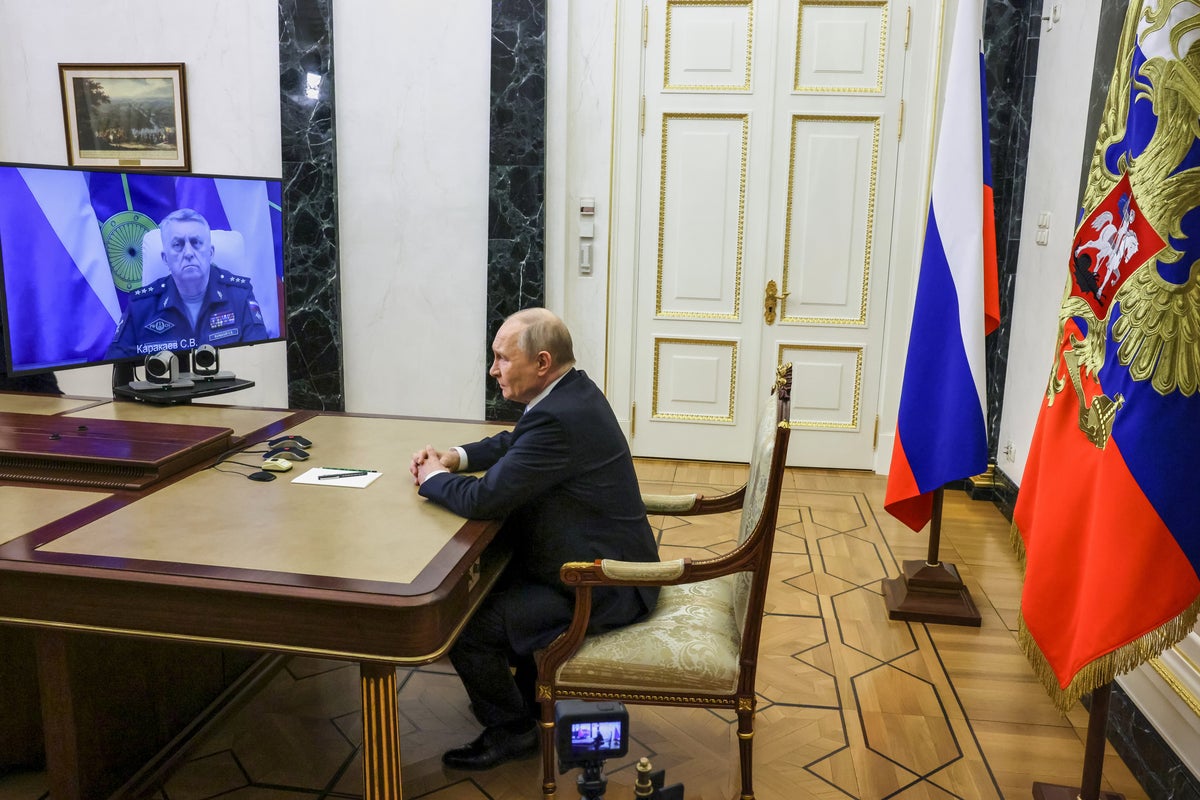
The headlines are screaming about a "super-weapon." Vladimir Putin just stood in front of a camera to claim the RS-28 Sarmat—the missile NATO calls "Satan II"—is the world’s most powerful kinetic asset. The mainstream media is dutifully repeating the talking points, breathless about "invincible" payloads and "unprecedented" range.
They are falling for a magic trick.
The obsession with "the most powerful missile" is a relic of 1960s thinking that ignores the reality of modern strategic deterrence. We are witnessing the birth of geopolitical vaporware. When a leader spends more time talking about a weapon's theoretical capabilities than actually deploying it in a functional, integrated combat system, you aren't looking at a threat. You are looking at a PR campaign designed to mask a crumbling conventional foundation.
The Overkill Trap
The "lazy consensus" among defense analysts is that the Sarmat changes the global math because it can carry 10 to 15 MIRV (Multiple Independently Targetable Re-entry Vehicle) warheads. The logic suggests that more warheads equals more leverage.
It doesn’t.
Nuclear deterrence is binary. You either have the capability to ensure Mutually Assured Destruction (MAD), or you don't. Russia has had that capability since the Eisenhower administration. Adding a bigger, heavier, more expensive rocket to deliver those warheads is the equivalent of buying a gold-plated sledgehammer to crack a nut you were already successfully cracking with a standard hammer.
The Sarmat is a liquid-fueled behemoth. In an era of rapid-response solid-fuel tech—like the US Minuteman III or the Russian Yars—relying on a massive liquid-fueled silo-based missile is a step backward. Liquid fuel is volatile. It’s hard to maintain. It makes the silos prime targets for a "use them or lose them" scenario.
The Hypersonic Myth vs. Reality
The big selling point of the Sarmat isn't just the weight; it's the compatibility with the Avangard hypersonic glide vehicle. We’re told these can dodge any missile defense system currently in existence.
Let’s dismantle that.
Missile defense has always been a game of probabilities, not certainties. No one—not the Pentagon, not the Kremlin—actually believes a mid-course interceptor system could stop a massive Soviet-style saturated strike. We don't need "hypersonic" maneuvers to bypass defenses that are already mathematically overwhelmed by sheer volume.
The real bottleneck isn't the speed of the missile; it's the quality of the targeting data and the reliability of the command structure. Having a "super-missile" is useless if your GLONASS satellite constellation is degraded or if your ground-based sensor net is riddled with 1980s-era vacuum tubes.
I’ve watched defense contractors burn through billions trying to solve the "re-entry physics" of hypersonic flight. The heat generated at Mach 20 creates a plasma sheath that makes communication and guidance nearly impossible. To claim these weapons are "unstoppable" ignores the fact that they are, as of right now, largely unguided once they start their high-alpha maneuvers.
The Cost of Posturing
Every ruble spent on the Sarmat is a ruble not spent on encrypted radios, drone integration, or basic logistics for the ground forces. This is the "Big Shiny Object" strategy.
- Conventional rot: While the Sarmat is hailed as world-leading, the conventional military has struggled with basic supply chain management.
- The maintenance burden: Silo-based heavy ICBMs require a massive, static footprint that is easily monitored by commercial satellite imagery.
- The psychological play: This isn't a weapon for a general; it's a weapon for a domestic audience. It provides the illusion of parity while the technological gap in precision-guided munitions (PGMs) and AI-driven battlefield management continues to widen.
Dismantling the "Invincibility" Narrative
People also ask: "Can the US stop the Sarmat?"
The honest, brutal answer is: No. But we couldn't stop the older R-36M either.
The question itself is a distraction. The goal of a nuclear weapon is never to be used. Therefore, the "power" of the weapon is entirely psychological. If the Sarmat is so powerful that it makes the user feel "invincible," it actually increases the risk of a miscalculation in conventional conflicts.
Imagine a scenario where a leadership team believes their nuclear shield is so impenetrable that they can ignore the red lines of conventional warfare. That leads to the "Stability-Instability Paradox." By making the nuclear level "stable" (through terrifying overkill), you make the conventional level "unstable" because you think you can get away with anything.
The Engineering Reality Check
Let's look at the math of $E=mc^2$. A warhead doesn't care if it was delivered by a "super-missile" or a 40-year-old truck. The blast radius remains the same.
The Sarmat’s supposed 18,000km range is being touted so it can "attack via the South Pole." This is technically impressive and strategically irrelevant. Why fly over the South Pole when you can just launch a sub-surface missile from the Atlantic? It’s a solution in search of a problem. It’s over-engineering for the sake of a headline.
The Trust Gap
We are told the test was a "complete success." In the world of aerospace engineering, "complete success" on a first or second full-scale test of a system this complex is statistically rare.
When I see a defense program that claims zero setbacks, I don't see brilliance; I see suppressed data. True innovation is messy. It involves engines exploding on the stand and telemetry failing in the upper atmosphere. The "flawless" narrative surrounding the Sarmat is the clearest indicator that this is a political project first and a military asset second.
The obsession with "the world's most powerful" anything is a loser’s game. In modern conflict, the "most powerful" tool is the one that is invisible, integrated, and actually works when the power goes out. A giant rocket in a hole in the ground is just a very expensive target.
Stop looking at the fire and smoke of the launch pad. Start looking at the microchips and the logistics trains. That’s where the real wars are won and lost. The Sarmat is a distraction. Don't let the glare of the engines blind you to the fact that the era of the "Heavy ICBM" ended decades ago.
Everything else is just theater.
Go back and look at the telemetry data—if you can find it. You’ll see a weapon system designed for a world that no longer exists, built by a budget that can’t afford it, to scare an enemy that has already moved on to a different map.
The missile isn't the point. The fear is the point. And fear is the cheapest weapon in the arsenal.
Stop buying it.