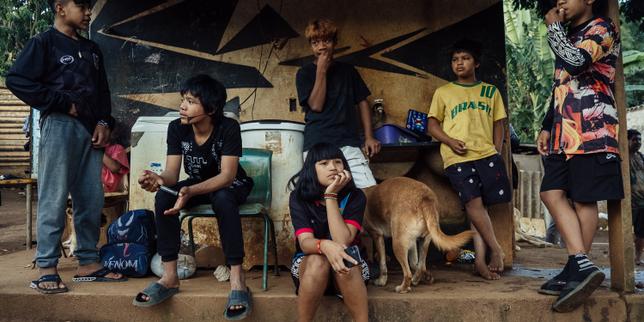
The megacity of Sao Paulo expands outward like an insatiable organism, consuming every patch of green in its path. At its northern periphery, this concrete tide crashes against an ancient barrier. It is the Jaragua Indigenous Territory, legally recognized as the smallest indigenous reserve in Brazil. Spanning just over three hectares in its primary demarcated section, this postage-stamp sanctuary serves as the ancestral home of the Guarani Mbya people.
Urban encroachment has transformed their homeland into an isolated green island surrounded by asphalt, industrial parks, and high-density housing developments. The pressure from real estate speculation and municipal neglect threatens the very survival of these communities. Journalists often report on Amazonian deforestation with massive aerial photography, but the silent strangulation of urban indigenous reserves in Brazil receives far less attention. This micro-territory tells a story of systemic pressure, broken government promises, and an indigenous community forced to defend their culture within shouting distance of a sprawling metropolis.
The Geography of Confinement
To understand the crisis at Jaragua, one must look at the math of modern urban growth. Sao Paulo houses over twelve million residents within its municipal borders, pushing outward relentlessly. The Jaragua territory sits at the foot of the Pico do Jaragua, the highest peak in the city.
The original demarcation established in the late twentieth century allocated a minuscule portion of land to the Guarani. Families originally lived across a broader expanse of forest, hunting, gathering, and practicing traditional agriculture. As the city paved over these corridors, the boundaries hardened into prison walls of concrete.
- Spatial Suffocation: The primary village, Tekoa Itypona, and surrounding settlements are packed tightly together, leaving no room for traditional swidden agriculture or the expansion of community housing.
- Ecological Isolation: Wildlife corridors have been severed by highways like the Rodovia dos Bandeirantes and local arterial roads, trapping indigenous fauna and cutting off spiritual connections to the wider forest.
- Infrastructure Pressures: Sewage runoff from unauthorized hillside housing developments above the reserve frequently threatens local streams, compromising the water supply that the Guarani rely upon.
State and federal authorities have dragged their feet on expanding the reserve boundaries despite anthropological studies confirming that the historical territory of the Guarani Mbya covers a much larger area. Bureaucratic inertia acts as a silent partner to real estate developers who view the surrounding green buffers as prime land for logistics warehouses and middle-class apartment blocks.
The Clash Over Land Titling
Legal recognition in Brazil operates as a multi-stage bureaucratic maze designed to test the patience of marginalized populations. For the Guarani at Jaragua, the battle for an expanded demarcation decree has dragged on for decades.
In recent years, federal agencies issued decrees recognizing a larger area of roughly five hundred hectares. This administrative victory triggered immediate pushback from local politicians, real estate syndicates, and private landowners holding disputed titles within the buffer zone. Lawsuits filled state and federal courts, freezing the land regularization process.
Opponents of the expansion argue that returning land to the indigenous population stifles economic growth and housing development in a region desperate for infrastructure. This framing presents a false dichotomy between human survival and urban progress. The expansion zone does not contain skyscrapers or major industrial hubs; it consists largely of secondary forest, steep hillsides prone to landslides, and contested private lots held for speculation.
The Guarani do not seek luxury or commercial exploitation of the soil. They demand the right to practice their customs, plant native crops, and protect the remaining forest canopy that helps cool a notoriously polluted megalopolis. Every hectare saved at Jaragua functions as an ecological lung for Sao Paulo, scrubbing carbon from the air and managing stormwater runoff that would otherwise flood working-class neighborhoods downstream.
Cultural Resistance in the Concrete Jungle
Living inside a compressed territory forces the Guarani to adapt without surrendering their identity. Elders pass down oral histories, language, and spiritual rituals inside community houses constructed from wood and thatch, even as the distant rumble of diesel trucks provides a constant soundtrack to daily life.
Artisan crafts serve as an economic lifeline and cultural expression. Because traditional hunting and gathering are impossible within three hectares, community members travel to city squares and cultural centers to sell woven baskets, carved wooden animals, and traditional beadwork. This integration into the urban economy is not a choice born of assimilation; it is a survival mechanism forced upon them by spatial deprivation.
State schooling systems often fail to respect indigenous pedagogy. Community leaders have fought to establish bilingual education programs within the reserve, ensuring children learn both Portuguese and Mbya Guarani. These classrooms function as bulwarks against cultural erasure, teaching ecological stewardship rooted in indigenous philosophy.
Yet, external pressures remain relentless. Drug trafficking networks operating in the surrounding urban periphery occasionally spill into the fringes of the reserve. Municipal police responses are often heavy-handed, treating indigenous youth with the same suspicion applied to marginalized urban populations across Sao Paulo.
The Broader Implications for Brazilian Land Rights
The battle lines drawn at Jaragua echo across Brazil. While international headlines focus on the Amazon basin, dozens of ethnic groups live on the edges of major cities or within agricultural heartlands where agribusiness and urban sprawl collide with constitutional rights.
The Federal Constitution of 1988 guaranteed indigenous peoples permanent rights over their traditional lands. Article 231 recognizes their original rights to the lands they traditionally occupy, defining traditional occupation broadly enough to encompass ancestral territories now covered by cities. When governments stall demarcation processes, they violate foundational legal frameworks to appease short-term economic interests.
Sao Paulo municipal leaders frequently promote sustainability initiatives, planting trees in wealthy neighborhoods and investing in green building certifications. Simultaneously, they ignore the indigenous guardians who have protected the largest remaining tract of Atlantic Forest in the northern zone for generations. This hypocrisy exposes the limits of urban environmentalism when it refuses to confront land justice.
Resolving the Jaragua crisis requires political will at the federal level to finalize land titling without bowing to local real estate lobbies. It requires municipal cooperation to provide basic sanitation, healthcare access, and security without infringing upon autonomy.
The concrete continues to press against the boundaries of the forest. The Guarani remain inside, cultivating their culture on a dwindling patch of earth while the metropolis rushes past them toward an uncertain ecological future.


