
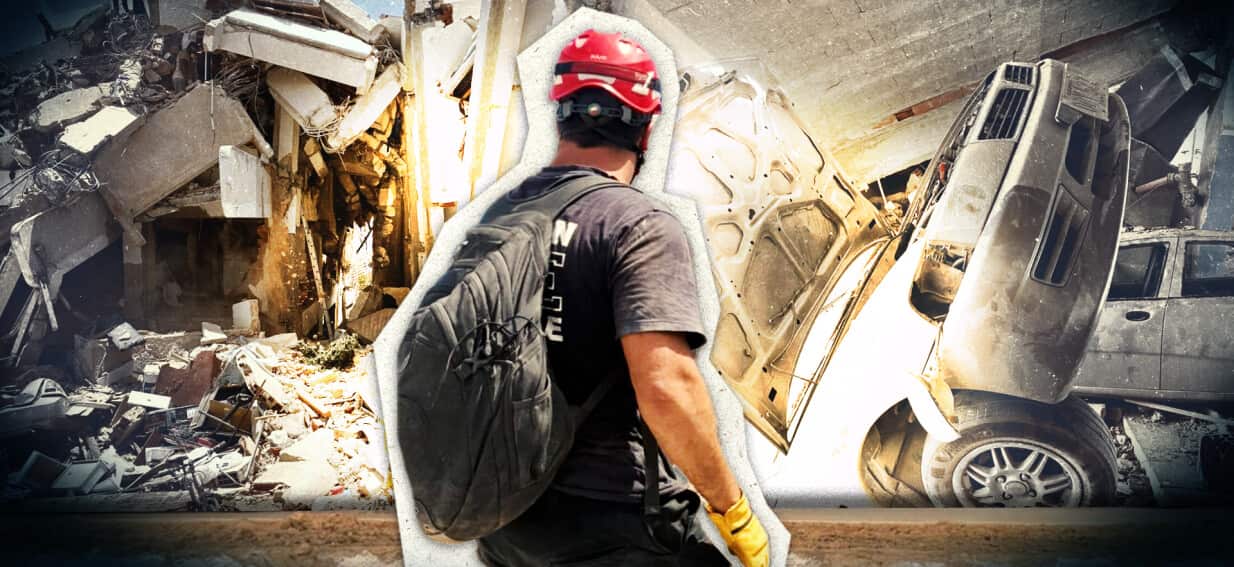
The traditional global supply chain for modern construction relies on three core elements: steel, standard Portland cement, and aggregate. In the Gaza Strip, a near-total blockade on these materials has forced a radical, localized pivot toward primitive engineering. Local builders, engineers, and families are currently constructing semi-permanent housing out of pulverized war debris, compressed earth, and crude clay mixtures. This is not a creative sustainability trend. It is a desperate, structurally volatile survival mechanism born out of absolute material deprivation.
While international aid discussions frequently focus on the logistical gridlock at border crossings, a parallel crisis is unfolding on the ground. The immediate reality is that hundreds of thousands of displaced people require immediate shelter before political resolutions manifest. To understand how Gaza is rebuilding from its own ruins, one must examine the specific mechanics of this makeshift masonry and the severe structural risks it introduces.
The mechanics of debris concrete
Standard concrete relies on specific ratios of clean sand, gravel, stone aggregate, and chemical cement binders to achieve high compressive strength. When these components are unavailable, builders turn to the only abundant resource left on the strip: millions of tons of demolished concrete structures.
The process of recycling this debris into new building blocks is highly informal and mechanically inefficient. First, workers manually salvage chunks of fallen walls, separating them from twisted rebar and rusted structural steel. These chunks are then broken down using sledgehammers or rudimentary, diesel-powered crushing machines that lack proper sorting screens.
The resulting aggregate is deeply flawed. Unlike virgin gravel, which features clean, sharp edges that bind effectively with cement paste, recycled rubble aggregate is contaminated with old mortar, gypsum plaster, dust, and organic matter. This contamination fundamentally degrades the chemical bonding process.
To turn this aggregate into a brick, builders mix it with highly rationed amounts of low-grade cement—often salvaged from unexploded ordnance sites or old storage facilities—and whatever water is available, which is frequently highly saline. The mixture is poured into manual hand-press molds to form hollow blocks.
The structural implications are severe. Independent engineering tests on blocks manufactured under these conditions show a compressive strength that rarely exceeds 5 to 7 megapascals (MPa). For context, standard residential building codes globally require a minimum compressive strength of 20 to 25 MPa for load-bearing walls. These recycled blocks are highly porous, brittle, and prone to rapid degradation under moisture or minor seismic stress. They are essentially compressed dust.
The return to earth and mud
In areas where even salvaged concrete aggregate is scarce or too difficult to process, builders are retreating further back into architectural history. They are reviving earth-building techniques, specifically adobe and rammed earth variants.
The basic formula for these structures utilizes the local clay-heavy soil, mixed with water and a binding fiber—traditionally straw, though current builders frequently substitute shredded plastic waste, cardboard, or animal manure. The mixture is trodden by foot until it reaches a plastic consistency, rammed into wooden formworks, or shaped into sun-dried bricks.
Thermal efficiency is the primary benefit of these mud structures. Thick earth walls possess high thermal mass, meaning they absorb heat during the day and release it slowly at night, providing crucial climate control in a region with severe fuel shortages.
However, the limitations of raw earth architecture in a dense, modern conflict zone are profound.
- Water vulnerability: Unstabilized mud bricks dissolve when exposed to sustained rainfall or pooling water. Without specialized chemical stabilizers like lime or bitumen, these structures require continuous maintenance and plastering with fresh mud layers after every winter storm.
- Load-bearing constraints: Earth structures cannot safely support multiple stories without massive, thick foundational walls that drastically reduce the usable interior living space. In a highly urbanized, space-constrained environment like Gaza, building horizontally instead of vertically severely worsens overcrowding.
- Sanitation issues: Porous mud walls easily harbor insects, rodents, and moisture, leading to mold growth that exacerbates respiratory issues among occupants who are already living in compromised sanitary conditions.
The missing structural steel crisis
A wall made of mud or low-grade rubble blocks can theoretically support a roof if the weight is distributed evenly. But the true structural bottleneck in Gaza’s shadow construction industry is tensile strength, which is normally provided by reinforcing steel rebar.
Concrete is incredibly strong under compression (pushing forces) but weak under tension (pulling or bending forces). Roofs, beams, and lintels over doors and windows are subjected to intense tensile stress. Without steel rebar running through the concrete, a horizontal slab will crack and collapse under its own weight.
To circumvent the lack of imported rebar, local builders are engaging in dangerous metallurgical salvage. They extract bent, stressed rebar from collapsed multi-story buildings.
This salvaged steel is fundamentally compromised. The initial blast or structural collapse that brought down the original building subjected the steel to stresses far beyond its yield point, causing microscopic fractures and work-hardening. When workers manually straighten these bars using heat and levers, they weaken the metal further.
Furthermore, rebar must bind tightly with the surrounding concrete to function. Salvaged steel is typically coated in a thick layer of old, hardened mortar and rust, which prevents proper adhesion to the new, weak rubble concrete. This creates a high probability of sudden, catastrophic structural failure in roofs and upper floors.
Economic survival and the shadow market
The emergence of rubble and mud architecture has catalyzed a volatile shadow economy within Gaza. This is not an organized market driven by established developers, but a hyper-fragmented network of micro-entrepreneurs.
A single diesel-powered crusher can become the economic engine for an entire neighborhood. Laborers—often teenagers and young adults—are paid meager daily wages to clear sites and sort debris by hand. The financial reality is brutal. The cost of manufacturing these substandard, recycled blocks is deeply tied to the black-market price of diesel fuel needed to run the crushers and transport the heavy materials.
When fuel prices spike due to border closures, the cost of recycled blocks rises, forcing families to abandon even the rubble-concrete method in favor of unreinforced mud.
This economic dynamic creates a multi-tiered hierarchy of displacement shelter:
| Shelter Type | Primary Materials | Key Risk Factors | Cost Tier |
|---|---|---|---|
| Rubble Concrete | Salvaged aggregate, low-grade cement, salvaged rebar | Sudden roof collapse, brittle walls | High (Local Scale) |
| Earth / Adobe | Local clay soil, straw/plastic fibers, sun-dried | Water dissolution, pest infestation | Medium |
| Improvised Tents | Plastic sheeting, wooden scraps, fabric | Fire hazard, zero thermal insulation | Low |
International aid agencies face a severe ethical and logistical dilemma regarding this informal construction. Funding or encouraging the building of structures using unverified, unreinforced rubble concrete risks validating housing that could easily collapse and kill the occupants. Conversely, prohibiting the use of these materials leaves millions without any solid protection from the elements.
The long term toxicity of war debris
Beyond the immediate mechanics of collapse and weathering lies an overlooked environmental health crisis embedded directly within the walls of these new homes. War debris is not clean building material.
When modern buildings are pulverized by high explosives, the resulting rubble is mixed with a toxic cocktail of hazardous materials. This includes pulverized asbestos insulation, lead-based paints, heavy metals from electronics, and chemical residues from munitions.
When workers crush this debris without dust suppression systems, respirators, or personal protective equipment, they release massive clouds of fine, toxic dust into the air. This dust settles into the newly manufactured blocks.
As families move into these homes, the unplastered, brittle walls continually shed fine particulate matter into the living spaces. Long-term exposure to this airborne debris significantly increases the risk of chronic respiratory diseases, heavy metal poisoning, and cancers—particularly in children whose respiratory systems are still developing. The homes built to protect people from the immediate threat of exposure are systematically poisoning them over time.
The reliance on clay and rubble is a stark demonstration of human adaptation, but it must not be mistaken for a viable reconstruction strategy. It is a temporary, high-risk stopgap that trade-offs future physical safety for immediate survival. Each structure erected from unreinforced debris represents a future structural failure waiting to happen, highlighting the absolute necessity of verified, industrial-grade construction materials for true rehabilitation.
:max_bytes(150000):strip_icc()/parts-of-a-swamp-cooler-2718628-a477e6f0787b4f8bb62ddf2def31d495.png)