The water does not care about your kilowatt-hours.
It does not know about the grid operator’s spreadsheet in Bucharest, nor the quiet hum of the control room at Cernavodă, where men and women watch glowing green lines trace the pulse of a nation. The Danube simply flows. Or, more precisely, it struggles to.
Stand on the banks of Europe's second-longest river during a dry autumn, and you realize how thin the margin really is. You smell the dry silt, baked hard under a stubborn sun. You watch the barges sit low and heavy, grounded in the shallows upstream. The river is shrinking. And when the river shrinks, the machinery that depends on its cool, steady breath begins to choke.
This is the hidden vulnerability of our electrified lives. We flip a switch and assume the current springs from some ethereal, frictionless domain. We forget that every watt of nuclear power has an anchor. It needs an ocean, a sea, or at the very least, a mighty river willing to share its cold embrace.
Consider what happens inside the belly of a nuclear reactor. Atoms split, unleashing unimaginable heat. That heat turns water into steam, the steam screams through turbines, and electricity is born. But physics demands a trade-off. You cannot create that kind of work without generating waste heat that must be cast away. Enter the condenser, a massive chamber where millions of liters of cold water rush in from the outside world, absorb the excess thermal burden, and carry it away.
Without that endless drink, the system overheats. The safety margins vanish.
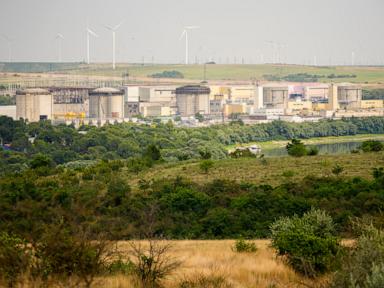
Which brings us to the gray concrete monoliths rising above the Danubian plains at Cernavodă.
For days, the operators at Romania's sole nuclear power plant watched the gauges. They saw the river levels drop below the critical thresholds mandated by safety protocols. They knew the math. Unit 2, a heavy-water reactor responsible for a substantial slice of the national power supply, was pumping life into the grid. But nature was staging an intervention.
To understand the weight of this decision, imagine running a marathon while someone slowly pinches your straw shut. You can keep stride for a little while, but eventually, your body makes a choice to protect itself. You slow down. You drop out.
That is precisely what happened. Romania began the phased, deliberate shutdown of the plant's second reactor.
It is a process that requires surgical precision. You do not simply pull a giant breaker switch and walk away. You drop the control rods into the core, absorbing the neutrons, quieting the atomic dance step by step. The output drops from hundreds of megawatts to a whisper. The cooling systems continue to circulate, but the strain eases. The river gets a momentary reprieve.
Yet, the grid feels the shock immediately.
When you slice off a chunk of baseload power—the steady, unwavering hum that keeps hospitals lit and factories humming regardless of whether the wind is blowing—you leave a gaping hole. Grid managers scramble. They fire up peaker plants, burning fossil fuels to make up the difference, adding carbon to the very atmosphere that baked the river dry in the first place. Irony is a harsh taskmaster in the energy sector.
We have built a civilization on the edge of hydrological assumptions that no longer hold true.
For decades, engineers designed power infrastructure using historical climate data as a sacred text. They looked at the past fifty years of river flow records, calculated the worst-case scenario, and added a safety buffer. But the past is no longer a reliable prologue. Climate volatility is rewriting the rules of hydrology in real time. Low water levels in the Danube are no longer a freak statistical anomaly; they are part of a recurring, punishing rhythm of summer heatwaves and meager snowpacks.
When the Danube runs low, it exposes the fragility hiding behind our most advanced technology.
Let us step away from the abstract economics for a moment and look at the human scale. Picture Elena, a shift supervisor with twenty years of experience at Cernavodă. She has spent her career mastering the invisible choreography of nuclear physics. She knows the sound of every pump, the vibration of every pipe. She is trained for mechanical failures, electrical faults, and worst-case containment scenarios.
She is not, however, trained to make the rain fall.
When the river drops, Elena is caught in the crosshairs of a planetary crisis that she cannot recalibrate with a wrench or a software patch. She watches the intake channels. She watches the temperature differential between the river water entering the plant and the warmed water returning to the ecosystem. Environmental laws dictate strict limits on thermal pollution—you cannot cook the river's fish population just to keep the lights on in Bucharest. The regulations are there to protect the ecosystem. The physics are there to protect the reactor. And the public is out there in the dark, wondering why their bills are climbing and their power feels increasingly precarious.
This is the squeeze.
We talk endlessly about the energy transition as if it were a clean line on a PowerPoint slide. We draw arrows from fossil fuels to renewables, sketching a future of wind turbines and solar panels. But we rarely talk about the physical tethering of our current fleet to the earth itself. Nuclear plants, coal plants, natural gas facilities—they are all massive heat engines. They are all thirsty.
When the water fails, the machines fail.
And it is not just Romania. Across Europe, from the Rhône in France to the Po in Italy, power operators have sweated through summers where rivers ran too warm or too shallow to cool nuclear and thermal plants. France has repeatedly had to dial back nuclear generation during scorching heatwaves because the cooling water discharged back into local rivers would otherwise exceed legal temperature caps, threatening local aquatic life.
We are asking our rivers to do double duty: quench the thirst of a warming continent and cool the fires of our industrial appetite.
The shutdown of Cernavodă's second reactor is a warning shot. It is a quiet event—no sirens wailed, no alarms flashed across international news networks in red letters. It was handled with the methodical, unglamorous professionalism that nuclear operators are famous for. Power was reduced, the reactor went dark, and the grid absorbed the blow.
But quiet crises are the most dangerous kind. They allow us to look away.
They let us pretend that everything is normal, that this is just a seasonal blip, that next year the rains will return and the Danube will swell back to its historical girth. Maybe they will. But the underlying trend line points in a different direction. The atmosphere holds more heat, the evaporation rates climb, and the rivers bear the brunt of the burden.
We are entering an era where energy security and water security are the exact same thing. You cannot have one without the other. Every kilowatt is bound to a drop of water.
As the control room at Cernavodă settles into a quieter rhythm with half its heavy-water heart resting, the water outside continues its slow, diminished crawl toward the Black Sea. The engineers will wait. They will watch the weather reports, scanning the horizon for storm clouds over the Alps and the Carpathian Mountains. They are ready to bring the reactor back online the moment the river grants permission.
Until then, the current runs a little slower, the grid strains a little harder, and the river keeps whispering its quiet warning to anyone willing to listen.