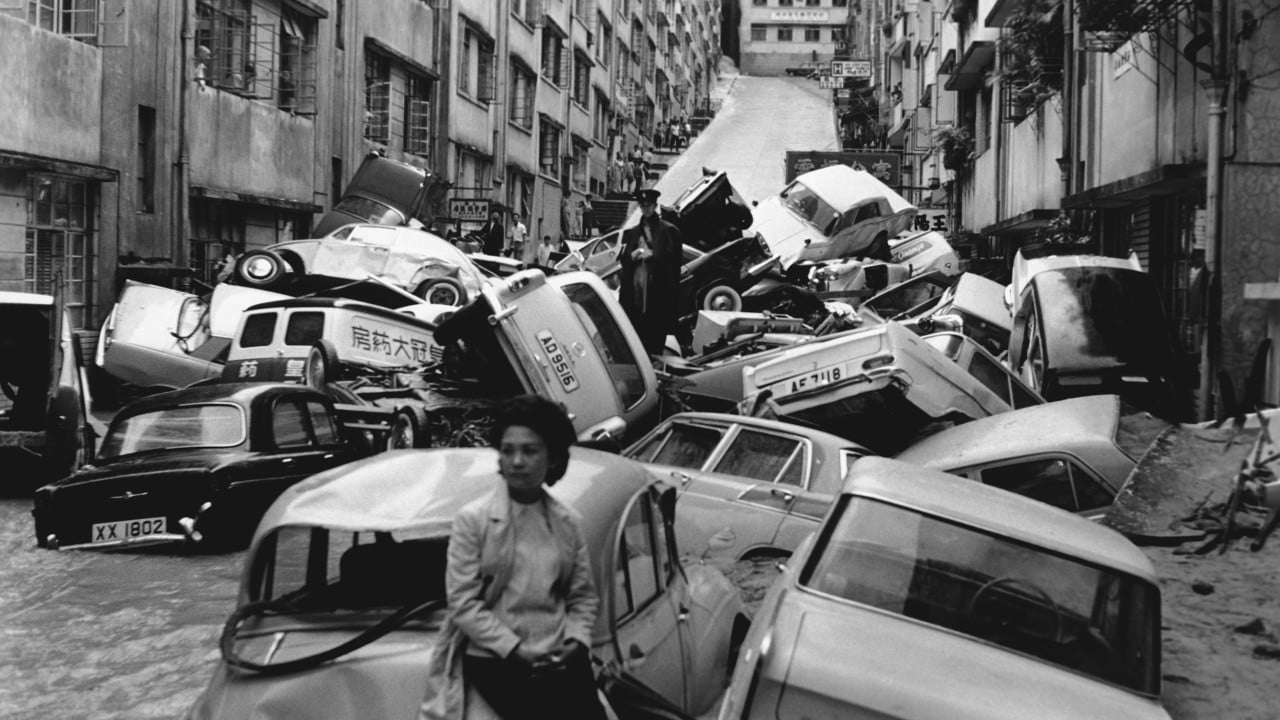
Historical disaster narratives love a body count and a dramatic weather report. When looking back at the June 1966 Hong Kong rainstorms—which dumped over 15 inches of rain in 24 hours, triggered over 700 landslides, and claimed 64 lives—mainstream reporting fixates entirely on the tragedy. They paint it as an unpredictable act of God that overwhelmed an innocent city.
They are looking at the wrong map.
The lazy consensus among historians and journalists is that the 1966 deluge was purely a natural disaster compounded by post-war refugee squatter settlements. That narrative is comforting. It shifts the blame to the sky and to the vulnerable. But it misses the structural mechanics of how cities actually grow, fail, and adapt.
The 1966 floods were not an isolated tragedy. They were a brutal, necessary stress test that exposed a fundamental truth about civil engineering: you cannot build a resilient metropolis without first experiencing a catastrophic failure. The real story isn't the rain. It is how structural failure dictates modern infrastructure policy.
The Myth of the Unpredictable Deluge
Journalists cover extreme weather as if infrastructure exists in a vacuum. They ask why the government didn't predict the intensity of the June torrents.
This question is fundamentally flawed. In 1966, the British colonial administration wasn't blind to the weather; they were operating on historical data that was completely irrelevant to the rapid urbanization happening beneath their feet.
Between 1945 and 1965, Hong Kong’s population ballooned from roughly 600,000 to nearly 4 million. Hillsides were stripped of vegetation to make way for both legal high-rises and makeshift squatter huts. When you replace absorbing topsoil with concrete and loose excavated dirt, you change the hydrodynamics of the entire terrain.
Standard engineering metrics of the era relied on historical rainfall averages. They did not account for how rapid concrete development accelerates surface runoff. The water didn't just fall from the sky; it was weaponized by the altered topography of the city.
Landslides Are an Engineering Problem, Not a Geological Surprise
The media archive focuses heavily on the dramatic collapse of hillsides in the Mid-Levels and along Victoria Peak. The implication is always that the earth simply gave way.
Let's dismantle that. Slope stability is governed by pore water pressure. When water fills the spaces between soil particles, it exerts upward pressure, reducing the friction that holds the slope together. In 1966, Hong Kong had no centralized authority managing slope safety. Retaining walls were built haphazardly by private developers using substandard materials, often without proper weep holes to let trapped water escape.
Imagine a scenario where you stack dry sand on a table and slowly pour water into the center. For a while, surface tension holds it. Then, instantly, the base liquefies. That is what happened on the slopes of Hong Kong Island. It was a failure of regulatory oversight and civil engineering, disguised as a natural geological event.
I have analyzed municipal infrastructure rollouts across rapidly developing regions. The pattern is always identical. Governments rarely fund invisible subterranean safety measures until bodies are pulled from the mud. The 1966 disaster was the exact catalyst required to shift engineering philosophy from reactive repair to aggressive prevention.
The Geotechnical Engineering Office Was Bought in Blood
If you ask the public what keeps Hong Kong safe from typhoons and rain today, they will point to giant drainage tunnels or the Hong Kong Observatory's color-coded warning system. They are wrong. The single most critical piece of infrastructure keeping that city upright is a regulatory body born directly from the failures of the mid-60s and early 70s: the Geotechnical Engineering Office (GEO), originally established as the Geotechnical Control Office in 1977.
Before the 1966 floods and the subsequent 1972 Po Shan Road disaster, slope management was a fragmented joke. The Public Works Department handled roads, while private landowners did whatever they wanted with hillsides.
The creation of a centralized authority with the power to legally mandate how private developers anchor soil changed the game entirely. The GEO implemented a comprehensive slope registration system, upgrading over tens of thousands of man-made slopes. They introduced the concept of soil nailing—inserting steel reinforcing bars deep into the bedrock—long before it became a global standard.
Here is the uncomfortable truth that bleeding-heart retrospectives refuse to admit: without the public horror of the 1966 casualties, the political will to override private property rights and enforce stringent geotechnical standards would never have existed. The modern, safe, high-density skyline of Hong Kong was paid for by the structural failures of 1966.
Dismantling the People Also Asked Fallacies
When people look up historical floods, their queries expose their misconceptions about urban planning.
Why didn't the colonial government clear the squatter huts earlier?
This question assumes that clearing settlements is purely a matter of administrative will. The reality is an economic calculation. In the 1950s and 60s, the influx of labor from mainland China was the engine driving Hong Kong's manufacturing boom. The colonial government tolerated the danger of squatter settlements on steep hillsides because they provided cheap housing that the state didn't have to fund. The disaster forced the state to recognize that the economic cost of infrastructure collapse and loss of life far outweighed the cost of building public housing estates, like those managed by the Housing Authority.
Could modern AI weather forecasting have prevented the 1966 deaths?
Absolutely not. This is a tech-utopian fantasy. Knowing the rain is coming does nothing if your hillsides are fundamentally unstable and your drainage systems are built for a city one-tenth the size. Prediction without structural capacity is useless. A six-hour warning in 1966 would have resulted in mass panic on gridlocked, poorly designed roads, potentially increasing the casualty count rather than lowering it. Safety is built into the concrete, not the weather app.
The Real Cost of Absolute Safety
It is easy to demand that cities be built to withstand any possible event. But total risk elimination is a financial impossibility.
Engineering is always a trade-off between cost and probability. Engineers design systems based on return periods—the statistical probability of an event occurring. A 1 to 50-year storm requires a certain pipe diameter; a 1 to 200-year storm requires something vastly larger and more expensive.
If a city chooses to build every single drain and retaining wall to withstand a 500-year event from day one, it goes bankrupt before it even pours the foundation. You cannot build a thriving economy if 80% of your municipal budget is buried underground waiting for a cloudburst that might not happen for two centuries.
The downside to the contrarian reality of urban evolution is that optimization requires data, and the most accurate data points are unfortunately measured in human lives and collapsed structures.
The Blueprint for Modern Urban Vulnerability
The lessons of 1966 are being ignored by the fast-growing megacities of today. Look at the rapid expansion happening across parts of Southeast Asia, Africa, and Latin America. They are repeating the exact same playbook:
- Cutting into hillsides without calculating pore water pressure.
- Allowing informal settlements to cluster in natural drainage pathways.
- Treating flood management as a sanitation issue rather than a structural engineering mandate.
They look at Hong Kong today and see a glittering, hyper-efficient metropolis. They copy the glass towers but ignore the hidden, steel-reinforced retaining walls that hold the mountains back. They are waiting for their own 1966 to teach them the lessons they should be learning from history.
Stop reading historical disasters as sad stories about bad weather. Start reading them as blueprints of systemic engineering failure. The sky is predictable; human short-sightedness is what varies.
Stop looking at the clouds. Look at the retaining walls.