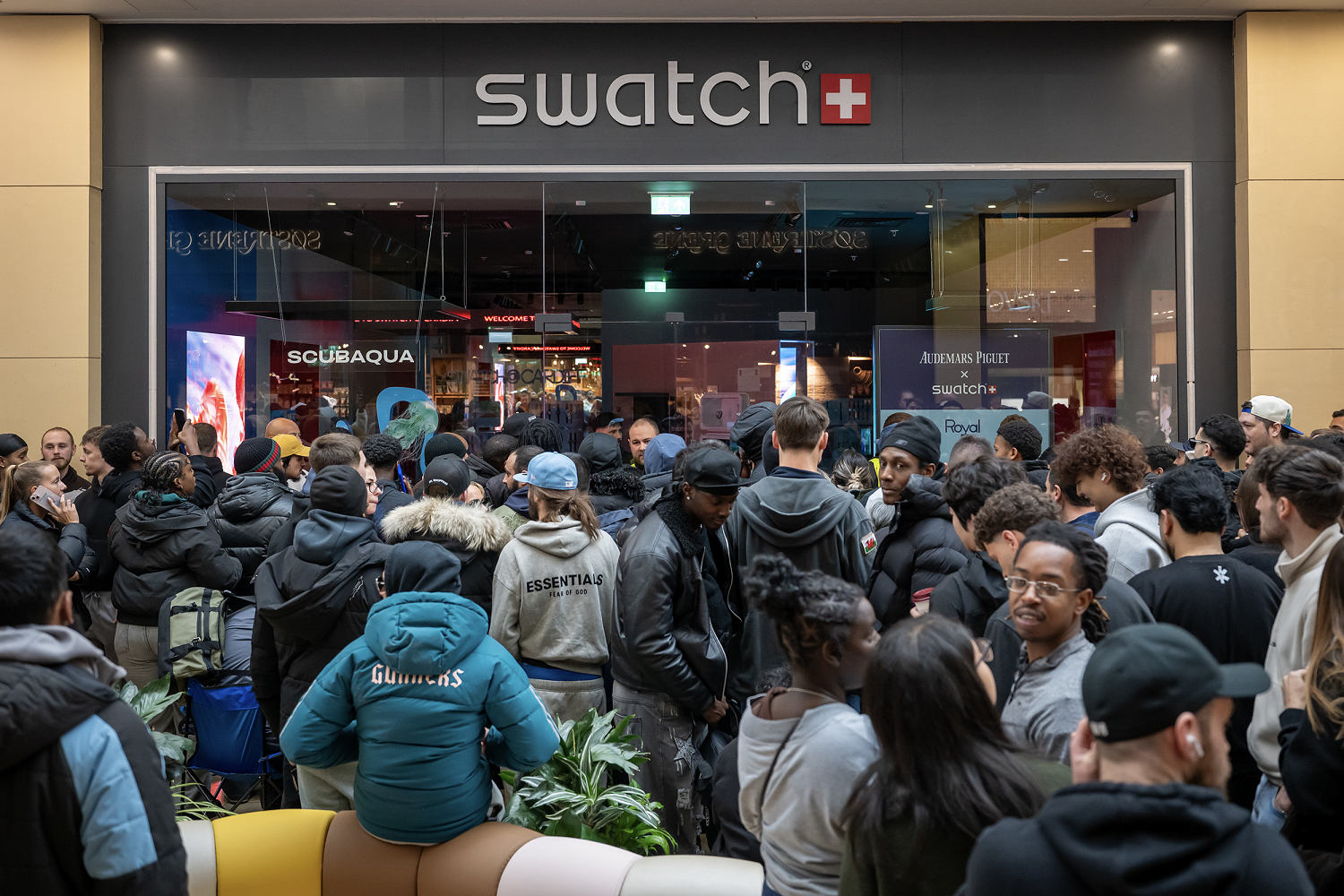
The media is running the same tired headline again. Whenever a highly anticipated watch collaboration drops, crowds swell, police get called, and Swatch is forced to pull the shutters down on its flagship boutiques. The immediate consensus from commentators is always a mix of scolding and pity. They call it a logistical failure. They call it a customer service nightmare. They claim Swatch is leaving millions on the table by failing to manage the chaos.
They are completely missing the point.
Closing a retail store due to overcrowding isn't a failure of operations. It is the ultimate manifestation of modern brand equity. In a world where traditional retail is dying a slow, algorithmic death, a shuttered storefront surrounded by a mob is the purest form of marketing gold. Swatch isn't failing to manage the line; they are deliberately engineering the scarcity that creates it.
The Scarcity Illusion and the Value of Chaos
Traditional retail logic dictates that a business should maximize efficiency. You calculate foot traffic, optimize inventory levels, staff up for peak hours, and ensure every customer walks out with a product and a smile. If you run out of stock or have to close your doors, you lose.
That logic works perfectly well if you are selling toilet paper or mid-tier blenders. It fails spectacularly when applied to cultural hype.
The modern consumer does not buy a watch just to tell time; your phone already does that with absolute precision. Consumers buy entry-level luxury collaborations to signal belonging, taste, and insider status. The moment an item becomes easily accessible—the moment anyone can walk into a well-lit mall at 2:00 PM on a Tuesday and buy it without effort—the cultural value drops to zero.
By deliberately under-supplying physical locations and refusing to sell these high-profile collaborations online during the initial wave, Swatch forces a physical confrontation between supply and demand. The resulting chaos, the viral videos of lines wrapping around city blocks, and the inevitable store closures do more for the brand's long-term health than a smooth, orderly transaction ever could. It creates a spectacle.
I have spent years analyzing retail supply chains and brand positioning, watching companies burn through millions trying to manufacture "viral moments" through influencer campaigns and bloated ad spends. Swatch triggers global media coverage for the price of a few security guards and a temporary lock on a glass door.
Dismantling the Customer Experience Myth
Critics love to ask: "Aren't they alienating their core customer base?"
The premise of this question is fundamentally flawed. It assumes that the person standing in line for fourteen hours, only to be turned away empty-handed, walks away hating the brand forever.
Psychology tells us the exact opposite occurs. This is a classic application of the paradox of effort. When an object is difficult to obtain, our brains automatically assign a higher value to it. The consumer who misses out doesn't abandon Swatch; they become obsessed. They join online forums, track restock rumors, and prepare to fight harder during the next drop.
Let's look at the mechanics of the secondary market to understand how this plays out. Within hours of a store closure, these collaborative timepieces hit resale platforms at three to four times their retail price.
+-------------------+-----------------+-------------------+
| Retail Price      | Average Resale  | Immediate Premium |
+-------------------+-----------------+-------------------+
| $260 - $300       | $800 - $1,200   | 200% - 300%       |
+-------------------+-----------------+-------------------+
This premium does not go into Swatch's pockets directly, which drives traditional accountants mad. "Look at all that secondary market value you are giving away to resellers!" they cry.
What they fail to see is that the resale premium acts as a permanent, crowdsourced advertisement for the brand's cultural relevance. It validates the brand's cultural currency. Every time a reseller flips a watch for a profit, they are validating the choice of the consumer who managed to buy one at retail. It transforms a mass-produced quartz watch into a high-yielding asset class in the eyes of the consumer.
The Operational Genius of Intentionally Broken Logistics
Amateur analysts look at a shuttered store and see a broken system. An insider looks at it and sees a highly optimized friction engine.
Imagine a scenario where Swatch optimized its logistics to perfectly meet demand. They utilize a pre-order system. They print enough plastic cases and dial assemblies to fulfill every single request within a week. They ship them directly to consumers' doorsteps in neat, orderly cardboard boxes.
What happens next? The hype evaporates. The watch becomes a commodity. It sits on wrists unnoticed because everyone else has one too. The conversation stops.
By maintaining an intentionally broken brick-and-mortar distribution model for these launches, Swatch achieves three critical strategic objectives:
- Foot Traffic Halos: The thousands of people who show up to a store and can't buy the hyped collaboration don't all walk away empty-handed. A predictable percentage of them buy standard catalog items, boosting baseline sales.
- Media Dominance: Local news stations and global tech blogs alike cover retail chaos. Free press on this scale is impossible to buy through traditional media agencies.
- Brand Rejuvenation: Swatch, a brand rooted in the 1980s, instantly repositions itself at the center of youth culture, competing directly with streetwear brands and luxury houses for cultural bandwidth.
There is a downside to this strategy, and it is one that executives rarely admit publicly: it places an immense, unfair burden on retail staff. The frontline employees bear the brunt of consumer frustration, safety risks, and chaotic environments. It is a cynical, top-down strategy that treats retail workers as shock absorbers for engineered corporate chaos. But from a pure brand equity standpoint, it is flawless.
Stop Trying to Fix the Line
The most common advice from consulting firms to heritage brands trying to replicate this success is to "fix the line." They recommend digital queueing systems, lottery apps, and smooth, orderly pickup windows.
This is an expensive mistake.
When you digitize scarcity, you sanitize it. A notification on a smartphone screen saying "You were not selected" produces a brief sigh and an immediate swipe away. A physical line that you can see, stand in, and watch get cut off by a security guard produces a visceral, emotional reaction. It creates a narrative. It gives the consumer a war story to tell their friends.
Luxury brands have understood this for centuries. Hermès does not have a "seamless" digital checkout for its most coveted bags. You cannot optimize your way into an elite tier of desire by making things easy.
Swatch took the playbook of ultra-luxury haute horlogerie, stripped away the six-figure price tag, and applied the exact same mechanics of artificial friction to a mass-market product. The fact that the storefronts are closing isn't a sign that the strategy is broken. It is proof that it is working perfectly.
Stop looking at the closed doors as a failure. The closed door is the product. The line is the marketing campaign. The chaos is the profit.