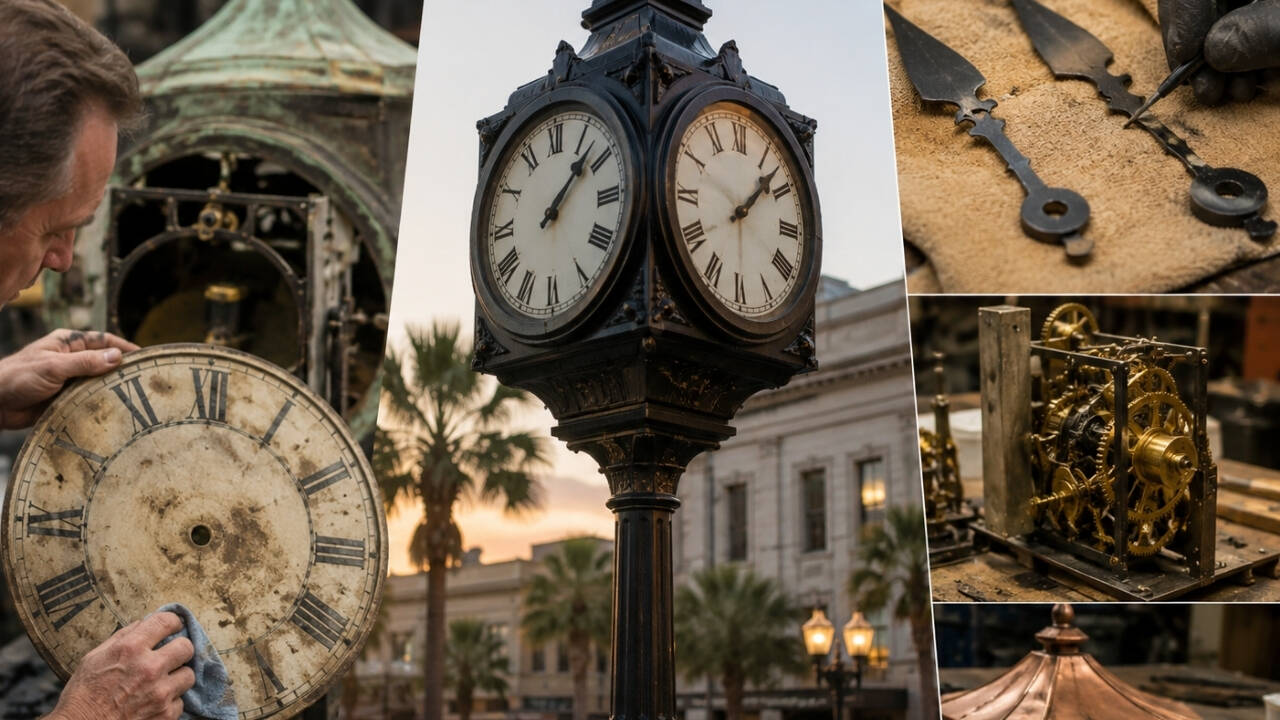
Everyone loves a good heritage redemption story. Media outlets salivate over the narrative of a weather-beaten, rusted antique rescued from decades of Florida humidity, subjected to 700 hours of painstaking manual labor, and brought back to ticking life. It feels romantic. It feels like a triumph of human patience over the relentless decay of time.
It is also an economic and engineering absurdity.
I have watched organizations and municipal bodies throw good capital after bad artifacts for decades, mistaking sentimental hoarding for historic preservation. We throw 700 billable hours of highly specialized restoration expertise at a piece of brass and iron that has zero functional utility, calling it a victory for culture.
Let us dismantle the lazy consensus.
The Myth of Material Immortality
Restoration junkies operate under a flawed premise: that original physical matter holds some mystical, intrinsic value simply because it survived a long time outdoors.
Let us look at the reality of metallurgy. Expose any complex mechanical clock to a century of subtropical Florida weather—salt air, thermal shock, torrential downpours, and relentless UV radiation—and you do not have an artifact. You have a heavily oxidized paperweight. By the time a restorer spends 700 hours machining custom replacement bushings, welding pitted gear teeth, and polishing micro-tolerances, the resulting object is essentially a replica housed in a tiny percentage of original scrap metal.
This is the Ship of Theseus fallacy on steroids.
When you replace eighty percent of a mechanism's load-bearing components just to say the housing is original, you have built a modern reproduction with expensive historical baggage. True expertise recognizes the difference between a functional machine and a historical relic. A clock is, by definition, a tool designed to measure time accurately. If it requires constant environmental life support and a dedicated team of horological surgeons just to tell you it is noon, it has failed its primary design parameters.
The Opportunity Cost of Nostalgia
Let us talk about what 700 hours of skilled labor actually buys in the real world.
At standard rates for master-level mechanical restoration, plus overhead, diagnostic tooling, and specialized machining, a project like this sucks up resources that could have funded working infrastructure, digital archives that actually survive floods, or modern public art that engages living citizens instead of honoring dead gears.
We romanticize the analog past because digital infrastructure feels cold and ephemeral. A glowing smartphone screen does not rust in the rain. But fetishizing obsolete mechanical failures does not make a community more culturally rich. It makes it financially irresponsible.
Imagine a scenario where a city council has a fixed cultural preservation budget of fifty thousand dollars. They can either digitize an entire regional archive of rare manuscripts, making them accessible globally to thousands of scholars, or they can restore one clock that three people a day glance at while walking to get overpriced iced coffee.
The choice reveals our cultural neurosis. We prefer tactile vanity projects over scalable utility.
The Brutal Truth About Outdoor Public Mechanics
Outdoor public clocks are a masterclass in municipal hubris. Mechanical clocks were never meant to live outside in Florida. European town clocks survived centuries because they were housed inside massive stone towers that regulated temperature and blocked moisture. Sticking a delicate gear train into a humid coastal environment is an engineering war crime.
Nature wins every single time. Within five years of this grand unveiling, thermal expansion, microscopic marine corrosion, and lubricant breakdown will begin micro-pitting those freshly polished pinions. The cycle starts over. Another 700 hours. Another round of self-congratulatory press releases about saving history.
Stop trying to freeze time using brute-force manual labor. Let the rust win, or build something new that speaks to the present.
Leave the gears in the scrap heap where physics intended them to be.