The nightmare didn't end when Major General Rabe Abubakar died in a forest hideout. It actually got worse.
For weeks, Nigerians watched a horrifying drama play out in Katsina State. Bandits ambushed the retired general and his wife, Amina Abubakar, on May 30, 2026, along the Marabar Musawa–Kafinsoli Road. The criminals didn't care about his former rank as Director of Defence Information. They didn't care about his decades of service. They just wanted leverage.
Then came the tragic twist. The general died in captivity. The Katsina State government blamed health complications from diabetes and hypertension, though family members disputed this, whispering about snake bites and horrific conditions. His body was dumped near Karaduwa like common trash, recovered by an ambulance under heavy military escort, and buried amid national tears. But his wife, Amina, remained in the dark.
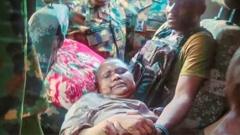
On June 15, 2026, the military finally struck back. In a bloody clash at Tunga Village, troops from Operation Fansan Yamma closed in. Cornered and desperate, the bandits shot Amina in the body before fleeing into the brush. Soldiers pulled her out bleeding, administered emergency first aid, and rushed her to a military hospital.
She's alive. But let's look past the celebratory military press releases. This entire saga exposes a structural rot in how Nigeria handles its internal security. If a retired two-star general and his family can be hunted down, held hostage, and shot on a major northern road, nobody is safe.
The High Cost of Reactive Military Operations
Nigeria has a bad habit of waking up only after a high-profile tragedy.
The military launched Operation Clean Sweep III in Matazu Local Government Area on June 14, 2026. Why then? Because a general had just died in a ditch. The Joint Task Force North West suddenly found the coordination, the air power, and the boots on the ground to level criminal camps.
This isn't an isolated incident. Think back to the Kaduna train attack or the countless school abductions across the northwest. The pattern is always the same.
- Bandits strike a high-value target.
- The public expresses outrage.
- The military launches a heavily named operation (Operation This, Operation That).
- Troops clear out a few forests, rescue survivors, and declare victory.
It's a cycle that doesn't work. The rescue of Amina Abubakar is a tactical win, absolutely. The soldiers who braved gunfire at Tunga Village deserve credit. They saved a woman's life while she was actively bleeding from gunshot wounds.
But it's a strategic failure. The bandits shouldn't have felt comfortable holding a general's wife for weeks in the first place. Relying on massive kinetic operations after the fact is like trying to fix a leaky dam by catching the water in a bucket.
What the Captivity Video Revealed About the Enemy
Before his death, a chilling four-minute video circulated online. It showed General Abubakar and Amina sitting in the bush, surrounded by armed men. Amina spoke directly to the camera, begging the Katsina State government to meet the captors' demands.
The bandits weren't asking for billions of naira this time. They wanted their own people back.
Amina explicitly named three detained bandit associates—Aminu, Sani, and Nasiru. She also demanded the return of livestock seized by local authorities. This reveals the true nature of the conflict in the northwest. It's no longer just random criminal enterprise; it has evolved into a structured, transactional insurgency.
The bandits treat human beings like currency. They use state failures, weak border controls, and poor local policing to build parallel power structures. When the state arrests their members or seizes their cows, they simply go to the nearest highway, kidnap a prominent citizen, and force a trade.
When you look at it this way, the military's current approach is completely mismatched. You can't defeat an ecosystem of grievance, criminality, and local complicity just by flying fighter jets over forests.
The Logistics of Terror on Nigeria Highways
Let's talk about the geography of this crime. The ambush happened near Zakin Baure village along the Marabar Musawa–Kafinsoli Road. This isn't a hidden track in the middle of nowhere. It's a key transit route in Katsina State.
The bandits opened fire on the general's vehicle, wounded his driver, and dragged the couple away. They managed to move two high-profile hostages through communities, keep them alive for weeks, record videos, and negotiate with state officials without getting caught.
This shows a massive failure in grassroots intelligence. The military can't be everywhere, but the local population knows who these guys are. They know the tracks they use. Security experts have argued for years that Nigeria needs to transition away from heavy military deployment toward community-centered policing and intelligence gathering.
Instead, the country relies on the military's 17 Brigade to act as local cops. Soldiers aren't trained to police communities; they are trained to destroy enemies. When you use an army to fight an internal law enforcement war, you get prolonged conflicts, high collateral damage, and an exhausted military force.
Real Steps Toward True Security
If Nigeria wants to stop burying its heroes and rescuing their bleeding widows, the security architecture needs a complete overhaul.
First, the government must secure the highways through technology, not just checkpoints. Fixed military checkpoints are useless against bandits who know the bush paths. Nigeria needs drone surveillance along known vulnerability corridors like the Marabar Musawa axis.
Second, the state must stop the policy of secret concessions. The confusion surrounding how General Abubakar's body was recovered—with reports of state officials meeting kidnappers near Karaduwa without security personnel—creates a dangerous precedent. It shows the bandits that the state will play by their rules when the pressure gets high enough.
Amina Abubakar is currently recovering in a military hospital. Her physical wounds will heal, but the trauma of losing her husband in a terrorist camp will linger forever. Her rescue shouldn't be celebrated as a triumph of national security. It should be treated as a stark, bloody warning that the current strategy is broken. It's time to stop launching operations after the funeral and start preventing the abductions before they happen.