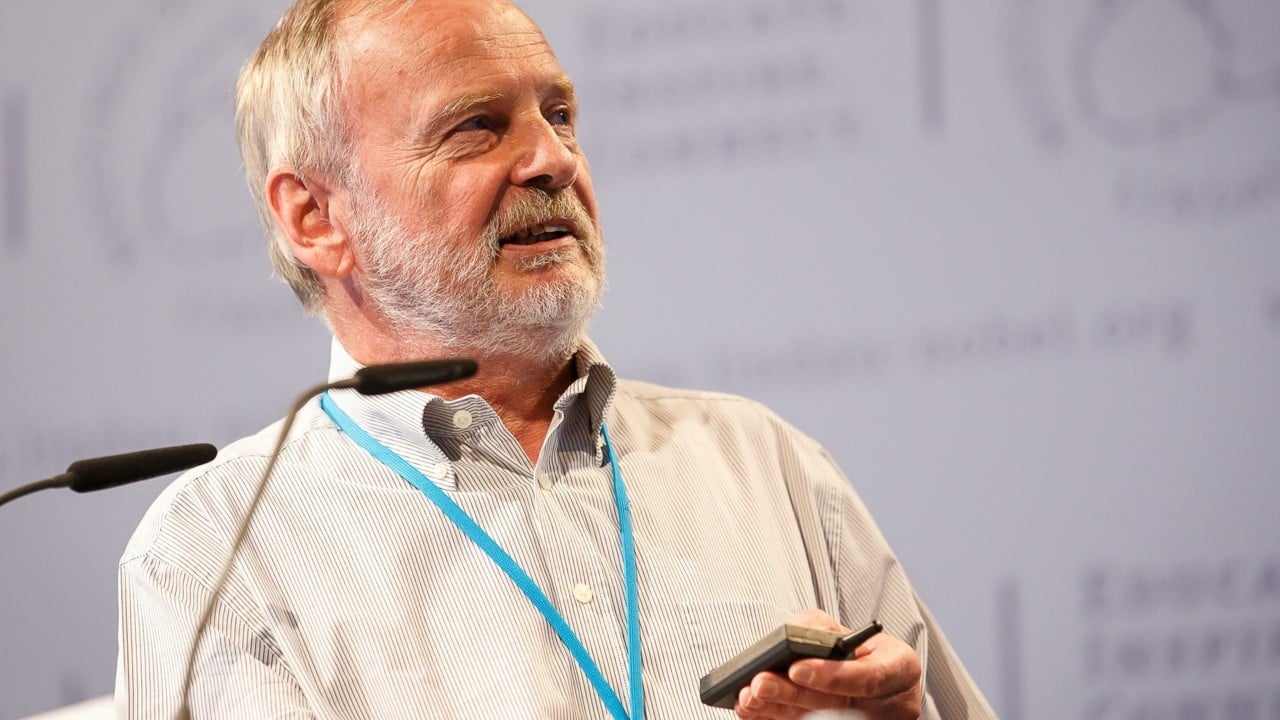
The laboratory in Frankfurt was quiet, but it was the kind of quiet that precedes a storm. For decades, Hartmut Michel had worked within the disciplined, predictable rhythms of European academia. He is a man who looks at the world through the lens of atomic precision, a scientist who won the Nobel Prize in Chemistry back in 1988 for mapping the heart of photosynthesis. He didn't just study life; he figured out the structural blueprint of how plants turn sunlight into the energy that sustains every living thing on this planet.
But science is rarely just about the molecules. It is about the soil where those ideas are planted. Don't forget to check out our previous article on this related article.
In a move that sent a subtle but undeniable tremor through the global scientific community, Michel packed his bags. He didn't move to another storied institution in the West. He didn't take an emeritus position to fade into a comfortable retirement of guest lectures and ribbon cuttings. Instead, he headed east. He accepted a position at Jilin University in Changchun, China.
To understand why this matters, you have to look past the press releases. You have to look at the hunger. If you want more about the context here, The Guardian offers an excellent breakdown.
The Gravity of Resources
Imagine a young researcher in a cramped lab, struggling to secure a grant for a microscope that costs as much as a small apartment. In much of the West, that researcher spends forty percent of their time writing justifications for their existence—filling out forms, navigating bureaucracy, and praying for a slice of a shrinking federal budget. Now, imagine a different world. A world where the doors are thrown open, the equipment is state-of-the-art, and the mandate is simple: solve the impossible.
China has become that world for many.
Jilin University isn't just a name on a map; it is a massive engine of intellectual ambition. By bringing in a titan like Michel, they aren't just buying a name for their letterhead. They are importing a methodology. They are buying the decades of intuition that live inside the mind of a man who saw the three-dimensional structure of a membrane protein when the rest of the world thought it was an invisible blur.
The stakes are invisible but absolute. We are currently in a global arms race, but the weapons aren't missiles. They are patents, peer-reviewed papers, and protein structures. The nation that masters the bridge between biology and technology—synthetic biology, carbon capture, advanced medicine—will dictate the terms of the next century. When a Nobel laureate moves his base of operations, the center of gravity for that specific field shifts with him.
A Walk Through the Changchun Lab
If you were to walk through the halls of Jilin University today, you would feel a frantic energy. It is the sound of heavy machinery being installed and the hushed, rapid-fire Chinese of doctoral students who know they are standing in the presence of a living legend.
Michel’s work at Jilin isn't a hobby. He is there to lead the Institute of Molecular Biology. Think of it as a bridge. On one side, you have the raw, brute force of Chinese industrial and academic investment. On the other, you have the refined, meticulous tradition of German biochemistry.
Why Jilin? Why now?
The answer lies in the friction of the modern era. Scientists are nomadic by nature. They go where the data is clean and the funding is "thick." China has been aggressively recruiting "High-End Foreign Talents" for years, but the acquisition of Michel feels different. It signals a transition from recruiting promising young minds to anchoring the entire ship with established giants.
The Human Cost of Borders
There is a tension here that we rarely talk about in polite company. We like to think of science as a universal language, a pure pursuit that exists above the fray of geopolitics. We want to believe that a discovery made in Changchun is just as beneficial to a child in Chicago or a farmer in Bavaria.
In theory, that is true. In practice, knowledge is power.
When Michel joined the faculty at Jilin, it wasn't just a career move; it was a statement about the shifting geography of intellect. There is a specific kind of heartbreak in seeing an intellectual heritage exported. For Europe, losing a mind like Michel is a quiet tragedy. It is a sign of a system that has perhaps become too rigid, too cautious, or too bogged down in its own history to provide the lightning-rod environment that a visionary requires.
Consider a hypothetical graduate student at Jilin—let's call her Wei. Before Michel arrived, Wei might have looked at her research on membrane proteins as a difficult, lonely climb. Now, she sits in a seminar room and watches a man who changed the course of chemistry sketch a diagram on a whiteboard. That proximity is electric. It creates a lineage. Ten years from now, Wei will be leading her own lab, carrying the "Michel method" into frontiers we haven't even named yet.
That is how empires are built: one mentor, one student, one breakthrough at a time.
The Invisible Stakes
What is Michel actually looking for in the structures of life? He is hunting for the mechanics of energy. Specifically, he is obsessed with how cells move electrons. It sounds dry until you realize that every problem we face—from climate change to neurodegenerative diseases—is essentially an energy problem.
If we can understand how a protein moves an electron with 100 percent efficiency, we can revolutionize battery technology. If we can understand how a cell repairs its own respiratory chain, we can potentially stop the aging process of tissues. These aren't just "facts." These are the keys to the kingdom.
The fact that these keys are being forged in Jilin, under the guidance of a German master, tells us everything we need to know about the future. The borders are closing in some ways, but the minds are still finding ways to cross them.
The Weight of the Medal
A Nobel Prize is a heavy thing to carry. It brings with it a certain expectation of wisdom. Michel has often been outspoken about the flaws in modern research, criticizing the "publish or perish" culture that rewards safe, incremental steps over bold, risky leaps.
Perhaps he found a place that was willing to take the leap with him.
China’s academic culture is often criticized for being derivative or overly focused on metrics, but you cannot deny the sheer velocity of their progress. They are building laboratories at a rate that makes the West look like it is standing still. They are hungry for the prestige that a Nobel laureate provides, yes, but they are also hungry for the truth.
Michel’s presence provides a "seal of quality." It tells other researchers that Jilin is a serious player. It tells the world that the "Brain Drain" is no longer a one-way street leading to the Ivy League.
A New Map
The move isn't without its critics. There are those who worry about the transfer of dual-use technologies or the ethical implications of such close cooperation with a state-driven academic system. These are valid fears. But for a scientist, the primary directive is always the work. The work demands the best tools. The work demands the best environment.
If the environment in Changchun is more conducive to solving the riddles of life than the environment in Frankfurt, a true scientist will choose Changchun every time.
We are witnessing the redrawing of the intellectual map. We used to think of knowledge as a fountain that flowed from West to East. Now, it is a whirlpool. It is messy, it is fast, and it is shifting the very ground beneath our feet.
As Hartmut Michel walks across the campus of Jilin University, he isn't just a professor going to his office. He is a pioneer in a new kind of territory. He is a man who spent his life studying how plants capture the sun, and now, in the autumn of his career, he has followed the light to a place where the horizon seems wider.
The quiet in the Frankfurt lab remains, but the conversation has moved. It is happening now in Mandarin and English and the universal symbols of chemical equations, thousands of miles away, in a city that most people couldn't find on a map but which might soon hold the answers to how we live, how we breathe, and how we survive the coming century.
The mind goes where it can grow. Everything else is just geography.