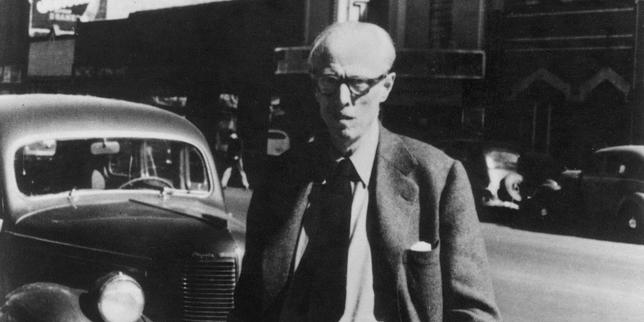
He was ugly, he was loud, and his face looked like a scarred, pitted moon.
Harry Sinclair Lewis did not look like a man who would alter the psychological DNA of a superpower. Yet, in the roaring morning of the twentieth century, as America gorged itself on its own new wealth, this red-haired son of a country doctor from Sauk Centre, Minnesota, walked into the great hall of American self-satisfaction and pulled the pin on a grenade.
The year was 1920. The First World War was over, the stock market was climbing toward a fever dream, and the United States was celebrating nearly a century and a half of relentless, noisy expansion. The national narrative was set in stone: we were the virtuous, the self-made, the pioneers of progress.
Then came Main Street.
The Myth of the Perfect Town
We all know Gopher Prairie, even if we have never set foot in Minnesota. It is the fictional town Lewis constructed as a surgical operating theater for the American soul. To the people living inside it, Gopher Prairie was the pinnacle of human civilization. It was safe. It was godly. It was prosperous.
But through the eyes of Carol Kennicott, Lewis’s brilliant, suffocating protagonist, the town was a living cemetery of the mind.
Imagine a young woman, full of music, poetry, and a desire to see the world grow beautiful, married to a decent but unimaginative country doctor. She arrives in Gopher Prairie expecting the romance of the great American frontier. Instead, she finds a gray, rigid oligarchy of small minds. The townspeople do not want beauty; they want cheaper lumber and higher rents. They do not want intellect; they want conformity.
Lewis did something terrifying to his readers. He did not write about monsters. He wrote about the nice neighbors next door who would gladly starve your spirit to death if it kept the property values high.
He called out the "village virus"—the infectious, complacent belief that because you have a Ford in the driveway and a piano in the parlor, you have achieved the summit of human existence. It was a direct, savage assault on the standard American success story.
The book should have been rejected. Instead, it became an absolute obsession.
People did not just read Main Street; they fought over it at dinner tables. It sold hundreds of thousands of copies in an era when a fraction of that was a triumph. Readers across the nation looked out their windows, saw the same drab storefronts and heard the same hollow gossip, and realized with a jolt of horror that they were living in Gopher Prairie.
The Birth of the Booster
If Main Street was a warning shot, his 1922 follow-up was a direct hit to the chest.
Meet George F. Babbitt. He is a real estate broker in the fictional city of Zenith. He is a "joiner." He belongs to the Elks, the Boosters, the Presbyterian church, and the local country club. His clothes are perfectly standardized. His opinions are handed to him by the morning newspaper. He talks with "zip and zowie" about the glory of capitalism, yet he is secretly terrified of his own shadow.
"He wanted to seize something more than motor cars and a house before it was too late."
That line, buried in the heart of the novel, is the tragedy of modern life. Babbitt is the man who has won everything the American dream promised him, only to find that his soul is entirely empty.
Consider what happens next: Babbitt attempts to rebel. He takes a trip to the woods of Maine. He flirts with bohemian ideas. He speaks kindly of a local radical strike leader. And the moment he steps out of the herd, the herd turns its teeth on him. The Good Citizen’s League shuns him. His friends stop speaking to him on the street. His business begins to wither.
The pressure is too great. In the end, Babbitt crawls back to conformity, defeated, passing the torch of unfulfilled rebellion to his son.
With this single book, Lewis gave the world a new noun: Babbittry. It became the international shorthand for the smug, unthinking, gadget-loving middle class that mistakes material wealth for spiritual greatness.
The Prize That Felt Like an Insult
By 1930, the Swedish Academy could no longer ignore the red-haired tornado from the American Midwest.
When Sinclair Lewis was awarded the Nobel Prize in Literature—the first American ever to receive the honor—it was not a moment of pure national pride. It was deeply uncomfortable. The international community was handing its highest literary award to a man who had spent a decade telling America exactly what was wrong with it.
His acceptance speech in Stockholm was not a polite thank-you note. It was a scorching critique of his own homeland’s cultural immaturity. He told the gathered dignitaries that America was a place where "intellectual life is hard," where writers were expected to be cheerleaders rather than critics, and where the average citizen was terrified of originality.
He did not hate America. That was the secret his critics never understood. You do not look that closely at something unless you love it enough to want it to be better. He was desperate for his country to match its immense physical and economic power with an equally vast moral and intellectual depth.
The Long Shadow over the Anniversary
We approach a massive milestone: two hundred and fifty years of American independence.
Flags will wave. Speeches will be made from platforms decorated in red, white, and blue. Politicians will use the same booming, self-satisfied adjectives that George F. Babbitt used at the Zenith Chamber of Commerce luncheons a century ago.
But if you listen closely beneath the fireworks and the brass bands, you can still hear the raspy, mocking laugh of Sinclair Lewis.
The variables have changed, but the equation remains identical. The standardization that Lewis mocked in the 1920s has merely moved from the physical town square to the digital landscape. Today, we have our own versions of Zenith. We have our own digital Gopher Prairies, where algorithms enforce a conformity that would make the Good Citizen’s League weep with envy. We still buy the gadgets to fill the silence. We still fear the person who steps off the sidewalk of acceptable opinion.
Lewis’s true legacy is not that he won a gold medal in Sweden. It is that he left behind an open, bleeding wound in the national consciousness. He showed us that the greatest threat to any civilization is not an enemy at the gates, but the quiet, creeping satisfaction within the walls.
The mirror he held up to the face of the average citizen is still hanging on the wall, cracked but perfectly clear. We still look into it every single day, adjusting our ties, smoothing our hair, desperately hoping that we are not exactly what he said we were.