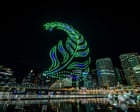
Vivid Sydney has grounded its centerpiece drone light show indefinitely after a major mid-air malfunction forced 89 automated aircraft to plunge into Darling Harbour. The incident occurred just minutes into the 7:30 pm "Star-Bound" performance at Cockle Bay, forcing specialist operator Sky Magic to kill the display and cancel all subsequent performances for a comprehensive safety review.
While organizers point to standard safety protocols working exactly as intended, the mass grounding reveals a deeper, structural vulnerability plaguing the commercial drone entertainment market. This is not just a story of bad luck. It is a stark reminder of the invisible, chaotic reality of operating mass synchronized robotics within dense metropolitan environments.
The Illusion of Flawless Automation
For years, drone light shows have been marketed as the clean, high-tech successor to traditional fireworks. They are quiet, reusable, and infinitely customizable. However, the technology relies on an incredibly fragile foundational element: pristine, uninterrupted radio frequency communication.
According to operator Sky Magic, Monday night's mass plunge was triggered by a sudden, unforeseen shift in the local radio frequency environment. In the world of swarm robotics, thousands of individual drones do not act independently. They exist in a constant, millisecond-by-millisecond dialogue with a central ground control station, relying on real-time kinematic (RTK) GPS coordinates to maintain formations with centimeter-level accuracy.
When that dialogue is interrupted, chaos is the default state. To prevent 1,000 drones from colliding with each other or drifting into skyscrapers, manufacturers program hard-coded failsafes into the flight software.
- Loss of Signal (LOS) Triggers: If a drone loses its positional lock or central connection for a predefined number of seconds, it stops moving.
- Controlled Descent: If the signal is not recovered, the drone is programmed to execute an immediate, vertical descent to the ground—or in this case, the water.
The fact that 89 drones chose to drown themselves simultaneously proves the software worked perfectly. They did exactly what they were programmed to do when blinded by interference. The true failure lies in the vulnerability of the operational space itself.
The Cockle Bay Trap
Moving the show to Cockle Bay for the current season was a calculated logistical choice meant to distribute the massive Vivid crowds away from the choking congestion of Circular Quay. But from a radio frequency perspective, Cockle Bay is an absolute nightmare.
+-----------------------------------------------------------+
|               THE COCKLE BAY INTERFERENCE ECOSYSTEM       |
+-----------------------------------------------------------+
|                                                           |
|    [ High-Rise Hotels ]     [ Corporate Wi-Fi Networks ]  |
|             |                            |                |
|             v                            v                |
|     ( 2.4 GHz / 5.8 GHz Bandwidth Saturation )            |
|                                                           |
|    [ 10,000+ Spectators ] ----> [ Active Smartphones ]    |
|                                                           |
|                             |                             |
|                             v                             |
|               =============================               |
|               | CRITICAL DRONE FLIGHT PATH |               |
|               =============================               |
|                             ^                             |
|                             |                             |
|               [ Maritime Radar / Ferries ]                |
|                                                           |
+-----------------------------------------------------------+
As thousands of spectators crowd the boardwalks, thousands of smartphones actively search for Wi-Fi, stream live video, and ping local cell towers. This creates a localized dome of electronic noise. Commercial drone fleets typically operate on standard ISM bands (2.4 GHz and 5.8 GHz), which are the exact same frequencies utilized by consumer electronics, corporate office routers, and maritime communication gear in the harbor.
Destination NSW head Karen Jones explicitly stated there was no evidence of deliberate signal jamming or malicious interference. That actually makes the problem worse. It means the ambient electronic pollution of downtown Sydney was enough to overwhelm a professional-grade commercial light show.
Why the Tech is Hitting a Hard Ceiling
This is not the first time Vivid Sydney has run into a drone wall. The attraction was completely scrapped during the previous season due to skyrocketing operational costs and growing logistical friction with regulatory bodies like the Civil Aviation Safety Authority (CASA). The 2026 return was supposed to be a triumphant redemption arc, boasting a 1,000-drone fleet.
Instead, the incident highlights a reality that tech evangelists rarely want to discuss: swarm robotics scale poorly in unpredictable real-world environments.
As you add more aircraft to a show, the risk profile does not increase linearly; it increases exponentially. A 100-drone show requires minimal data bandwidth. A 1,000-drone show demands a pristine, high-capacity data pipeline where even a brief microsecond spike in latency can cause localized system collapse.
When an unexpected frequency shift blinds a segment of the swarm, the system cannot afford to wait and see if the signal returns. The aircraft must descend immediately. Recovering nearly 90 waterlogged, highly sophisticated electronic units from the bottom of Cockle Bay is a logistical nightmare, but the financial blow to the operator is secondary to the reputational damage.
The Regulatory Reckoning
What happens next will determine the future of large-scale drone entertainment in urban areas. CASA maintains incredibly strict rules regarding drone operations over populous areas. Currently, these shows are permitted only because operators guarantee strict geofencing and automated termination protocols that ensure drones fall into designated "exclusion zones"—like the waters of the harbor—rather than onto the heads of pedestrians.
But relying on a body of water as a dumping ground for failing tech is a short-term luxury. If future investigations reveal that ambient urban noise can routinely trigger these mass descents, regulatory bodies may push exclusion zones so far away from crowds that the visual impact of the shows will be completely ruined.
Sky Magic and Destination NSW are currently parsing the telemetry data from Monday night's flight logs to pinpoint the exact frequency that caused the drop. They need to find a definitive answer quickly. If this was a freak, transient signal spike, the show might recover by the weekend. If it was simply the baseline electronic hum of Sydney waking up to a Friday night crowd, the Star-Bound show is dead in the water.