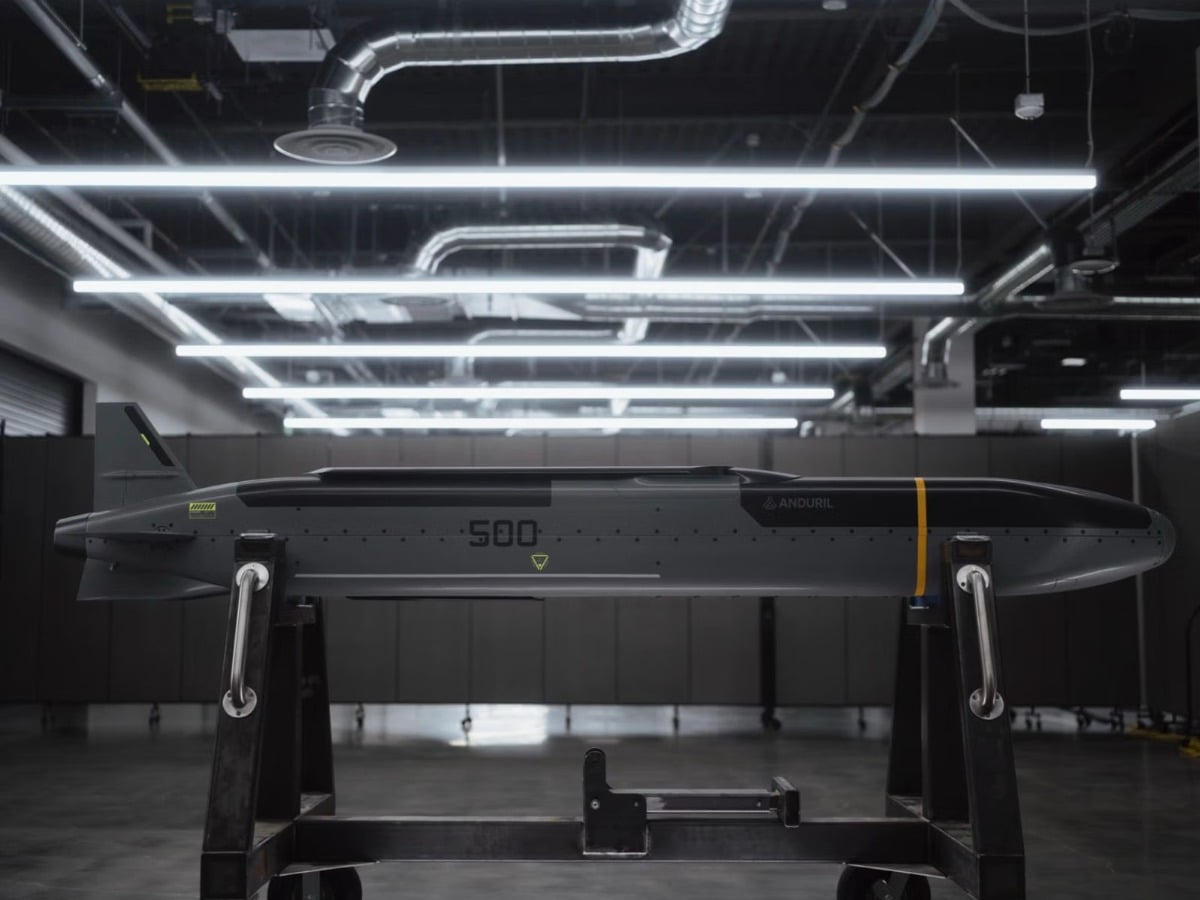
Poland has finalized a massive production agreement with American defense contractor Anduril Industries to manufacture thousands of Barracuda-500M cruise missiles annually at a facility in Bydgoszcz. Signed in the presence of Prime Minister Donald Tusk, the deal enlists state-owned defense giant Polska Grupa Zbrojeniowa (PGZ) and Military Aviation Works No. 2 to establish Europe’s first mass-production line for low-cost, software-defined strike weapons. This move addresses a critical flaw in Western military strategy: the acute shortage of affordable, mass-producible munitions capable of sustaining a long war of attrition on NATO’s eastern flank.
For decades, Western defense procurement prioritized exquisite, multi-million-dollar weapon systems designed for surgical strikes. The war in Ukraine exposed this philosophy as a dangerous miscalculation. Modern high-intensity conflict consumes ammunition at a rate that traditional industrial bases cannot match. By embracing Anduril’s architecture, Warsaw is attempting to rewrite the economics of deterrence.
The Brutal Mathematics of Attrition
The strategic anxiety driving this deal is simple arithmetic. A single American Tomahawk cruise missile or a joint air-to-surface standoff missile costs anywhere from 1.5 million to 3 million dollars. They are built like luxury Swiss watches. They require specialized clean rooms, highly bespoke components, and years of meticulous assembly. In a clash with a peer adversary, a nation's entire inventory of these weapons could be depleted within the first fortnight of hostilities.
Poland is currently spending an unprecedented 4.7 percent of its gross domestic product on defense. Yet, buying expensive American platforms off the shelf creates an illusion of security. If you have a stockpile of only a few hundred high-end missiles, an adversary can simply overwhelm your air defenses with cheap drones, forcing you to deplete your precious inventory.
The Barracuda-500M approaches this problem from the opposite direction. With an estimated unit cost of less than 200,000 dollars, it is intentionally disposable. It carries a 100-pound warhead and possesses a range exceeding 900 kilometers. It is not designed to be a perfect weapon. It is designed to be a sufficient weapon, available in numbers that cannot be easily intercepted or exhausted.
+-------------------+-------------------------+-------------------------+
| Characteristic    | Traditional Cruise      | Anduril Barracuda-500M  |
|                   | Missiles (e.g. Tomahawk)|                         |
+-------------------+-------------------------+-------------------------+
| Estimated Cost    | $1.5M - $3.0M           | Less than $200,000      |
+-------------------+-------------------------+-------------------------+
| Production Focus  | Low volume, high spec   | Hyper-scale, commodity  |
+-------------------+-------------------------+-------------------------+
| Build Complexity  | Months of custom labor  | 30 hours, 10 hand tools |
+-------------------+-------------------------+-------------------------+
| Primary Software  | Proprietary, rigid      | Lattice AI ecosystem    |
+-------------------+-------------------------+-------------------------+
Dismantling the Artisanal Military Complex
To understand how a factory in Bydgoszcz can produce thousands of these weapons, one must examine the internal design of the vehicle. Anduril did not build a traditional missile. They built an air-breathing autonomous vehicle made largely from commercial components.
The airframe uses commercial-grade plastics and metals rather than military-grade specialized alloys. It relies on a simple, inexpensive turbojet engine instead of the highly optimized, exquisitely expensive propulsion units found in stealth cruise missiles. According to manufacturing data, a Barracuda requires 50 percent less time to produce, uses 95 percent fewer specialized tools, and contains half the parts of a conventional missile.
The company claims the entire system can be assembled in just 30 hours using ten common hand tools. This represents a fundamental shift in defense manufacturing. Instead of relying on a highly specialized, security-cleared workforce that takes years to train, the Bydgoszcz plant can utilize standard automotive-style assembly practices.
This approach shifts the complexity from hardware to software. The missile avoids expensive hardware-based guidance systems by using Anduril’s Lattice software system to handle navigation, threat avoidance, and coordinated target allocation. When launched in mass, these vehicles operate as a collective unit, communicating with one another to find gaps in enemy air defense networks.
The Tech Transfer Trap and Sovereign Illusions
While the Polish government celebrates this agreement as a victory for domestic industry, an investigative look behind the press releases reveals significant friction. Poland wants genuine technology transfer. PGZ executives want their engineers to understand the underlying source code and the algorithmic logic governing these autonomous systems.
Historically, American defense firms treat their software as a closely guarded secret. They give foreign partners the blueprint to bend metal and bolt wings together, but the computational brain remains a black box. If Poland merely operates an assembly plant for American-controlled software components, its claimed sovereignty over the weapon system is an illusion.
There is also the cultural clash between a state-owned enterprise like PGZ and a Silicon Valley venture-backed firm. PGZ operates under heavy bureaucratic inertia, bogged down by domestic political interests and rigid state procurement rules. Anduril moves with the aggressive, software-first mentality of a technology company. Merging these two corporate philosophies on a factory floor in central Poland will not be easy.
Furthermore, the integration of autonomous swarming behaviors introduces legal and ethical minefields. If a swarm of Polish-built Barracudas loses contact with its human operators and autonomously selects an unintended target, who bears the responsibility? Western military doctrine insists on a human in the loop, but in a heavily jammed electronic warfare environment, that loop inevitably breaks.
Supply Chain Vulnerabilities in the Fake Commercial Model
The promise of using 70 percent commodity components to build a cruise missile sounds brilliant on paper. It avoids the bottleneck of specialized defense sub-contractors. However, it introduces an entirely different set of supply chain headaches.
Commercial supply chains are highly optimized for efficiency, not resilience. They rely on just-in-time delivery models that break down instantly during a geopolitical crisis. If the microchips, commercial sensors, and simple turbojet components are sourced from global commercial markets, they remain vulnerable to interdiction, export controls, or sabotage.
"The assumption that commercial components are always easy to get is a dangerous myth," notes a former Polish procurement official. "During a major conflict, every nation will scramble for the same commercial chips, the same battery cells, and the same basic plastics. A factory in Bydgoszcz can only build missiles if the global shipping lanes remain perfectly open."
To mitigate this, the agreement emphasizes a gradual increase in the share of Polish domestic suppliers. Localizing the production of explosives, solid rocket boosters, and structural elements is the easy part. Localizing the advanced semiconductor fabrication required to run autonomous target-recognition models is virtually impossible within Poland’s current industrial framework.
The Real Cost of Forcing the Enemy to Spend
The true value of the Bydgoszcz factory lies in shifting the economic burden of air defense back onto Russia. During recent conflicts, Western nations have found themselves on the wrong side of the cost curve, firing two-million-dollar Patriot missiles to shoot down twenty-thousand-dollar Iranian-designed drones.
By deploying thousands of Barracudas along the eastern flank, Poland flips this equation. If an adversary faces a wave of hundreds of low-cost cruise missiles, they cannot afford to ignore them. Each Barracuda carries enough high explosives to destroy a radar installation, a command bunker, or a fuel depot.
The adversary is forced to fire its high-end air defense interceptors, such as those from the S-400 system, which cost millions of dollars per shot and take months to manufacture. Even if the enemy shoots down 80 percent of the incoming Barracudas, the attack is an economic and material victory for Poland. The enemy’s air defense magazine is depleted, leaving them vulnerable to subsequent strikes by high-end Western aircraft.
This strategy assumes that Poland can scale production faster than the enemy can manufacture interceptors. If the Bydgoszcz facility runs into regulatory delays, labor shortages, or software integration issues, the entire concept of economic deterrence collapses. The next twelve months will reveal whether a legacy European defense apparatus can successfully execute a software-driven manufacturing model under the shadow of an active regional threat.