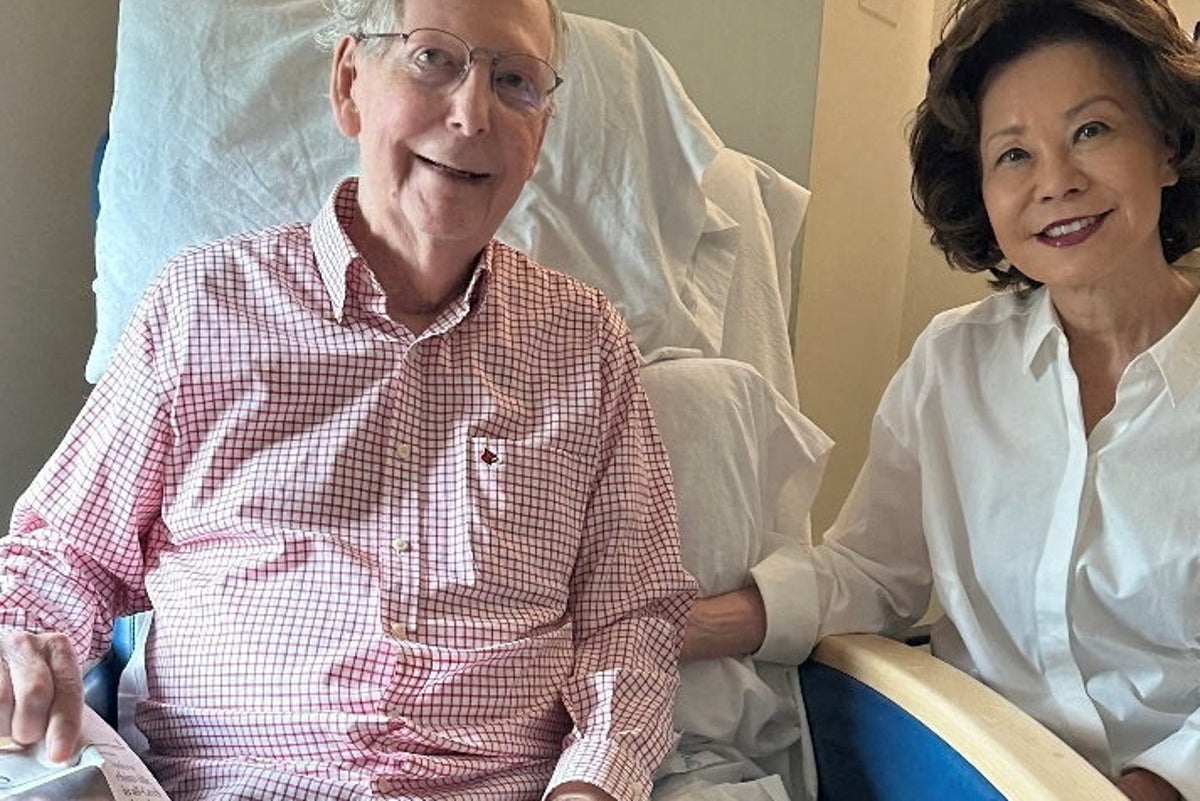
The frantic online speculation that eighty-four-year-old Senator Mitch McConnell had secretly died or lapsed into a permanent vegetative state was finally debunked after a political reporting intern at the Washington Post, Ben Binday, spearheaded an investigation into a bizarre "proof of life" hospital photograph. By verifying the image's embedded metadata and consulting a leading global forensics expert, the Post established that McConnell was indeed alive, holding a genuine copy of the newspaper's July 12, 2026, sports section. The investigation put to rest a weeks-long informational blackout that had spiraled completely out of control across social media platforms.
Yet, the fact that a major political figure's staff felt compelled to utilize a hostage-style public relations tactic—holding up a physical Sunday newspaper in a hospital bed—reveals a much deeper crisis in American political communication. It exposes how a month of administrative silence, combined with the rise of deepfakes and the sudden death of another Senate icon, created a perfect storm of modern paranoia. If you liked this post, you might want to check out: this related article.
The Sudden Silence that Sparked a Washington Conspiracy
The trouble began on the morning of June 14, 2026. Emergency medical services dispatched an ambulance to McConnell’s private residence in Washington, responding to a call regarding an unconscious individual. Audio from the dispatch operators soon leaked online. The emergency operators explicitly mentioned "CPR in progress" and referenced a "cardiac arrest" at the senator's address.
McConnell was rushed to the hospital. For nearly a month, his press office refused to provide concrete details regarding what had transpired. For another perspective on this development, see the latest coverage from NBC News.
They released brief, vague statements indicating that the senator was "recovering" and "continuing to improve". They insisted he was still actively working with his staff on Senate business. However, he did not appear in public. He cast no votes.
This silence created a vacuum. In politics, an empty space is never left unfilled.
Right-wing influencers, led prominently by activist Laura Loomer, stepped into the void. Loomer claimed, citing anonymous high-level sources, that McConnell was "brain dead" and that Republican leaders were actively participating in a massive cover-up. The conspiracy gained immense traction. The tension escalated dramatically on Saturday, July 11, when Senator Lindsey Graham of South Carolina died suddenly of an aortic rupture.
With Graham gone, the sudden mortality of the Senate's old guard became the only story in Washington. Rumors that McConnell was next—or already dead—reached a fever pitch. The pressure on McConnell's team to produce undeniable proof of his survival became overwhelming.
The Post-Truth Trap of the Modern Proof of Life Photo
On the evening of Sunday, July 12, McConnell’s office finally broke its silence. They issued a lengthy personal statement from the senator alongside a photograph.
In the picture, McConnell is shown sitting up in a hospital bed, smiling alongside his wife, Elaine Chao. He is holding the front page of the Washington Post Sports section. The visible portion of the page featured a photograph of Chris Hacopian, a newly drafted player for the Washington Nationals, alongside coverage of Linda Nosková’s Wimbledon performance from the previous Saturday.
[Visual Detail of the Verified Newspaper Page]
--------------------------------------------------
Publication: The Washington Post (Sports Section)
Date: Sunday, July 12, 2026
Key Elements Visible:
  - Lead story on MLB Draft (Chris Hacopian, Texas A&M)
  - Sidebar coverage of Linda Nosková's Wimbledon victory
--------------------------------------------------
Rather than quelling the madness, the photo acted as fuel.
Skeptics on social media immediately claimed the image was the product of generative artificial intelligence. Critics pointed to the slightly blurry, low-resolution text of the newspaper as evidence of an algorithmic hallucination. Others alleged the photo was recycled from a previous hospitalization in 2023.
The internet had entered a state of epistemic closure. To these online observers, no piece of visual media could be trusted, particularly when issued by a political establishment they deeply distrusted. The antiquated practice of holding up a newspaper—once the gold standard of demonstrating current time and survival—was now viewed as a primary indicator of a visual hoax.
How a Political Intern Cracked the Digital Forensics
The task of dissecting this visual dispute fell to Ben Binday, an intern covering politics for the Washington Post. Rather than letting the rumors circulate unchecked, Binday bypassed the standard political spin and initiated a rigorous verification process.
The Post requested and secured a copy of the original, uncompressed photo directly from McConnell's staff. Binday then took two critical steps.
First, he submitted the raw file for metadata analysis. The metadata of a digital photograph acts as a digital fingerprint, recording the exact camera model, settings, and the timestamp of when the image was captured. The Post’s review confirmed that the file's metadata aligned perfectly with Sunday, July 12, dismantling the theory that the photo was an archival shot from years prior.
Second, Binday brought in Hany Farid, a professor of digital forensics at the University of California, Berkeley. Farid ran the image through advanced analytical models designed to detect artificial intelligence generation, face-swapping, and localized pixel manipulation.
The scientific analysis was definitive.
Farid confirmed there was absolutely no evidence of generative tampering. The lighting across McConnell and Chao’s faces was physically consistent, the shadows aligned with the hospital room's light sources, and the newspaper layout perfectly matched the physical print run of that morning's sports section. The blurry text on the newspaper flap was not an AI hallucination; it was merely the natural result of a standard digital camera lens focusing on the human subjects in the foreground rather than the printed paper.
The Paranoia that Replaced Traditional Politics
The scientific verification of a single photograph does not cure the underlying rot in our political discourse.
The McConnell episode is a warning sign of what happens when institutional secrecy meets decentralized skepticism. McConnell’s team attempted to run a standard twentieth-century communications playbook. They hid the principal, managed his decline in private, and expected the public to accept occasional written reassurances.
That playbook is officially dead.
When public figures refuse to provide timely, verifiable information, they no longer control the narrative. The public will build its own narrative out of leaked emergency dispatch logs, social media algorithms, and deep-seated biases. In a world where seeing is no longer believing, silence is interpreted as a confession of the worst possible scenario.
McConnell remains in a rehabilitation facility, recovering from pneumonia and the fallout of his June tumble. He is still scheduled to retire when his term concludes in January 2027. His staff successfully proved he is breathing, but they failed to recognize that in the modern information arena, the truth requires radical transparency, not a staged photo shoot with the morning sports section.