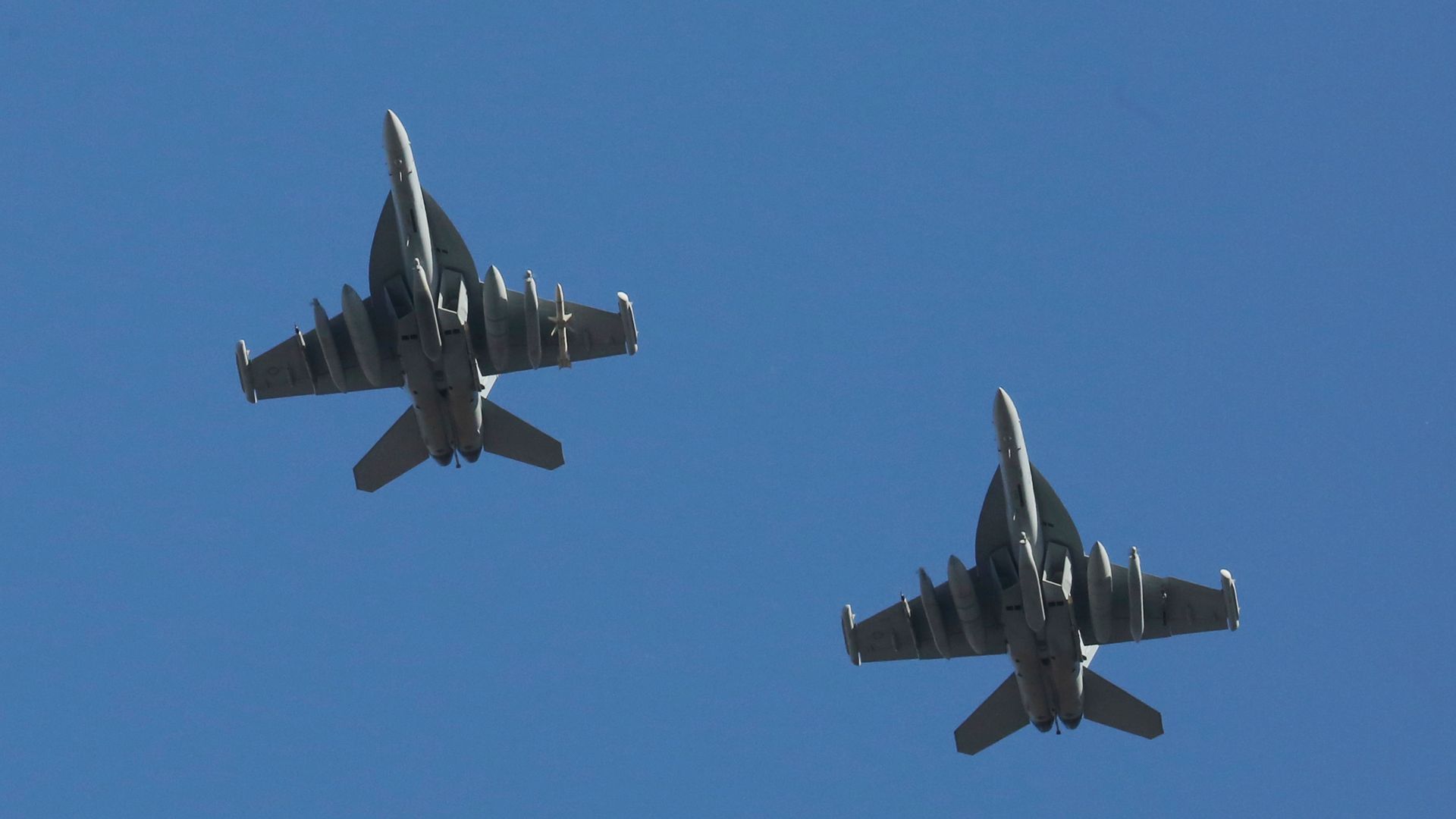
Two United States Navy EA-18G Growler electronic warfare jets collided mid-air on May 17, 2026, during the Gunfighter Skies Air Show at Mountain Home Air Force Base in Idaho. All four crew members successfully ejected and are in stable condition, avoiding what could have been a catastrophic loss of life. The two advanced combat aircraft, valued at roughly $67 million each, locked together in mid-air before tumbling into a local field and exploding. While early reports focus entirely on the miracle of four clean parachutes, the incident exposes a deeper, structural crisis facing military aviation: the escalating risk of flying frontline tactical platforms in low-altitude public spectacles.
The crash occurred at approximately 12:10 p.m. during a tight aerial demonstration. Witnesses captured footage of the two Whidbey Island-based Growlers, assigned to Electronic Attack Squadron 129, operating in close proximity before making contact. The impact was extraordinary. Instead of glancing off one another, the airframes became physically entangled, pitched upward, stalled, and entered a terminal spin. Within five seconds of contact, both pilots and their respective electronic warfare officers pulled their ejection handles, clearing the falling wreckage just before impact.
The Illusion of Zero Margin
Military flight demonstrations are designed to look dangerous, but they rely on an absolute illusion of safety built on rigid geometry. When frontline fleet aircraft like the EA-18G are brought to the air show circuit, they are pulled from standard combat training to perform aggressive, low-altitude maneuvers for the public.
The Growler is not a nimble, lightweight stunt plane. It is a heavy, twin-engine variant of the F/A-18F Super Hornet, weighed down by specialized internal avionics and wingtips designed for electronic jamming. When two of these massive platforms operate within feet of each other at low altitudes, the aerodynamic forces are immense.
The National Weather Service reported wind gusts up to 29 mph at the time of the Idaho crash. In a standard tactical environment, a 30-mph gust at 5,000 feet is an annoyance. At 500 feet, while flying wingtip-to-wingtip in a public display box, that same gust alters the closing rate between two aircraft faster than a human pilot can process.
The immediate lockdown of Mountain Home Air Force Base and the cancellation of the remaining schedule follow standard Pentagon protocol, but the investigation will face hard questions about the necessity of these specific maneuvers.
The Tracking Trap
Every tactical military demonstration flight requires a grueling amount of preparation, but the training environment cannot perfectly replicate public show conditions. Fleet pilots are trained to look for an enemy or maintain tactical formation spacing measured in hundreds of yards, not inches.
When the Navy or Air Force deploys specialized demonstration teams, they are often using operational pilots who must balance public relations duties with actual combat readiness training. This dual mandate creates hidden friction.
- Wake Turbulence: A heavy fighter jet leaves a massive vortex of disturbed air behind it. If a trailing aircraft slips even slightly out of position, it can be sucked into this invisible wake, causing an uncommanded roll.
- Visual Illusions: Flying at high speeds close to the ground reduces the pilot’s peripheral depth perception, making closure rates incredibly difficult to judge without looking at instruments.
- Mechanical Lag: Large turbofan engines take time to spool up. If a pilot needs immediate power to back away from a wingman, a two-second delay in engine response can prove fatal.
The terrifying detail from the Idaho incident—the two jets appearing to lock together—points to a structural entanglement, where the wing or tail of one aircraft became wedged into the surface of the other. Once two airframes are mechanically linked, aerodynamic control surfaces become useless. The only option left is the ejection seat.
A Pattern of Public Risk
The Gunfighter Skies event has a fraught history with safety. This year's show was the first iteration in eight years, following a long hiatus after a fatal civilian glider accident during the 2018 event. Going back further, a high-profile U.S. Air Force Thunderbird F-16 crashed at the exact same base during the 2003 show after the pilot misjudged his altitude during a split-S maneuver.
This is not an isolated geographic curse; it is a symptom of a larger systemic issue. The Pentagon uses these air shows as vital recruitment and public relations tools. Showing off the raw power of a $67 million electronic warfare platform generates headlines and inspires the next generation of aviators.
Yet, the strategic cost is soaring. The Navy has a finite number of EA-18G Growlers. These are not surplus inventory; they are the premium, frontline electronic eyes and ears of the fleet, heavily deployed in modern conflict zones to suppress enemy radar systems. Losing two operational airframes in a single afternoon for a public relations exhibition strains an already overworked fleet supply chain.
The Survival Metric
If there is a success story in the Idaho crash, it belongs exclusively to the engineers who designed the Martin-Baker US14 ejection seats installed in the Growlers.
The fact that four separate crew members successfully cleared two entangled, tumbling aircraft at low altitude without sustaining fatal injuries is an engineering triumph. The sequencing of a dual-seat ejection is incredibly complex. To prevent the pilot and the rear-seat electronic warfare officer from colliding in mid-air, the system uses a microscopic delay, firing the aft seat a fraction of a second before the forward seat, while rockets angle the chairs away from each other.
That technology saved four lives. But relying on survival equipment to justify high-risk public maneuvers is a dangerous philosophy.
As the Navy launches its formal safety investigation, investigators will dissect the telemetry, telemetry data, and cockpit voice recorders to determine whether pilot error, environmental factors, or mechanical failure caused the initial contact. The larger question, however, won't be answered by a mishap board. The military must decide if the reward of a public applause is worth the risk of flying its most advanced, irreplaceable warplanes on the razor's edge of disaster.