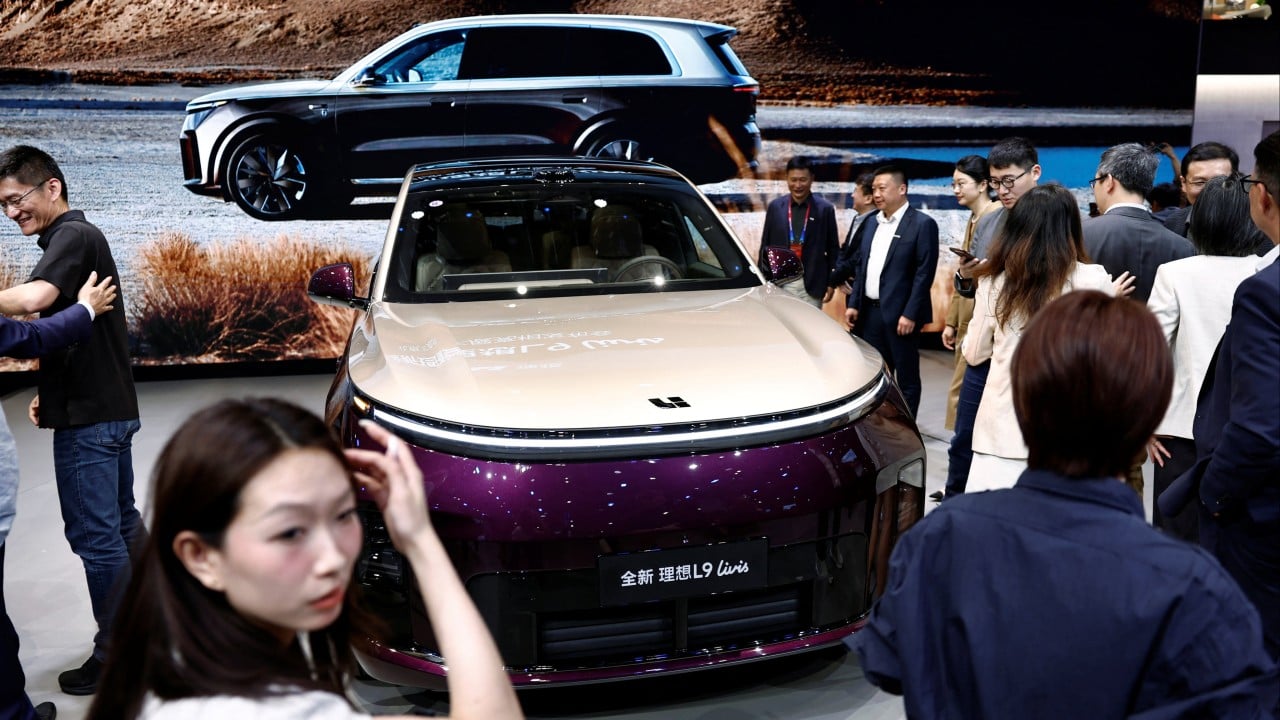
Li Auto, the Chinese automaker that built a multibillion-dollar empire on "range anxiety," is finally taking its act on the road. After years of tethering its growth to the domestic Chinese market, the company has officially signed distribution agreements with Al Fahim Motors in the UAE and Mohamed Yousuf Naghi Motors in Saudi Arabia. This is not just another export play; it is a calculated assault on the high-margin fortress long held by BMW and Mercedes-Benz.
By the end of May, the "L-series" SUVs will begin appearing in showrooms across the Gulf, followed by aggressive entries into Cambodia, Laos, Macau, and Myanmar. While competitors like BYD are flooding the world with affordable hatchbacks, Li Auto is hunting bigger game. They are betting that the wealthy families of Riyadh and Dubai are tired of the aging prestige of German engineering and are ready for a tech-heavy, family-centric alternative that doesn't require a charging station every 200 miles.
The EREV Trojan Horse
The core of this expansion is a piece of technology the West largely abandoned: the Extended-Range Electric Vehicle (EREV). While Tesla and Lucid struggle with the infrastructure gap in the sprawling deserts of the Middle East, Li Auto uses a small gasoline engine purely as an on-board generator. It drives like an EV, has the silent torque of an EV, but refuels at any standard gas station.
This is the "bridge" technology that makes Li Auto a lethal threat in regions where ultra-fast charging is still a luxury of the capital city. In 2025, the company faced its first real crisis at home, with deliveries dropping 18.8% to roughly 406,000 units. The domestic price war in China turned into a bloodbath, forcing margins down and leaving the company with a massive surplus of production capacity. The Middle East represents a "reset" button—a chance to sell vehicles at a premium to a customer base that values air-conditioned comfort and "lounge-on-wheels" interiors above all else.
Why the Middle East is the Perfect Lab
The Gulf market is uniquely suited for Li Auto’s specific brand of luxury for several reasons:
- Climate Demands: The brutal heat of the Middle East is a battery killer. EREVs mitigate the massive energy drain required for constant, high-powered climate control.
- Family Size: Li Auto’s L9 and L8 models are designed around the "three-generation family" concept, featuring integrated refrigerators, multiple entertainment screens, and massive cabin volume.
- Low Fuel Costs: In markets where gasoline is cheaper than bottled water, the "efficiency" of a pure BEV is a secondary concern compared to the convenience of a 1,100-kilometer total range.
The German Hegemony Under Siege
For decades, the "BBA" (BMW, Benz, Audi) trio has treated the Middle East as a reliable cash cow. A Mercedes S-Class or a BMW X7 is a status symbol that transcends borders. However, the 2026 Beijing Auto Show revealed a staggering shift in momentum. While the German booths relied on "heritage" and classic car displays, the Li Auto and Xiaomi booths were swarmed by international distributors and younger buyers.
The "New Generation" iX3 from BMW, which claims 70% of its software was developed in China, is a tacit admission of defeat. The Germans are no longer the innovators; they are the pupils. Li Auto isn't selling a car; they are selling a mobile living room equipped with L3 autonomous driving capabilities and an AI-driven "digital twin" assistant. To a tech-savvy Saudi millennial, the wood-grain interior of a Mercedes feels like a relic from their father’s era.
The 2026 Reckoning
Li Auto’s CEO, Li Xiang, has set an ambitious growth target of 20% for 2026, aiming for nearly 500,000 deliveries globally. To hit this, the company must overcome a significant reputational hurdle. In China, they are a household name. In Abu Dhabi, they are an unknown entity.
The strategy to counter this is a localized "operational system" approach. They aren't just shipping cars; they are setting up R&D hubs in Munich to prepare for a European launch later this year and hiring local sales executives across Spain and Poland. They are joining the China Chamber of Commerce to the EU (CCCEU) to navigate the tightening net of tariffs and trade restrictions.
However, the path is fraught with risk. The company posted a net income drop of 85.8% in 2025. Their first foray into pure battery electric vehicles (BEVs) with the "MEGA" MPV was a marketing stumble that cost them dearly in consumer confidence. The Middle East expansion is, in many ways, a high-stakes gamble to prove that their EREV success wasn't a fluke of the Chinese subsidy environment.
The Southeast Asian Pivot
While the Middle East provides the margins, the Asia-Pacific expansion provides the volume. Markets like Myanmar and Laos are being entered through nimble distribution partnerships. These are not markets for $80,000 SUVs, but they are crucial for establishing a regional footprint that circumvents the logistical and political hurdles of the North American and European markets.
A New Definition of Prestige
The automotive industry is no longer defined by how many cylinders are under the hood or the smoothness of a dual-clutch transmission. It is defined by "intelligence." Li Auto’s move into the Middle East is the first real test of whether Chinese "smart luxury" can translate to a global audience.
If they succeed, the traditional luxury hierarchy won't just be disrupted—it will be dismantled. BMW and Mercedes have spent a century perfecting the internal combustion engine, but in a world where the car is an extension of the smartphone, that expertise is becoming increasingly irrelevant. The battle for the streets of Riyadh is about to show us which version of the future the world actually wants to buy.
Expect to see the first wave of L-series SUVs on the Sheikh Zayed Road by July. The silence of their electric motors will be the loudest warning the German auto industry has received in decades.