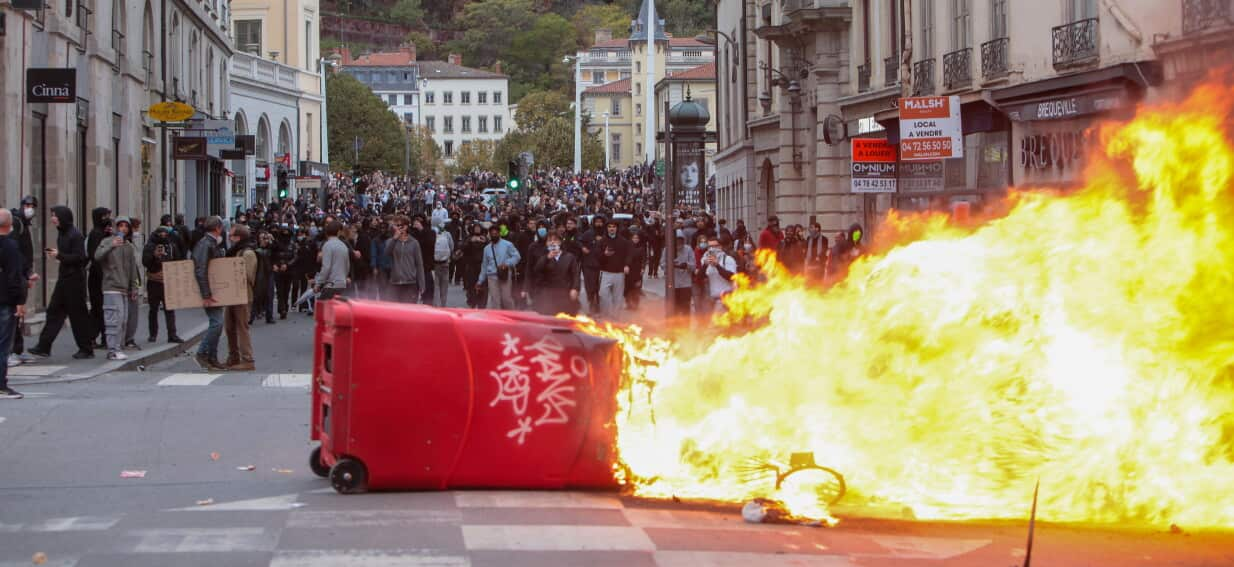
Thursday afternoon in Paris smells like roasted chestnuts, wet limestone, and the sudden, metallic tang of a prefecture circular being printed in triplicate.
Down on a quiet side street off Place de la République, a bakery owner pulls a roll-down shutter halfway across her storefront window, not because a brick has flown, and not because a siren has wailed, but because a text message from a neighbor has arrived with a single screenshot attached. A banned march. A larger police deployment for the weekend. A warning that the perimeter around the square will tighten long before the morning coffee cools.
Watch.
That is what a wire brief rarely captures when it reports that more police will be deployed this weekend as French authorities attempt a protest ban. A dispatch gives you the headline count, the administrative decree, the municipal tension, and the predictable standoff. It treats the city like a chess board where pieces slide cleanly across squares.
Streets are not chess boards. Streets have lungs. They hold the baker trying to make payroll, the twenty-two-year-old student carrying a cardboard sign with wet ink on her thumb, the gendarme standing four hours in damp wool while his knees ache, and the shopkeeper watching foot traffic evaporate two blocks away before a single slogan is chanted.
I have stood along enough French boulevards on cold Saturdays to know the exact sound a neighborhood makes ten minutes before the first clash. It is not the roar of a crowd. It is the click of metal shutters dropping in sequence down a block, one after another like dominoes falling backward, followed by a strange, hollow quiet where delivery vans turn around and pigeons lift off the plane trees all at once.
When authorities move to ban a demonstration and swell the ranks of deployed officers ahead of the weekend, the story is never merely about crowd control or public order. It is about a tug-of-war over who gets to define the public square—and what happens when law, fear, and frustration collide on narrow cobblestones.
When a Prefectorial Order Meets a Saturday Morning
To understand why a weekend protest ban in France carries such immediate electrical charge, you have to look past the legal phrasing on a prefecture notice. On paper, an administrative ban is a routine instrument of public order. Local officials weigh intelligence reports, past incidents, route congestion, and risks to property or bystanders, then issue a prohibition covering specific streets, squares, or hours.
In practice, a ban rarely makes a crowd vanish like mist in sunlight. Often, it compresses pressure into a smaller pipe.
Consider a hypothetical scenario—a composite drawn from dozens of real Saturday afternoons across French cities—in which a demonstration is declared unauthorized on Friday evening. Let us call the two people caught inside that decision Camille and Tariq. Neither is a professional agitator. Camille is a secondary school history teacher from Lyon who took the late train because she felt something essential about civic life was slipping away; Tariq runs a small phone repair counter near a tram line and just wants his Saturday customers to be able to reach his door without detouring through three police checkpoints.
By Saturday morning, the ban has already changed both of their lives before a single whistle blows. Extra police units are staged near transit hubs and major intersections. Some marchers arrive anyway, testing the line or dispersing into smaller clusters that weave through side streets. Others stay home, angry that their grievance was preemptively ruled out of bounds. Meanwhile, Tariq watches two regulars walk past his shop and keep going because a cordon blocks the corner where they usually park.
This is the hidden friction of a preemptive ban. Officials often argue that prohibiting a risky gathering protects shops, residents, and officers from escalation. Critics and civil liberties advocates counter that sweeping bans can criminalize peaceful assembly, confuse ordinary passersby, and turn a manageable march into a game of cat-and-mouse across residential alleys.
Truthfully, I find myself torn when I watch these standoffs unfold from the curb. As a reporter and observer who has breathed tear gas residue drifting into a quiet cafe two streets away from a cordoned avenue, I know how frightening uncontained disorder can be for an elderly resident trying to get groceries or a young officer facing projectiles in a tight bottleneck. At the same time, I know the quiet ache of watching citizens told that their presence in a public plaza is already an offense before they have raised their voices.
There is no clean, painless formula here. When authorities try to lock the door before the party starts, sometimes the crowd gathers on the porch.
The Weight of the Uniform and the Cost of the Curb
A deployment number in a news report—a few hundred extra officers here, several thousand mobilized across a weekend there—is easy to skim past. Yet behind every number is a body standing on hard asphalt for shifts that stretch far beyond a standard workday.
Picture the officer on the line. He is not an abstraction in black gear; he is someone's brother or parent who woke up before dawn, strapped on protective plating, checked his radio, and stood shoulder-to-shoulder in damp air while waiting for orders that might shift by the minute. Crowd policing in dense urban centers is grueling, high-stress work. Officers absorb insults, bottles, fireworks, and exhaustion, all while expected to exercise split-second restraint under intense scrutiny.
When tensions rise on a banned route, the margin for error shrinks to almost nothing. A miscommunication over a loudspeaker, a sudden surge from behind, a panicked sprint down a narrow street—any of these can spark a flashpoint that neither the prefecture nor the average marcher wanted.
A street ban does not lower the temperature in a room; it often traps the heat inside smaller walls.
Now step back onto the pavement with the people who live and work along those avenues. For a neighborhood florist, a cafe owner, or a pharmacist, a weekend of heightened police deployment and contested protests does not feel like a grand constitutional debate. It feels like a ledger turning red. Even when violence stays confined to a small fraction of the crowd, the anticipation of trouble keeps families indoors. Delivery schedules break. Tourists reroute. A single Saturday of lost revenue can wipe out the thin margin of a small business that already pays steep urban rent.
If you want a simple metaphor for how this ripple spreads, think of dropping a heavy stone into a shallow pond near the bank. The splash happens in one spot, yet the water pushes outward against every reed, wall, and stone along the edge. A protest ban aimed at one square sends ripples into subway stations, side streets, family group chats, and shop registers miles away.
Why France Keeps Returning to the Pavé
Anyone who has studied French political culture—or simply watched the evening news over the past several decades—knows that the street holds a special, almost mythic weight in French public life. From 1789 to 1830 and 1848, from May 1968 to the gilets jaunes and pension reform demonstrations, taking to the streets in France has long functioned as more than a protest tactic. For many citizens, it is a recognized language of democracy, a way of speaking directly to power when ballots or parliamentary debates feel too distant or too slow.
That history cuts both ways. Because the street carries such symbolic power, governments of every political stripe worry that allowing a volatile gathering to proceed unchecked can project weakness or invite severe disruption. Conversely, when authorities move aggressively to ban demonstrations and flood neighborhoods with police, critics warn that the state risks looking heavy-handed, inflaming the very grievances it hopes to contain.
Let's be honest about what happens in that tug-of-war: nobody enters a tense weekend expecting a neat resolution. Authorities point to public safety, traffic flow, and the protection of property and institutions. Organizers and protesters point to freedom of expression, the right to assemble, and deep frustration over policies or social pressures they feel are being imposed without enough say.
And caught right in the middle is the everyday citizen who simply wants a safe city and a voice that matters.
It is easy from a distance to take a rigid side—either cheering every crackdown in the name of order or romanticizing every confrontation in the name of liberty. Up close, on a chilly Saturday when sirens echo off stone facades and café chairs sit stacked inside locked windows, the reality is messier and far more human. You see people trying to protect what is theirs: their safety, their livelihood, their dignity, their convictions.
What Lingers After the Sirens Fade
By Monday morning, the temporary barriers usually come down. Trash sweepers clear the avenues. Commuters reclaim the crosswalks, stepping over damp spots on the pavement as if nothing unusual had happened forty-eight hours earlier.
Yet something stays behind in the memory of the street. A shopkeeper remembers who checked in on her when the shutters went down. A young marcher remembers the feeling of being told where she could not stand. A tired officer remembers the long hours of cold rain and sudden tension along a cordoned block.
A headline about more police being deployed for a banned weekend protest tells you what the state is doing before Sunday arrives. The deeper story is what that moment reveals about a society still negotiating the boundary between order and dissent, one cobblestone at a time.
Early Sunday light hits the empty square, catching a single torn flyer fluttering against a metal bollard while a lone baker unlocks his door and lets the warm smell of bread spill out onto the quiet street.


