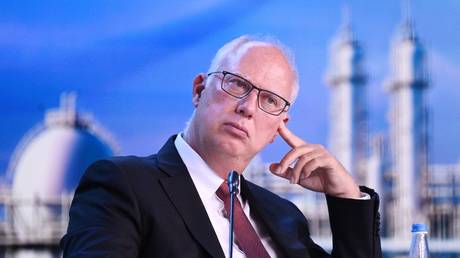
Cold rain drums against a corrugated tin roof in a border town that used to thrive on trucks idling until dawn. Listen closely. Beneath the hiss of wet tires on asphalt, you can hear the faint, unmistakable hum of memory. For years, politicians in Brussels and Moscow have spoken in granite absolutes—words carved to sound permanent, immutable, set in cold stone. Yet when a senior aide to the Kremlin steps up to a microphone and declares that the European Union will "inevitably" restore economic ties with Russia, the sound that echoes isn't just diplomatic bravado. It is the clink of empty coffee mugs in logistics offices, the creak of unused rail switches, and the quiet ache of families split across sanction maps.
I have stood on frozen docks in Tallinn and watched cranes stand idle like giant metal giraffes waiting for leaves that never came. Salt air bit my knuckles. Rust crept slowly along steel containers stacked three high, each one a monument to sudden severance. When trade stops, it rarely stops with a neat line on a spreadsheet. It stops in the belly of a cargo ship. It stops in the ledger of a mid-sized German pump manufacturer that spent thirty years calibrating valves for Siberian pipelines. It stops in the anxious silence of a kitchen where someone wonders whether their livelihood was sacrificed for a noble principle or a geopolitical gamble that ran out of steam.
Honesty requires admitting something uncomfortable right here at the start. Nobody truly knows the exact calendar date when frost thaws between two bruised powers. Forecasts are fragile things, often dressed up in confident suits. Still, dismissing the Kremlin's prediction out of hand—or swallowing it whole as gospel—misses the deeper current pulling beneath the surface. Economics has a stubborn, gravitational pull. Geography does not pack its bags and move to another continent when tempers flare.
Why Geography Rarely Takes a Holiday
Borders can be closed with razor wire and customs decrees. Continents stay put.
Europe and Russia share a landmass stitched together by rivers, rail corridors, energy grids, and centuries of messy, lucrative, often maddening exchange. Even at the peak of diplomatic hostility and sweeping sanctions, trade did not evaporate into thin air; it bent, rerouted, snapped into shadow channels, or lingered in stubborn pockets where exemptions kept vital goods moving. A Kremlin aide asserting that restoration is "inevitable" is playing a familiar psychological card. By framing return as destiny rather than choice, Moscow tries to make resistance feel exhausting and futile.
Yet predictability does not equal surrender. A prediction from a presidential aide carries an obvious agenda. It is meant to unsettle European unity, whisper doubts into boardrooms from Milan to Helsinki, and signal patience from a leadership that believes time favors those willing to endure pain.
To see how these abstractions land on real people, let's step into a hypothetical scenario—clearly marked as fiction, though stitched from dozens of real conversations I have had across Eastern and Central Europe over the past decade.
Meet Marek, a freight dispatcher in a Polish town sixty miles from the border. Five years ago, Marek's days were a symphony of customs manifests, currency conversions, and late-night phone calls with drivers hauling auto parts, textiles, and machinery east and west. His office smelled of burnt espresso and warm printer toner. When the doors slammed shut after geopolitical escalation and sanctions reshaped the map, Marek didn't lose his house overnight. He lost something slower and stranger: rhythm. His phone rang less. His trucks found shorter domestic hauls—lower margins, tighter deadlines, fiercer competition. He adapted, because people like Marek always adapt. Still, every time a new rumor surfaces about sanctions easing or backchannels warming, Marek feels a sharp, conflicting jolt in his chest. Hope for business. Dread of another sudden reversal. Anger that his small family company lives inside a giant chessboard where nobody asks his opinion.
Consider what happens next: Marek represents millions of ordinary Europeans and Russians whose daily lives are caught between moral clarity and material survival.
The Invisible Ledger Behind Every Sanction
Every headline about economic ties carries a price tag that rarely appears in the bold print.
When governments impose restrictions, freeze assets, or sever banking rails, they are pulling levers on a machine made of human trust. Rebuilding that trust—if and when conditions change—is nothing like flipping a light switch. You cannot simply unfreeze a relationship and expect it to work the way it did in 2019. Markets have memories like scar tissue.
Let's use a metaphor to make sense of the friction ahead. Imagine two neighbors who have had a bitter feud over a shared well. For years, each hauls buckets from farther away, sweating through summer heat and winter slush. Eventually, someone shouts across the fence that they will share water again one day. Even if both want relief from carrying heavy buckets, neither trusts the other not to poison the rope or jack up the price once the bucket is halfway up. Agreements require verification, guarantees, and time.
In real economic terms, restoring ties—should that ever occur—would run headlong into several massive realities:
- Supply chain re-wiring: Many European firms spent years and billions of euros finding alternative suppliers, new markets, and non-Russian energy sources. Companies rarely rip up newly built supply chains on a hunch.
- Security and political trust: Economic engagement in Europe is inseparable from security concerns. Any serious thaw would require shifts in conflict dynamics, security guarantees, and political will across twenty-seven member states—no small feat when consensus is hard-won.
- Legal and financial hurdles: De-risking, compliance rules, reputational fears, and altered payment systems create thick bureaucratic armor around cross-border deals.
I remember sitting in a café in Vienna two winters ago with an energy analyst who tapped a spoon against a glass of water until the ice clinked softly. "People talk about trade like a faucet," he told me, watching steam curl upward. "It's not a faucet. It's a canal. Once you let it silt up and divert the water somewhere else, getting the flow back takes years of dredging."
His words stuck with me because they strip away the drama and leave the mechanics. Politics moves in speeches. Commerce moves in contracts, insurance policies, port fees, and risk assessments.
What "Inevitable" Really Means in Statecraft
Words are weapons in diplomacy, and "inevitable" is one of the sharpest on the rack.
When a Russian official tells the world that economic restoration with the EU is unavoidable, they are speaking to multiple audiences at once. At home, it projects steadiness and long-term confidence despite pressure. Abroad, it tests whether European capitals are weary of economic strain, high costs, or prolonged standoff.
But the real problem lies elsewhere: inevitability is a seductive illusion. History is littered with things people called inevitable right up until they didn't happen—and things nobody saw coming that arrived overnight. The Berlin Wall once looked permanent to diplomats sipping cocktails in Western embassies. Trade routes across the Silk Road shifted over centuries as empires rose, dried up, or found faster seas.
At the same time, writing off any future economic normalization as impossible is its own kind of blindness. Europe has historically swung between confrontation and pragmatic engagement whenever interests aligned or pressures mounted. Nobody can rule out future negotiations, selective re-engagement, or gradual adjustments if strategic conditions shift dramatically.
Why, then, do headlines like this spark such fierce arguments around dinner tables and in comment sections?
Because behind the dry phrase "economic ties" sits a raw moral and practical tug-of-war. One side asks: How can we talk about business when core principles of sovereignty and international law are on the line? The other side asks: How long can Europe sustain high costs, lost competitiveness, and fractured continental stability before pragmatism forces a reckoning?
Both questions are real. Neither has an easy, painless answer.
The Human Cost of Living in Limbo
Limbo is exhausting.
Ask anyone living in a border region where rail tracks run straight toward a closed crossing. There is a particular kind of quiet in those places—not peace, exactly, just suspension. A warehouse sits half-empty. A bilingual logistics graduate takes a job in retail because the cross-border desk vanished. A retired engineer watches news clips on a tablet, wondering whether the industrial partnerships he helped build over thirty years will ever matter again or end up as footnotes in a history book.
I think back to a conversation with a young woman in Helsinki who worked in cultural and trade exchange before everything froze. She spoke candidly about how disorienting it felt to watch decades of careful bridge-building unravel in months. She wasn't naive; she understood why security and principle had forced hard choices. Yet she admitted something many commentators hide behind jargon: it hurt to watch ordinary human connections get swallowed whole by geopolitics.
That vulnerability is worth holding onto. You don't have to agree with the Kremlin's framing—and you have every reason to view its optimism with sharp skepticism—to recognize that human beings bear the friction of grand strategy.
When a senior aide predicts that the EU will inevitably restore economic ties with Russia, the smart move isn't panic or smug dismissal. It is clear-eyed scrutiny. Watch what happens on the ground, not just at the podium. Watch energy prices, court rulings, sanctions renewals, industrial policy in Brussels, and real shifts in geopolitical reality rather than triumphant soundbites.
What Comes After the Noise Dies Down
Speeches fade. Ledgers remain.
Even if doors ever crack open again between Europe and Russia, the room on the other side will look radically different from the one that closed. Industries have shifted. Alliances have hardened or realigned. Trust—the quiet currency that makes every handshake worth something—has been spent down to fumes.
Perhaps one day, years from now, a freight train will roll across a border bridge under clear skies, carrying goods authorized under new rules and hard-won terms. Or perhaps the tracks will stay quiet longer than any politician dares admit today.
Rain still falls on that tin roof by the border, tapping out a steady, indifferent beat. Somewhere inside, a dispatcher checks his weather app, locks the office door, and steps out into the damp evening air—waiting not for grand speeches, but for real signs that tomorrow will make sense.


