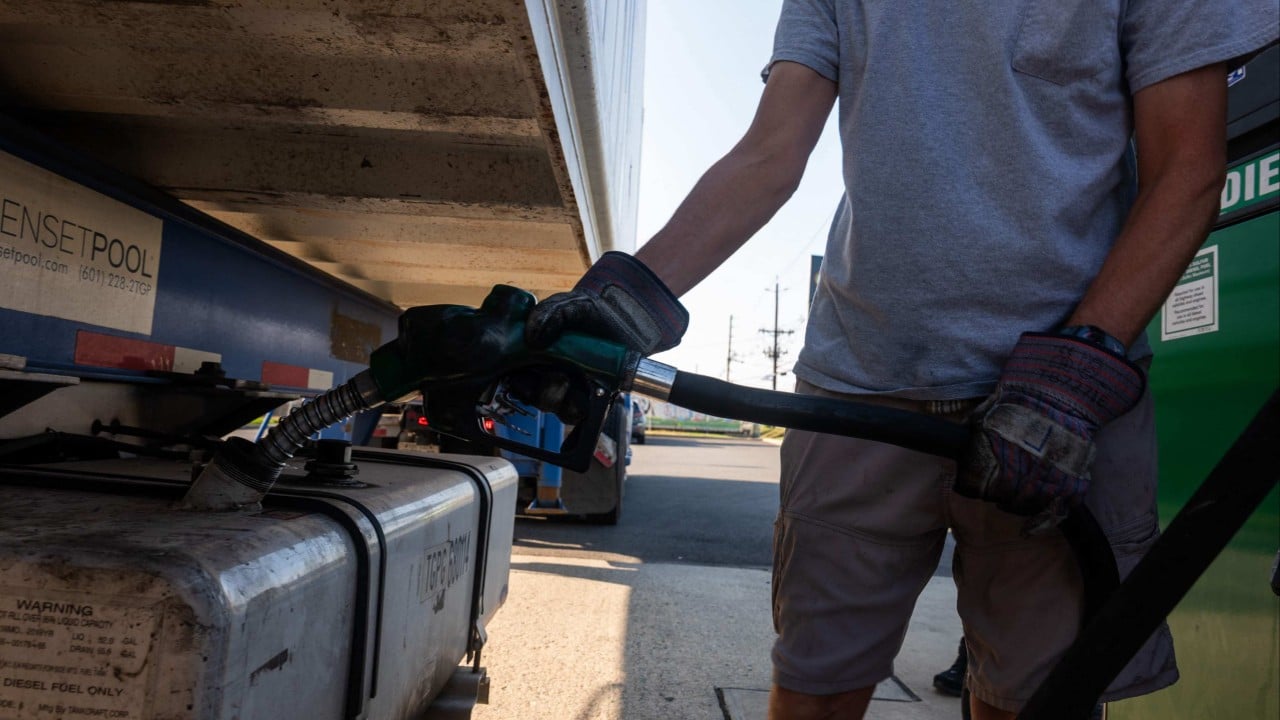
Cold rain drums against the cab of a semi-truck outside a midwestern rest stop at four in the morning. Inside, the green glow of the dashboard lights catches the tired eyes of a driver staring at a fuel receipt that looks less like a routine expense and more like a mortgage payment. Six dollars a gallon. Six dollars and twenty cents. At its peak in late September 2026, U.S. diesel hit $6.53 a gallon—nearly double what it cost at the start of the year, when a gallon averaged $3.48.
When you haul freight for a living, fuel is not a line item. It is oxygen. Every ten-cent jump eats into groceries on store shelves, parts in repair shops, and the margin between keeping a family business afloat and handing the keys back to the lender.
Which is why, when President Donald Trump announced a diesel agreement with Russian President Vladimir Putin in early October and followed it days later by pausing a sweeping sanctions package targeting Russia's economy, plenty of people felt a sudden, desperate jolt of hope. Relief. Finally, someone was pulling a lever to bring the pump down before winter set in and before voters headed to the polls in November.
Except geopolitics rarely works like a thermostat. And when a superpower trades economic leverage for a promise of fuel, the real cost is rarely printed on the receipt at the pump.
How a Tanker Deal Unspooled
To understand what happened, you have to trace the collision of two crises that converged in the autumn of 2026.
First came the shock to global energy markets following the U.S. war with Iran, which sent fuel and shipping costs spiking across continents. Truckers felt it on interstate highways. Farmers felt it running combines and grain dryers. Families felt it in the quiet inflation that creeps into every cart of food.
Second came the war in Ukraine and a legislative push in Washington to tighten the screws on Moscow. Congress had passed the Lindsey O. Graham Sanctioning Russia and Iran Act of 2026, which Trump signed into law on September 18, aiming to ratchet up economic pressure and tariffs on Russia and its energy buyers. Then, on October 9, after speaking with Putin, Trump announced a deal to bring Russian diesel onto global and U.S. markets. The Treasury Department's Office of Foreign Assets Control issued General License No. 135, carving out a six-month window through April 2027 for permitted transactions involving Russian diesel. Days later, on October 16, Trump issued an executive order pausing the broader sanctions package, citing national interests and the pursuit of peace.
On paper, the pitch sounded straightforward: add supply, cool prices, ease pressure on working people, and nudges toward an "energy ceasefire" in which Ukraine would stop hitting Russian refineries if Moscow curbed attacks on Ukrainian energy infrastructure.
Here is a hypothetical scenario to picture what that pitch looks like at street level. Imagine a fictional independent hauler named Clara, running two rigs out of Ohio. She isn't an ideologue. She just watches her fuel ledger bleed every week. When she hears that sanctions are being paused to let more diesel flow, she wants to believe the math will work in her favor. Who wouldn't, when every fill-up feels like a punch to the gut?
Yet math has a stubborn way of ignoring wishful thinking.
The Math Behind the Pump
Analysts and energy trackers quickly pointed out a glaring gap between the headline promise and physical reality.
Trump said Moscow would supply more than 300,000 metric tons of diesel right away, with larger waves to follow in the hundreds of thousands and millions of tons. To a casual reader, 300,000 metric tons sounds enormous. Against American consumption, energy analysts noted it amounts to roughly ten days of U.S. diesel demand—a drop in a vast, churning ocean. Worse, ocean transit takes weeks, Russian refining capacity has faced strain and damage, and six weeks after the announcement, not a single shipment had reached the United States.
Retail prices barely blinked. According to U.S. Energy Information Administration figures cited in mid-November coverage, average U.S. retail diesel prices sat around $6.25 a gallon between October 12 and November 9, essentially unchanged from the $6.20 average the week the relief was unveiled.
Think of it like pouring a pitcher of cool water into a sun-baked reservoir while a drought is still raging upstream. You might feel a brief wave of optimism holding the pitcher. The reservoir itself barely notices.
That gap is why so many drivers, farmers, and economists felt a mixture of frustration and skepticism. You don't need a degree in petroleum economics to feel cheated when relief is promised "fast" and "in record numbers," yet the number on the pump stays stubbornly above six dollars.
What Gets Traded Away in the Shadows
If the pump didn't drop, what did move?
That is the uncomfortable question sitting at the center of this story. Sanctions are blunt instruments, often messy and imperfect, yet they exist for a reason: to deny an adversary revenue and leverage without sending troops. When Washington pauses a major sanctions package and opens a door for Russian diesel exports, the Kremlin gains something tangible even if a single drop never touches an American dock.
Estimates from the Centre for Research on Energy and Clean Air indicated that Russian energy firms exported roughly $1.9 billion worth of diesel after the shift took effect, while facing less pressure to sell at steep discounts. Every dollar of energy revenue that flows back into Moscow helps finance a war machine that has spent years pounding Ukrainian cities, power grids, and civilian life.
I have sat across kitchen tables in places far removed from diplomatic summits—places where people worry about whether their savings will stretch through February—and watched how easily foreign policy gets flattened into slogans. It is completely human to want cheaper fuel today. Nobody wakes up eager to pay six-dollar diesel to prove a geopolitical point.
Still, there is a danger when short-term political calculations—especially ahead of a high-stakes midterm election—collide with long-term strategic consequences. Critics in Congress, European capitals, and statehouses sounded alarms almost immediately. Twenty-two House members pressed the administration to justify the move and reconcile it with existing law. New Jersey Governor Mikie Sherrill challenged the Treasury license in a November 2 letter, arguing it conflicted with the 2022 ban on importing Russian energy products and warning port operators of legal exposure.
Across the Atlantic, European leaders watched with growing unease. For years, Washington urged Europe to sever its energy ties to Moscow and stand firm on sanctions. Seeing the U.S. pivot unilaterally to ease sanctions for a diesel deal—without consulting European allies—deepened doubts about alliance cohesion and reliability.
Ceasefires Made of Smoke
The deal also tangled directly with the fragile diplomacy around Ukraine's energy infrastructure.
When Ukrainian President Volodymyr Zelenskyy indicated openness to halting strikes on Russian oil refineries if Russia stopped hitting Ukrainian energy targets, Trump quickly declared an "energy ceasefire" on social media. Almost as quickly, reality intruded. Zelenskyy said he hadn't seen a formal deal and accused Russia of continuing attacks, prompting Ukraine to resume strikes on energy facilities—and drawing sharp public rebukes from Trump, who called the renewed strikes a "disgrace" and cast Zelenskyy as harder to deal with than Putin.
Picture a metaphor for how fragile that truce was: two boxers told to stop throwing hooks to the body while neither trusts the referee and both are still bleeding. A ceasefire announced by post does not hold when missiles are in the air and survival is on the line.
For Ukrainians enduring winter blackouts, every generator hums with the weight of survival. For European allies trying to hold a unified front, every unilateral U.S. waiver looks like a crack in the foundation. And for American households, the promised salvation at the pump never materialized.
Where Honest Reckoning Begins
It is easy to get lost in blame when a policy disappoints on every front. Supporters argue the administration was trying a bold, unconventional move to attack high energy costs and force movement toward ending a grinding war. Critics counter that pausing sanctions handed Moscow a lifeline and fractured unity without delivering real relief to consumers.
Maybe the hardest truth is simpler: there are no painless shortcuts when global energy markets are strained by war and regional conflict. Pausing sanctions on a major oil and fuel exporter does not magically erase supply bottlenecks, shipping timelines, or refinery constraints. Nor does it settle the deeper question of what kind of world we want to build—one where economic leverage is traded away for modest, uncertain barrels, or one where alliances hold firm even when the bill comes due.
Back on that rainy highway at four in the morning, the diesel pump still clicks past six dollars a gallon. The truck pulls back onto the wet asphalt, headlights cutting through the mist, carrying goods toward a dawn that feels a little heavier than it did before.